Top 10 Hidden Gems in and Around Pune You Must Visit

Why Discover Hidden Gems in Pune?
Pune, often celebrated as the cultural capital of Maharashtra, is famous for landmarks like Shaniwar Wada, Aga Khan Palace, and Sinhagad Fort. However, the city’s true magic often lies in its quieter, lesser-known corners.

Exploring Pune’s hidden gems offers a unique kind of travel, one where you escape selfie-stick-wielding crowds and discover authentic stories, centuries-old secrets, and tranquil beauty. Beyond the traditional tourist spots, you’ll find medieval rock-cut caves, forgotten lake palaces, village art hubs, and biodiversity hotspots. The growing global interest in off-the-beaten-path experiences means more travelers now seek meaning over monotony. In Pune, that shift rewards you with deeper cultural connection, peace, and often, a local chai vendor who remembers your name. Let’s dive into the top 10 hidden gems you must visit.
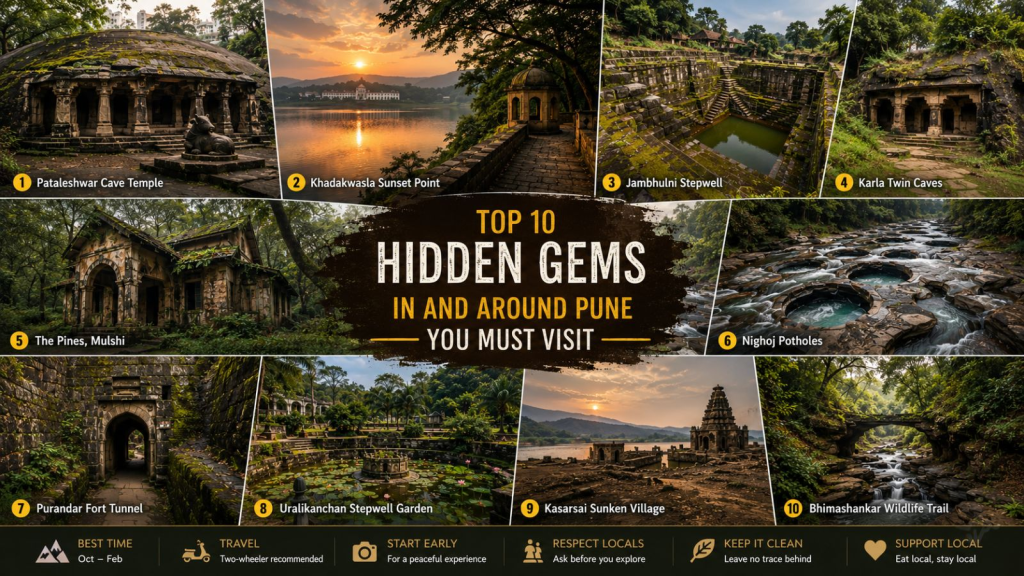
Top 10 Hidden Gems in and Around Pune
1. Pataleshwar Cave Temple (Jangli Maharaj Road)
- Intriguing details: A rock-cut temple from the 8th century Rashtrakuta period, carved entirely from a single basalt rock. It features a circular Nandi mandapa and a underground Shiva lingam.
- Accessibility & tips: Right in the city center near JM Road. Visit early morning (7–9 AM) to avoid noise. No entry fee. Wear socks, stone floors get cold.
2. Khadakwasla’s Sunset Point & The Old Dam Backwaters
- Intriguing details: Not the main dam, but a forgotten pathway behind the National Defence Academy (NDA). Offers mirror-still water and views of the NDA’s iconic Sudan Block.
- Accessibility & tips: Take a rickshaw from Khadakwasla village to the “Bund Garden end.” Best at 5:30 PM. No food stalls, carry your own snacks.
3. Jambhulni (The Forgotten Hamlet of Peths)
- Intriguing details: A tiny village 20 km from Pune that still uses 200-year-old stepwells (bawdis) for drinking water. The locals practice “warkari” farming, no machines, only oxen.
- Accessibility & tips: Hire a cab from Hadapsar. Visit after monsoon (Sep–Nov) when the stepwells are full. Ask the village sarpanch for a short tour, they welcome curious travelers.
4. Karla’s Lesser-Known Twin Caves (Not the Main Chaitya)
- Intriguing details: While tourists crowd Karla’s main Chaitya hall, 500 meters east lie two unmarked caves with ancient Brahmi inscriptions and a rainwater harvesting system from 200 BCE.
- Accessibility & tips: Park at Karla base and walk up the left trail (not the main stairs). Hire a local guide for ₹200–300. Carry a torch.
5. Mulshi’s Abandoned British Bungalow “The Pines”
- Intriguing details: A crumbling colonial bungalow hidden in the forests above Mulshi Lake. Built in 1862 as a summer retreat for a British judge. Now covered in moss and wild figs.
- Accessibility & tips: Requires a 30-min trek from Mulshi village. Best with a group. Avoid monsoon leeches. Ask at Mulshi MTDC for directions.
6. Nighoj’s Pothole Terrain (Not Just the River)
- Intriguing details: Nighoj is known for its “river potholes” (kunds), but 2 km downstream are 100+ perfectly circular granite potholes formed over 7,000 years, a geological wonder.
- Accessibility & tips: From Nighoj village, walk toward the old flour mill. Wear non-slip shoes. Visit in winter (Dec–Feb) when water is low.
7. Purandar Fort’s Forgotten Tunnel & Granary
- Intriguing details: Everyone visits the upper fort, but the lower fort (Purandar Vechas) has a 1.2 km dark tunnel leading to a secret granary that once stored food for 5,000 soldiers.
- Accessibility & tips: You need permission from the military office at the base (they share it 80% of the time). Take a powerful flashlight and a rope.
8. Uralikanchan’s Stepwell Garden (Anandvan)
- Intriguing details: Not a typical stepwell, it’s a 19th-century Maratha-era water structure now restored as a quiet garden with lotus ponds and antique hand pumps. No tourists ever.
- Accessibility & tips: 15 km from Pune on Saswad road. Open 9 AM–6 PM. Entry ₹20. Great for a picnic.
9. Kasarsai Dam’s Far End (Not the Dam Wall)
- Intriguing details: While influencers crowd the dam wall, the far northern shore has a sunken village, during summer, you can see old house foundations and a temple spire rising from the water.
- Accessibility & tips: From the main parking, walk left for 1 km. Visit in May for the “ghost village” effect. No shops, carry water.
10. Bhimashankar’s Forgotten Wildlife Trail (Not the Temple)
- Intriguing details: The main temple gets packed, but a 4 km trail behind the forest guesthouse leads to a natural rock bridge called “Ghoda Puli” and a waterfall pool where giant Malabar squirrels drink.
- Accessibility & tips: Hire a forest department guide at Bhimashankar bus stand (₹500). Start at 6 AM. Don’t go alone, leopard sightings happen.
Local Experiences at These Gems
Each hidden gem offers a unique activity that connects you with local culture and community:
| Hidden Gem | Unique Local Experience |
|---|---|
| Pataleshwar Cave | Attend the Monday morning “Rudra Abhishek” (6–8 AM) – local priests allow quiet observers. |
| Khadakwasla Sunset Point | Join fishing villagers at 6 AM to see them cast traditional “gol jal” nets. |
| Jambhulni | Cook a bharit (roasted eggplant) meal in a clay kitchen with a village elder. |
| Karla’s twin caves | Learn Brahmi script basics from a local college student who volunteers on weekends. |
| The Pines (Mulshi) | Have pithla-bhakri and kombdi vade at Aaji’s Kitchen (a 82-year-old’s home-turned-dhaba). |
| Nighoj potholes | Try pottery at the village’s last traditional kiln – they let you make a small pot for ₹50. |
| Purandar’s tunnel | Listen to powada (ballad) about Tanaji Malusare sung by tunnel caretaker Baburao. |
| Uralikanchan stepwell | Participate in the Pola festival (Aug/Sep) – farmers bring decorated oxen to the stepwell. |
| Kasarsai sunken village | Taste tambda-pandhra rassa at a floating shack that appears only in summer. |
| Bhimashankar trail | Spot Malabar giant squirrels (state animal) with a tribal tracker – he knows their calls. |
Pro tip: Ask for “gharguti” (home-style) food at any of these locations. You’ll often be invited into someone’s kitchen for fresh bhakri and thecha.
How to Plan Your Visit to Pune’s Hidden Gems
Best Time to Visit
- October – February: Ideal for all outdoor sites. Pleasant weather, clear skies.
- June – September: Great for waterfalls (Karla, Bhimashankar) but avoid Nighoj potholes and Kasarsai sunken village.
- March – May: Good for Kasarsai (ghost village visible) but avoid midday treks.
Transportation Options
- By two-wheeler (recommended): Rent a scooter (₹300–400/day) – gives you flexibility for narrow village roads.
- By cab: Ola Outstation or local aggregators like “Pune Cabs” – ₹1,500–2,500 for a full day.
- By bus + local rickshaw: Cheapest for solo travelers. MSRTC buses to Mulshi, Bhimashankar, Nighoj. Then take shared rickshaw.
- For caves/treks: Start before 7 AM to avoid heat and crowds.
Nearby Accommodations (Budget to Mid-range)
| Area | Stay Option | Approx. Price/Night |
|---|---|---|
| Near Pataleshwar | Treebo Trend Savali (Shivaji Nagar) | ₹1,800 |
| Khadakwasla/Mulshi | Mulshi Nest Homestay (lake view) | ₹2,500 |
| Jambhulni area | Gramin Stay (eco-hut) | ₹1,200 |
| Nighoj | Nighoj River Camp (tents) | ₹1,500 |
| Purandar base | Zostel Pune (Saswad) | ₹700 (dorm) |
| Bhimashankar | Forest Rest House (book online) | ₹2,000 |
Resources for Navigating Pune Overall
- Map apps: Google Maps works, but download offline Maps.me for remote areas (Nighoj, Jambhulni).
- Local transport: PMPML bus app “Pune Bus” for schedules; Ola/Uber for city.
- Safety: Keep a local contact (your hotel owner). In villages, ask for “gramsevak” (village officer) if lost.
- Language: Basic Marathi helps – learn “Kashi ahet?” (How are you?) and “Bhuka aahe” (I’m hungry). But English works in most places.
- Emergency: Dial 112 for statewide helpline. Keep a power bank, charging points are rare off the highway.
One-Day Sample Itinerary (Eastern Circuit)
- 6:30 AM – Pataleshwar Cave (spiritual start)
- 8:30 AM – Breakfast at Vaishali (Pune classic)
- 10 AM – Uralikanchan stepwell garden
- 12:30 PM – Jambhulni village + lunch with locals
- 3 PM – Nighoj potholes (easy exploration)
- 5:30 PM – Khadakwasla sunset point
- 7:30 PM – Return to Pune for dinner at a local “khanaval” (mess)
Final Word
Pune’s hidden gems are not just places, they are invitations to slow down, listen to old stones, share a meal in a farmer’s courtyard, and witness traditions that have survived without a single TripAdvisor review. The next time you’re in Pune, skip the obvious. Take the unmapped road. That’s where Pune still breathes.
Have you visited any of these? Or do you know a hidden gem we missed? Share below, and go explore responsibly.