Pakistani Warship Grazes Indian Navy Vessel in Arabian Sea After Cutting Across Its Bow; India Lodges Protest

A Pakistan Navy warship grazed an Indian Navy vessel in the North Arabian Sea on Monday evening, September 15, after approaching it at high speed and cutting across its bow in international waters.

The incident took place around 220 km east of Oman, outside the Exclusive Economic Zones of both countries. The Indian warship suffered no structural damage or operational loss, and no crew member was injured. It continued its patrol after the encounter.
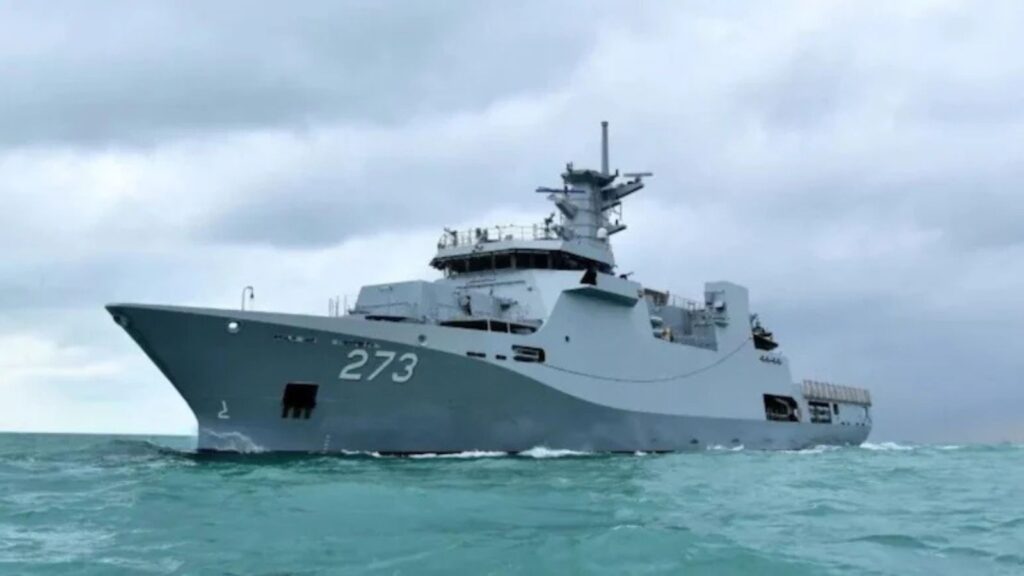
The Pakistan Navy vessel involved has been identified as PNS Hunain, a Hunain-class corvette/offshore patrol vessel commissioned in July 2024. The Indian vessel, a frontline destroyer or frigate of the Western Fleet based in Mumbai, was on a routine surveillance, maritime security and defensive deployment in the region, including escort and protection duties for Indian oil tankers.
According to the information available, PNS Hunain approached the Indian warship at high speed and shadowed it in what was described as an “aggressive, intimidatory, and unprofessional” manner.
The Indian vessel activated standard radio safety procedures and repeatedly warned the Pakistani ship over distress Channel 16. Direct communication also took place between the captains of the two vessels, but PNS Hunain did not reduce speed or maintain a safe distance.
The Pakistani vessel then accelerated and cut across the Indian ship’s bow from the starboard side. During the manoeuvre, its bow brushed against the hull of the Indian warship. Both vessels disengaged immediately after the contact, and the encounter did not develop into a standoff.
The commanding officer of the Indian warship refrained from escalating the situation, while the vessel continued its assigned patrol without interruption.
India subsequently lodged formal protests through diplomatic and military channels. The Ministry of External Affairs summoned Pakistan’s Charge d’Affaires in New Delhi over what it termed “unacceptable and unprofessional conduct”. The Pakistani diplomat remained inside the MEA for about 30 minutes.
A parallel protest was lodged in Islamabad, where India’s envoy to Pakistan, Satyanjal Pande, took up the matter with Pakistan’s Ministry of Foreign Affairs. The Indian Navy also raised the incident with the Pakistan military through established military-to-military communication channels.
India cited Article 10 of the April 1991 Agreement on Advance Notice on Military Exercises, Manoeuvres and Troop Movements. Under the provision, Indian and Pakistani naval ships are required to maintain a minimum distance of three nautical miles, or about 5.6 km, from each other in international waters.
India also cited the absence of prior notification regarding any Pakistani naval exercise or manoeuvre in international waterways. The encounter was additionally described as being contrary to international seamanship standards concerning freedom of navigation and safe passage under UNCLOS.
The incident has a precedent dating back to June 2011, when Pakistan Navy frigate PNS Babur grazed the Indian Navy’s Godavari-class frigate INS Godavari at high speed in the Gulf of Aden during an escort operation involving MV Suez. The contact damaged INS Godavari’s flight deck net.
Defence sources have described the latest encounter as the second such incident in six months in the Arabian Sea involving aggressive approaches by Pakistani naval vessels near Indian assets.
The encounter comes amid heightened India-Pakistan tensions following last year’s Operation Sindoor and an increased naval presence in the region linked to the Strait of Hormuz crisis.