India Enters the Private Space Industry Club: Skyroot’s Vikram-1 Reaches Space on Its First Flight
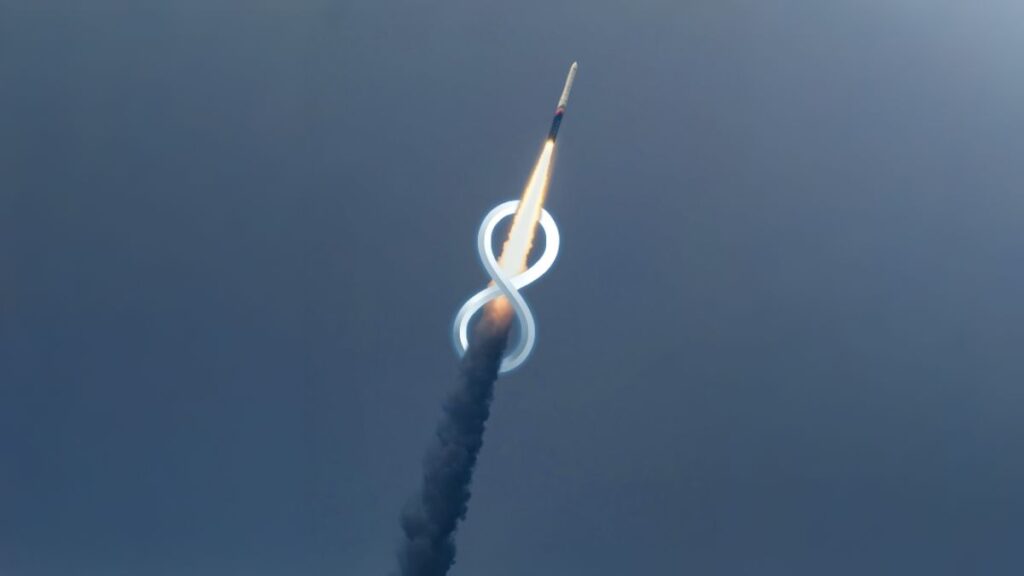

A privately built Indian rocket reached orbit for the first time on Saturday, on its first attempt, carrying five payloads to the altitude for which the mission was designed. Skyroot Aerospace’s Vikram-1 lifted off from the Satish Dhawan Space Centre at 12:05:30 p.m. IST and was confirmed in a 450-kilometer orbit roughly seventeen minutes later. The mission was named Aagaman – “arrival.”

The result makes India the third country in the world, after the United States and China, to have a private company successfully place a payload into orbit. Skyroot was founded seven years ago with $1.5 million in seed funding.
The Flight
Liftoff had been scheduled for 11:30 a.m. but slipped roughly 35 minutes after mission control called a hold at the T-minus-five-minute mark to check a technical issue. Vikram-1’s three solid-fuel lower stages then performed in sequence as planned. Its fourth stage, a restartable liquid engine cluster, fired for about six minutes to complete final orbital insertion. Fifteen minutes after liftoff, the vehicle had reached its target orbit; by 12:21 p.m., Skyroot confirmed all five payloads had deployed successfully.
Maiden flights of new orbital rockets fail more often than they succeed industry-wide, including for established aerospace companies with significantly larger budgets. Vikram-1 did not require a second attempt.
Background
Skyroot Aerospace was founded in Hyderabad in 2018 by Pawan Kumar Chandana and Naga Bharath Daka, two engineers who left ISRO to build launch vehicles commercially. The company now employs more than 1,000 people, up from an initial team of ten.
The company’s path to orbit included a scaled-down solid engine test in December 2020 and a full-duration test of the Kalam-100 engine in May 2022. In November 2022, Skyroot flew Vikram-S, a suborbital demonstrator, under Mission Prarambh (“the beginning”); it reached 89.5 kilometers and made Skyroot the first private Indian company to send a rocket to space, though not to orbit.
The buildup coincided with a series of Indian government reforms. In 2020, India liberalized its space sector, opening ISRO infrastructure to private operators and establishing a new regulator, IN-SPACe, along with a commercial arm, NewSpace India Limited. In November 2025, Prime Minister Narendra Modi inaugurated Skyroot’s new manufacturing campus in Hyderabad and unveiled the flight-ready configuration of Vikram-1, a visit that received limited coverage outside Indian and space-industry press.
The Vehicle
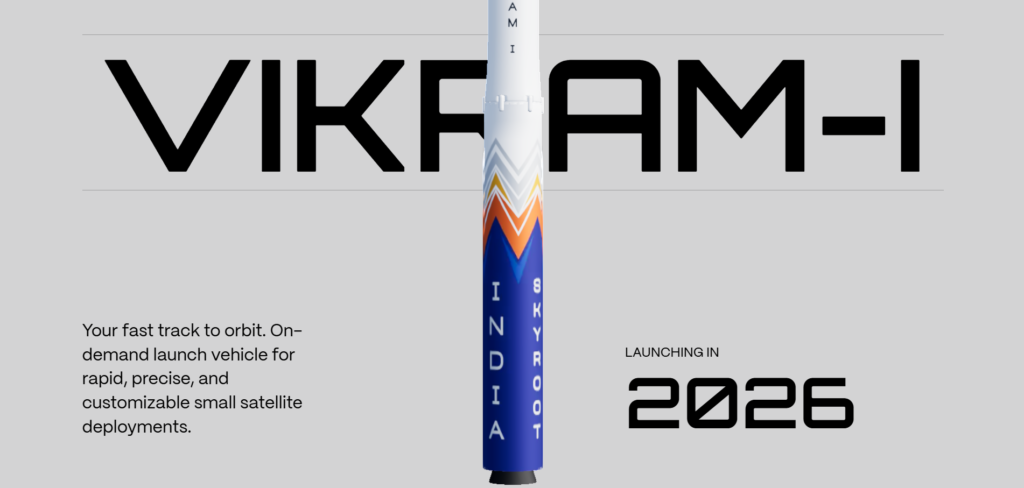
Vikram-1 is a four-stage, small-lift launch vehicle roughly 20 meters tall, built around an all-carbon composite airframe with in-house 3D-printed engine hardware.
| Stage | Engine | Thrust | Propellant |
| 1 (Kalam-1200) | Kalam-1000 | 1,000 kN | Solid |
| 2 (Kalam-250) | Kalam-250 | 250 kN | Solid |
| 3 | Kalam-100 | 100 kN | Solid |
| 4 | 4x Raman-I | 3.4 kN combined | N2O4/MMH (liquid) |
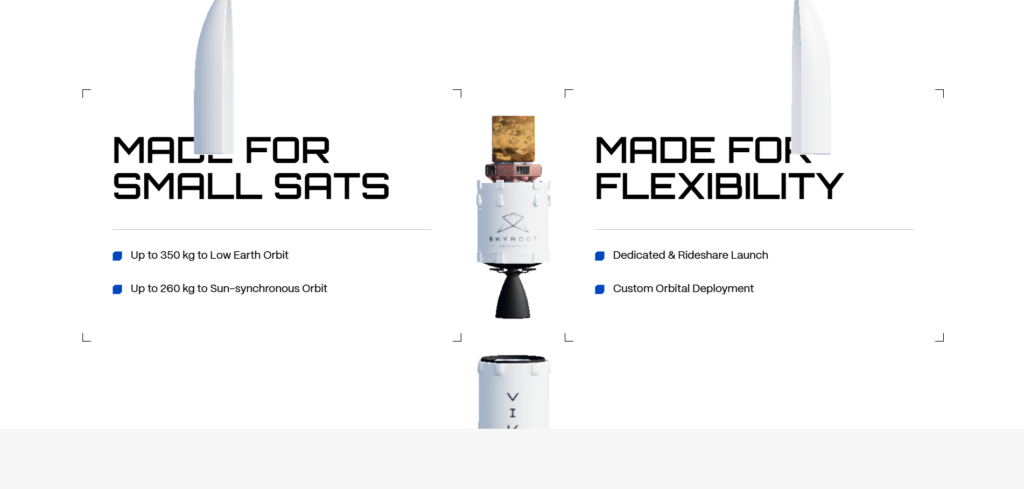
The fourth stage’s ability to restart lets Skyroot deploy multiple satellites into separate, customer-specified orbits within a single mission, rather than restricting all payloads to a shared trajectory, the basis for the company’s “space taxi” positioning in the small-satellite launch market. Baseline capacity is listed at 350 kg to LEO; an upgraded variant, Vikram-1U, with strap-on boosters, is rated for 550 kg. A larger vehicle, Vikram-2, is in development with a stated capacity of 900 kg to LEO.
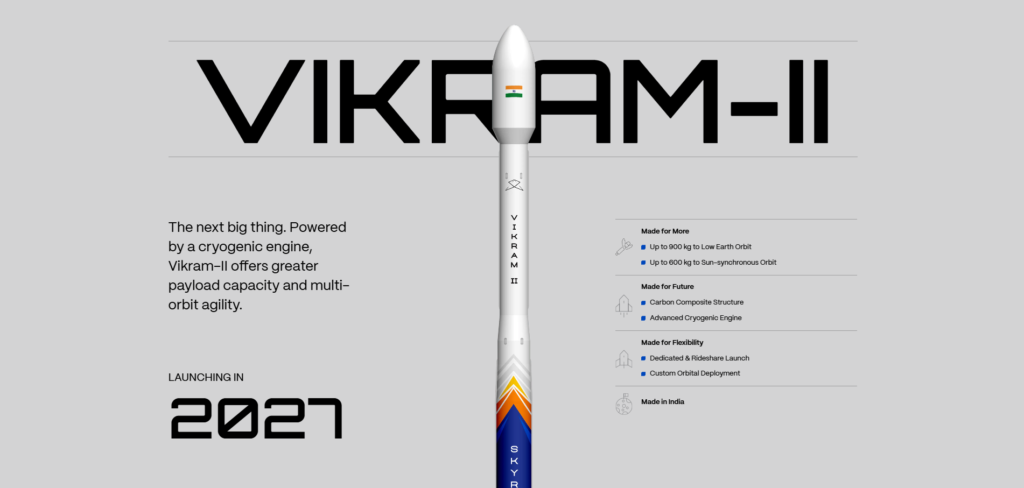
The vehicle is named for Vikram Sarabhai, widely credited as the architect of India’s space program, continuing a naming convention Skyroot has used across its rocket family.
Payloads
The manifest included four functional payloads: Grahaa Space’s SOLARAS S3 satellite, an orbital-debris-capture robotic arm called Embrace from Cosmoserve Space, a technology demonstration unit from DCUBED, and Skyroot’s own SCOPE satellite. Two symbolic items also flew: a floral artwork titled “Cosmic Bloom,” and an 18-karat gold micro-rocket bearing sculptures of C.V. Raman, Vikram Sarabhai, and A.P.J. Abdul Kalam, each described as smaller than a grain of rice. A postcard signed by the prime minister was also included among the cargo.
Reaction
Ahead of the launch, Chandana kept expectations measured: “We have done everything that could be done to test Vikram-1 on the ground. On July 18, we are eager to see how Vikram-1 performs in the real flight environment for the first time.” Following confirmation of orbital insertion, his statement was more direct: “India is proud to be the fastest-growing space tech ecosystem in the world, and now we achieved one of the biggest milestones ever in India’s space sector: the first private orbital rocket reaching orbit on the very first attempt. It still feels like a dream.” He credited ISRO and IN-SPACe for their support throughout the program.
Some journeys begin with a single spark.
— PuneNow (@itspunenow) July 19, 2026
Others begin with a countdown. 📷
Aagaman marks the arrival of Vikram-1, and another giant leap for India's space ambitions. 📷📷#Skyroot #Vikram1 #Aagaman #spacewall @SkyrootA pic.twitter.com/R9QyWvHtXO
Modi congratulated the Skyroot team publicly. Opposition leader Rahul Gandhi also issued congratulations, a rare instance of cross-party agreement in Indian politics.
Context
Vikram-1’s success places Skyroot in direct competition with Rocket Lab’s Electron and Firefly’s Alpha in the global small-satellite launch market, a market in which no Indian company previously had a flight-proven vehicle. It also represents a concrete result from India’s six-year effort to liberalize space launch, opening the sector to private capital and private risk while keeping core infrastructure public.
Skyroot has said it plans up to two more Vikram-1 test flights before the end of 2026, ahead of moving into commercial service, and raised $60 million in May specifically to fund production scale-up and development of Vikram-2. The launch received substantial coverage across Indian outlets and specialist space media; broader international coverage was comparatively modest relative to the scale of the milestone.