Pune to Mumbai in 48 Minutes? Inside India’s 6 Upcoming Bullet Train Projects That Could Redefine Intercity Travel
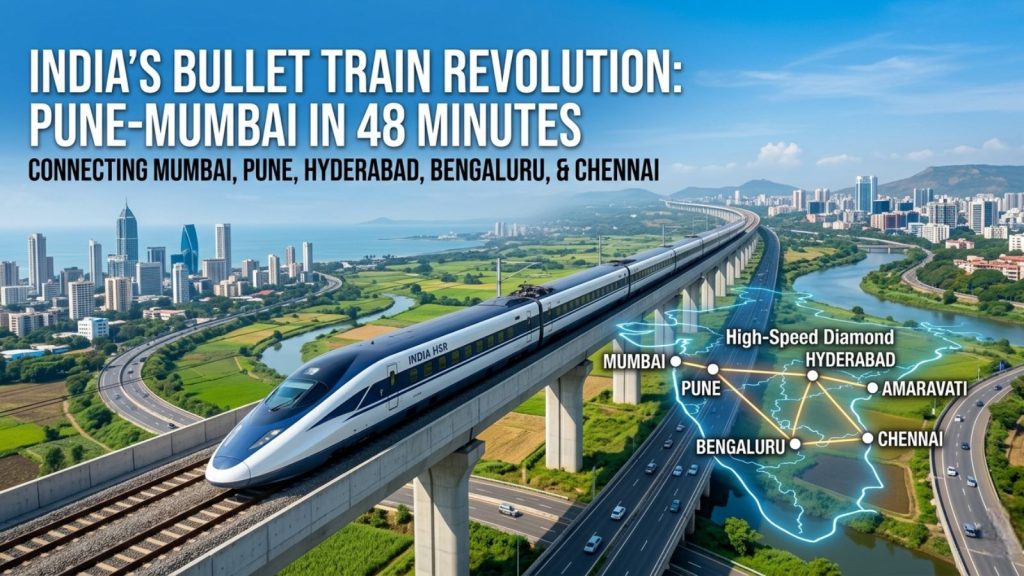

India is on the verge of a massive infrastructure breakthrough as the government outlines plans for an ambitious high-speed rail network. Aimed at transforming regional connectivity, the proposed “High-Speed Diamond” project will connect major economic hubs including Mumbai, Pune, Hyderabad, Amaravati, Chennai, and Bengaluru.

According to Union Minister Ashwini Vaishnaw, this high-speed corridor is designed to slash travel times, foster trade, and act as a catalyst for economic growth across Southern and Western India.
Unprecedented Travel Times: The 48-Minute Sprint
The primary draw of the new bullet train proposal is the drastic reduction in transit times between major urban centers. If implemented, commuters could see travel times drop to a fraction of their current duration:
- Pune to Mumbai: 48 minutes
- Amaravati to Hyderabad: 70 minutes
- Chennai to Bengaluru: 73 minutes
- Amaravati to Chennai: 112 minutes
- Hyderabad to Pune: 1 hour 55 minutes
- Hyderabad to Bengaluru: 2 hours 8 minutes
The “High-Speed Diamond”: An Economic Catalyst
Modeled after the ongoing Mumbai-Ahmedabad bullet train corridor, this southern network is positioned as more than just a transportation upgrade. By linking industrial hubs and urban centers, the government aims to:
- Boost Business Activity: Faster travel allows for seamless day-trips for professionals and entrepreneurs.
- Enhance Tourism: Shorter transit times make regional heritage sites more accessible to domestic and international travelers.
- Regional Integration: Strengthening the bond between the “Silicon Valley of India” (Bengaluru) and other tech and industrial hubs like Hyderabad and Pune.
Beyond Bullet Trains: Modernizing India’s Railways
The bullet train proposal is part of a broader overhaul of India’s railway infrastructure. Several key developments were announced alongside the high-speed rail plans:
1. New South Coast Railway Zone
A long-standing demand related to state reorganization is finally being met. The South Coast Railway Zone is scheduled to be formally notified on June 1, 2026, streamlining administrative operations in the region.
2. Quadrupling the Kolkata-Chennai Corridor
Plans are underway to expand the Kolkata-Chennai railway corridor into a four-line network. This massive upgrade will facilitate:
- The addition of nearly 500 new trains.
- Improved freight movement to and from key ports.
- Enhanced passenger capacity on one of India’s busiest routes.
3. Station Redevelopment and Investment
Andhra Pradesh has seen a significant surge in railway budget allocations, with 74 railway stations currently slated for redevelopment. This nationwide modernization effort focuses on improving the passenger experience through better amenities, digital infrastructure, and improved safety standards.
Frequently Asked Questions
The proposed high-speed rail corridor aims to reduce the travel time between Pune and Mumbai to just 48 minutes. This is a significant improvement over the current 3-to-4-hour journey by road or existing rail services.
The envisioned southern high-speed rail network is planned to connect major economic hubs, including Mumbai, Pune, Hyderabad, Amaravati, Chennai, and Bengaluru. This corridor is designed to strengthen trade and regional integration across Western and Southern India.
The South Coast Railway Zone is scheduled to be formally notified on June 1, 2026. This development addresses long-standing demands for better administrative focus on railway infrastructure and passenger services in the region.
By drastically cutting travel times between industrial and urban centers, such as the 73-minute route between Chennai and Bengaluru, the project acts as an economic catalyst. It is expected to boost business mobility, increase tourism, and enhance freight access to major ports.
The government plans to expand the Kolkata-Chennai corridor into a four-line network. This massive infrastructure upgrade is designed to accommodate nearly 500 additional trains, significantly improving both passenger capacity and cargo movement for key economic zones.
A Vision for a Connected India
The government’s strategy treats transport and digital infrastructure as the twin engines of national growth. By combining high-speed rail with domestic technology manufacturing and robust data infrastructure, India is setting the stage for a more integrated and mobile economic landscape.
As these projects move from planning to execution, the southern bullet train network promises to reshape how millions of people live and work, effectively shrinking the distances between India’s most vital cities.