RBI Introduces Six-Hour Cyber Fruad Reporting Rule: How New Guidelines Make Digital Payments Safer
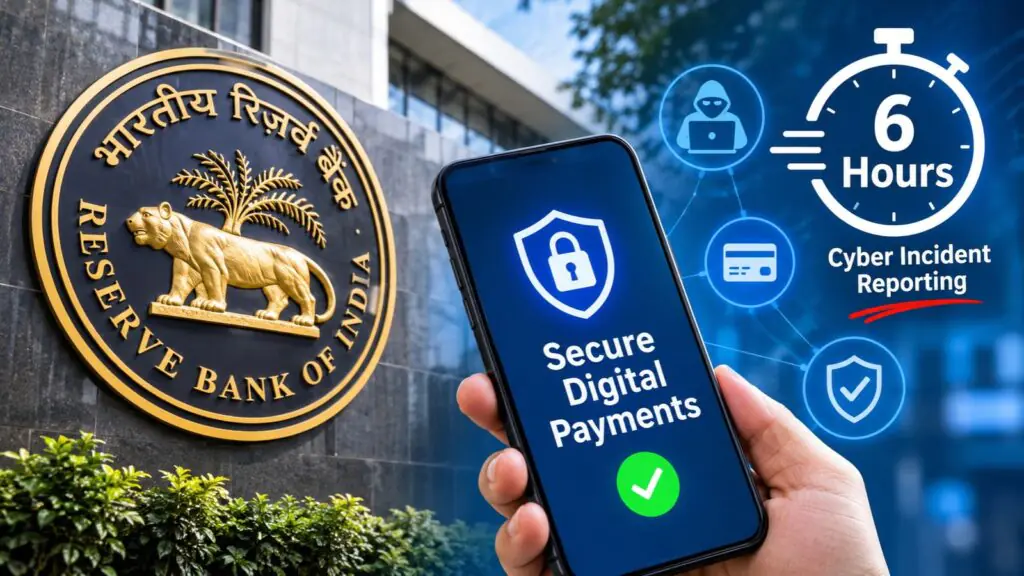

The Reserve Bank of India (RBI) has introduced stricter cybersecurity rules for non-bank payment operators, requiring them to report unusual cyber incidents within six hours of detecting them. The move is aimed at improving the security of India’s digital payment systems and ensuring that payment companies respond more quickly to cyberattacks, system failures and other security-related problems.

Under the RBI’s Master Directions on Cyber Resilience and Digital Payment Security Controls, 2024, payment operators must report incidents such as cyberattacks, major system outages, internal fraud and delays in settling payments. They must notify the RBI within six hours using the prescribed reporting format. They are also required to report cybersecurity incidents separately to the Indian Computer Emergency Response Team (CERT-In).
Who will have to follow the new RBI rules?
The directions apply to authorised non-bank Payment System Operators (PSOs). These include payment aggregators, digital wallet companies, card payment networks, white-label ATM operators and other organisations involved in processing or facilitating payments.
Major organisations covered by the framework include the National Payments Corporation of India (NPCI), NPCI Bharat BillPay, the Clearing Corporation of India and authorised payment aggregators and card networks.
The RBI has given companies different deadlines to meet the requirements, depending on their size. Large payment operators were required to comply from April 1, 2025, while medium-sized operators had to comply from April 1, 2026. Smaller operators have been given additional time, with a compliance deadline of April 1, 2028.
Stronger security and accountability at payment companies
The new rules place greater responsibility on the management of payment companies to protect their systems and customer information. Their boards of directors will be primarily responsible for overseeing cybersecurity, rather than leaving the entire responsibility to their IT departments.
Companies must also appoint a senior executive, such as a Chief Information Security Officer (CISO), to oversee information security and ensure that security policies are followed.
They must prepare a separate cyber crisis management plan explaining how they will identify a security incident, respond to it, contain the problem and restore normal services.
Payment operators must also test their computer systems regularly to identify security weaknesses before they can be exploited by attackers. This includes annual security checks and simulated cyberattacks, commonly known as penetration testing.
Payment companies must secure software supplied by vendors
One important requirement concerns software developed or supplied by outside companies.
Payment operators must either own the source code of critical third-party applications or keep it in a legally protected arrangement known as source code escrow. Source code is the underlying set of instructions used to build software.
In simple terms, this arrangement is intended to ensure that a payment company can continue operating critical services if its software developer becomes unavailable or can no longer provide support.
Where the operator does not own the source code, the developer must provide a certificate confirming that the software is free from vulnerabilities and hidden features that could compromise security.
Protection against payment fraud and unauthorised access
The RBI has also prescribed several measures that directly concern customers using digital payment services.
Multi-factor authentication (MFA) will be mandatory for electronic payment transactions and cash withdrawals. This means that customers must verify their identity using more than one authentication method, rather than relying on a single security check.
Another important measure is a mandatory 12-hour waiting period after a customer changes their registered mobile number or email address. Online payment transactions will not be permitted during this cooling-off period.
This requirement is intended to reduce the risk of fraud involving unauthorised changes to customers’ registered contact details.

Payment companies must also provide a facility through their websites and mobile applications that allows customers to flag fraudulent transactions after verifying their identity. This will help ensure that the concerned payment instrument issuer is notified.
Transaction alerts sent through SMS or email must also follow stricter rules. They must hide sensitive information, display the actual merchant’s name instead of the payment gateway or aggregator’s name, and include beneficiary details.
Stricter security for mobile apps, cards and payment systems
The new directions also require payment companies to strengthen security on their mobile applications and payment infrastructure.
Mobile applications must link access to the registered SIM card and device. They must automatically end inactive sessions, restrict repeated failed login attempts and block the use of live remote-access tools that could allow someone else to control a customer’s device.
Payment companies must also ensure that their card payment terminals meet prescribed security standards. Card networks must establish limits at the payment processing system level to help control risks.
In addition, companies must maintain records of system activities, including security-related events and transactions, for at least five years.
Disaster recovery arrangements made mandatory
The RBI has also strengthened requirements for companies to restore services if their primary computer systems or data centres become unavailable.
Payment operators must maintain a separate Disaster Recovery (DR) facility in a different seismic zone from their primary data centre. This is intended to reduce the risk of both facilities being affected by the same major event.
Companies must conduct disaster recovery drills at least twice a year to check whether they can restore services when required. Their backup arrangements must also aim to minimise the loss of transaction data if a system failure occurs.
Commenting on the new framework, Srinivas L, Joint Managing Director and CEO of 63SATS Cybertech, said the RBI had brought previously scattered requirements into one clear set of rules. He particularly highlighted the requirement for payment operators to own critical software source code or maintain it through an escrow arrangement.
He also pointed out that security breaches can originate in software supplied by outside vendors, making it important for payment companies to have better control over the technology they use.
Ravi Prakash, Founder and CEO of Apollo Infoways, said the six-hour reporting requirement sends a clear message that cybersecurity can no longer be treated as a reactive compliance exercise.
Subhasis Majumdar, CEO of Nerix Technoserve, said the new reporting deadline would encourage payment operators to improve their ability to monitor systems, respond to cyber incidents and manage security risks.
Does the six-hour rule apply to individual customers?
No. The six-hour reporting requirement applies to authorised non-bank payment system operators. It does not mean that customers must report fraudulent transactions to the RBI within six hours.
The directions also do not guarantee automatic refunds or reversals of fraudulent transactions. They are primarily aimed at making payment operators more accountable for identifying, reporting and responding to cybersecurity incidents.
The RBI’s initiative was first announced on April 8, 2022. A draft of the directions was subsequently released for public and stakeholder consultation on June 2, 2023, before the final Master Directions were published.

Vineet Gupta is the Founder and Managing Editor of PuneNow, where he leads editorial coverage on Pune’s civic developments, local infrastructure, traffic, and urban governance. With an academic background from the University of Wales and professional experience across journalism, hospitality, finance, and academia, Vineet brings a unique perspective to hyper-local journalism. Based in Pune, he is passionate about empowering residents with accurate, timely news that affects their daily lives, while also offering insightful commentary on mindful living, parenting, and community connection.