RBI Hikes Repo Rate: Home Loan EMIs to Rise; Pune Realtors Confident of Continued Demand
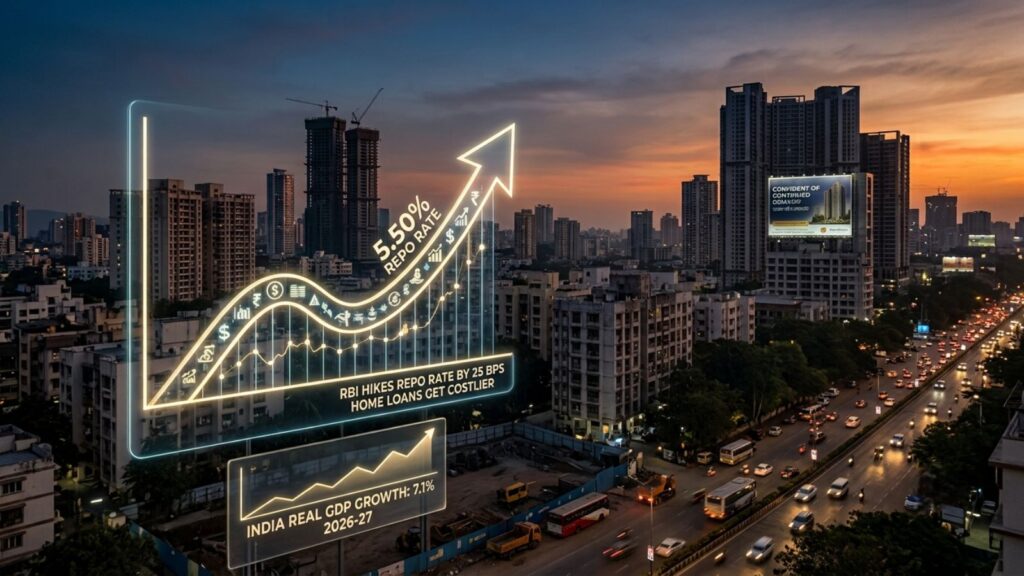

RBI has announced a hike in repo rates by 25 basis points to 5.50% on October 7. This decision would immediately impact liquidity in the market and could jeopardize festive shopping budgets and vehicle purchases, but the most visible impact will be seen across home loans.

Existing floating-rate home loan borrowers will see an increase in their monthly EMI burden while the new home loans will become more expensive.
The decision was taken unanimously by RBI’s Monetary Policy Committee (MPC) at its October 5-7 meeting and is influenced by renewed inflationary pressures, volatile global crude prices and heightened geopolitical uncertainty.
Further, RBI Governor Sanjay Malhotra made it clear that there are no plans of rolling back the hike in repo rates in the near future.
In fact, he said, there could more more rate hikes possible in the future and at best, a pause in rate hikes but no mention of rolling back the rates.
Why RBI Has Increased the Repo Rates
Rising inflation is the main reason cited by RBI for this increase in repo rates. RBI said the retail inflation rose from 4.5% in July to 4.8% in August, with food prices, including sugar and onions, contributing to the increase.
The RBI now expects Consumer Price Index (CPI) inflation to average 5.2% during 2026-27. Inflation is projected at 4.9% in the second quarter, rising to 6% in Q3 and 5.7% in Q4. For the first quarter of 2027-28, inflation is projected at 5.6%.
Governor Malhotra said headline CPI inflation could average almost 5.8% over the next three quarters.
“It is clear that inflation and its outlook are not benign as they were last year,” he said.
RBI is also concerned about the cascading effects of inflation, aka second-round effects of inflation. These include rising inflation expectations among consumers and increased prices of products by companies in response to higher costs.
Thus Central Bank is thus acting pre-emptively to ensure inflation does not go out of hand later.
Global Conflicts Add to the Pressure
There are global conflicts far from the shores of India and in which India has no role to play, but in today’s connected world, no country can stay insulated from geopolitical conflicts occurring in any corner of the world.
Energy prices are uncertain and energy supply chains are getting disrupted and that impacts India in particular, because of its high dependence on large amounts of crude imports.
India’s energy vulnerability puts it on the crossroads of world conflicts, even though it is not even remotely connected to any of them going on in the world currently.
The Silver Lining – RBI raises growth forecast despite rate hike
The rate increase does not reflect a weakening domestic economy.
In fact, the RBI has raised its real GDP growth forecast for 2026-27 by 40 basis points to 7.1%.
India’s economy grew 7.8% in the first quarter, supported by private consumption and around 12% growth in investment.
The RBI expects GDP growth of 7.2% in Q2, 6.9% in Q3 and 6.8% in Q4. Growth in Q1 of 2027-28 is projected at 7.1%.
Government infrastructure spending, a revival in private capital expenditure, strong credit growth, double-digit merchandise export growth during July-August and resilient services exports will continue to drive growth despite the headwinds.
The risks to growth, however, remain.
An uneven and deficient Southwest Monsoon 2026, combined with strong El Niño conditions, could affect the upcoming Rabi crop and rural non-farm consumption. High international commodity prices also remain a risk.
The RBI has nevertheless assessed the risks to its growth outlook as broadly balanced.
Governor Malhotra said the 40-basis-point upward revision in the growth forecast “underscores the strength of economic activity despite the significant headwinds.”
What the repo rate hike means for borrowers
The immediate impact of the rate hike will be felt through borrowing costs.
Banks and other lenders will review their lending rates following the increase in the policy rate. Borrowers with floating-rate loans, particularly those linked to external benchmarks, are likely to see their borrowing costs rise.
Home loans are among the most visible examples.
Most new floating-rate retail loans issued by scheduled commercial banks are linked to external benchmarks that are directly influenced by the RBI’s repo rate. A 25-basis-point increase can therefore result in higher EMIs or a longer repayment period for existing borrowers, depending on how individual lenders transmit the increase.
For example, a ₹1 crore home loan with 20 years remaining, initially carrying an 8% interest rate, would see the EMI rise by roughly ₹1,700 a month if the interest rate increases to 8.25%.
The actual impact will depend on the lender, the benchmark, the borrower’s outstanding principal and the remaining tenure.
The bigger concern for borrowers is not simply the 25-basis-point increase. It is the RBI’s forward guidance.
With rate cuts ruled out for the near term, borrowers cannot reasonably expect an immediate reversal in lending rates. The next move by the RBI will either be another hike or a pause, depending on inflation and economic conditions.
Borrowing costs could remain higher through the festive season
The timing of the decision is important for the credit market as India enters the festive season.
System liquidity had remained in surplus, averaging around ₹5.9 lakh crore on a daily basis since the previous policy meeting. The surplus moderated in September because of advance tax outflows and liquidity absorption measures by the RBI.
The availability of liquidity is important because it influences how easily banks can lend and at what cost.
Despite the rate hike, the RBI said credit demand remains robust and broad-based across sectors.
However, higher policy rates combined with tighter liquidity conditions could make banks more cautious about the pricing and approval of new loans.
For households, this could mean higher costs for home loans, vehicle loans, personal loans and other forms of credit. Businesses and developers could also face a higher cost of working capital and project finance.
The impact is unlikely to be uniform. Borrowers with strong credit profiles may continue to receive competitive rates, while borrowers with higher leverage or weaker repayment capacity could face greater scrutiny.
For existing borrowers, lenders may increase EMIs or extend loan tenures. Choosing a longer tenure can reduce the immediate monthly burden but increases the total interest paid over the life of the loan.
What the rate hike means for real estate
The real estate sector faces a mixed picture.
On one side, higher interest rates increase the cost of housing finance and can make home purchases marginally less affordable. Developers also face higher borrowing costs for land, construction and project financing.
On the other hand, the RBI’s 7.1% growth forecast points to a relatively strong underlying economy. Employment, infrastructure spending, urbanisation and continued credit demand can support housing demand despite a moderate increase in interest rates.
The impact is therefore likely to be more visible in affordability and buyer sentiment than in a sudden collapse in housing demand.
Premium housing could prove relatively more resilient because a greater proportion of buyers in this segment depend on income and wealth creation rather than borrowing costs alone.
Pune, MMR and NCR may remain resilient
The outlook for major property markets such as Mumbai Metropolitan Region (MMR), the National Capital Region (NCR) and Pune remains relatively positive despite the increase in borrowing costs.
Pune, in particular, continues to benefit from employment, infrastructure development and genuine end-user demand. MMR and NCR also have strong employment bases and sustained demand for well-located housing.
Sachin Bhandari, CEO & Executive Director, VTP Realty, said the rate increase was not in the best interest of the common man, particularly at a time when fuel prices and household expenses are already putting pressure on family budgets.
However, he does not expect the marginal increase to materially affect housing demand.
“Pune and MMR continue to have strong fundamentals, backed by employment, infrastructure and genuine end-user demand,” Bhandari said.
According to him, buying a home remains a long-term decision and a small movement in interest rates is unlikely to change the decision of buyers when the location, product and value proposition are right.
“The market may become a little more selective, but demand for the right homes in the right locations will remain strong,” he said.
Rajat Khandelwal, Group CEO, Tribeca Developers, also expects the impact on premium housing to remain manageable.
He said the RBI’s decision reflects a cautious approach to maintaining macroeconomic stability amid changing economic conditions. While the hike could put some upward pressure on borrowing costs and EMIs, he believes demand for quality housing in premium markets such as MMR, NCR and Pune remains resilient.
“At Tribeca, we see end-user confidence, strong economic fundamentals and the long-term value proposition of premium real estate continuing to support market momentum,” Khandelwal said.
He added that a stable and well-calibrated interest rate environment would be important for sustaining healthy growth in the sector.
What happens next?
The October policy marks an important change in the RBI’s monetary policy direction.
The central bank is no longer operating in an environment where falling inflation allows it to consider lower interest rates. Instead, it is preparing the economy for a period in which inflation could remain elevated for several quarters.
At the same time, the RBI is not signalling an aggressive tightening cycle. The language around the duration and extent of future rate increases remains conditional on actual growth and inflation developments.
“The duration and extent of the rate hike cycle therefore would be contingent on the actual growth-inflation developments and outlook, especially that of underlying inflation, the extent of broadening of price pressures and second round effects,” Governor Malhotra said.
For borrowers, this means that the era of expecting quick rate cuts has, at least for now, come to an end.
For homebuyers, the 25-basis-point increase is a relatively small rise in isolation. The more important signal is that borrowing costs may remain elevated for some time.
For the wider economy, the RBI is attempting to strike a balance between controlling inflation and preserving the strong domestic growth momentum that has taken India’s GDP growth forecast to 7.1%.
The central bank’s stated objective remains price stability without compromising the economy’s longer-term growth prospects.
“We shall strive for price as well as financial stability as we believe that both are essential for sustainable growth in the long run,” Governor Malhotra said.

Vineet Gupta is the Founder and Managing Editor of PuneNow, where he leads editorial coverage on Pune’s civic developments, local infrastructure, traffic, and urban governance. With an academic background from the University of Wales and professional experience across journalism, hospitality, finance, and academia, Vineet brings a unique perspective to hyper-local journalism. Based in Pune, he is passionate about empowering residents with accurate, timely news that affects their daily lives, while also offering insightful commentary on mindful living, parenting, and community connection.