
Pune has seen exponential growth in the last decade with the number vehicles increasing manifolds but the road infrastructure has not kept pace, resulting in suffocating traffic that is notorious for its slow speed.

Time and again, studies have placed Pune amongst world’s most congested cities with traffic speeds being one of the lowest in the world.
All this is about to change!
Authorities have acknowledged the urgent need for upgrade of road infrastructure in Pune and in the past few years have launched several projects to alleviate traffic and make commuting across the city faster.
Among these, four road projects stand out that really have the potential to streamline the city’s traffic and support smooth commuting for many years to come. The projects are:
- Outer Ring Road
- Inner Ring Road
- High Capacity Mass Transit Route (HCMTR)
- Kothrud-Panchvati-Pashan Tunnel
All these projects have already been approved and are at various stages of their development. Outer Ring Road is already under construction and for the other three projects, authorities have formed an executive committee headed by PMC Chairman to ensure smooth coordination between PMC, PCMC, PMRDA and other agencies.
Lets look at each of these projects one by one.
Outer Ring Road
This project is already under construction and is being executed by Maharashtra State Road Development Corporation (MSRDC). The ring road is approximately 168 km in length with an average width of 110 meters. It is an access-controlled corridor, designed to offer four to six lanes, supporting speeds up to 120 kmph.
This road will encircle Pune and connect all highways passing through the city. This will ensure that no highway traffic will enter the city, clearing city roads of heavy vehicles. At the same time, the Outer Ring Road will provide connectivity to the residents of Pune from one area to another without having to navigate through traffic bottlenecks inside the city.
There are two sections of this ring road- the western alignment and the eastern alignment.
The 69-km western alignment will connect the Mumbai-Pune expressway near Urse and run along the western borders of the city, finally joining the Pune-Bengaluru Highway near Khed Shivapur. It will cross a major bridge on the backwaters of the Khadakwasla dam and also cross a few tunnels under the Sinhagad foothills. Currently vehicles use the Urse-Shivare Bypass to cross Pune and normally it takes about 1 hour and 20 minutes. After the outer ring road is ready, this distance could be covered in as less as 30 minutes.
Currently, as on September 2026, 30 percent of the work has already been completed and the complete western alignment of the Pune’s Outer Ring Road is expected to be opened to traffic by December 2027.
The eastern alignment, approximately 90-99 km long, will connect the western alignment back to Mumbai-Pune Expressway near Urse through the eastern suburbs of Pune. Work on this alignment is currently in preliminary stages and is expected to be ready for traffic by December 2028.
Inner Ring Road
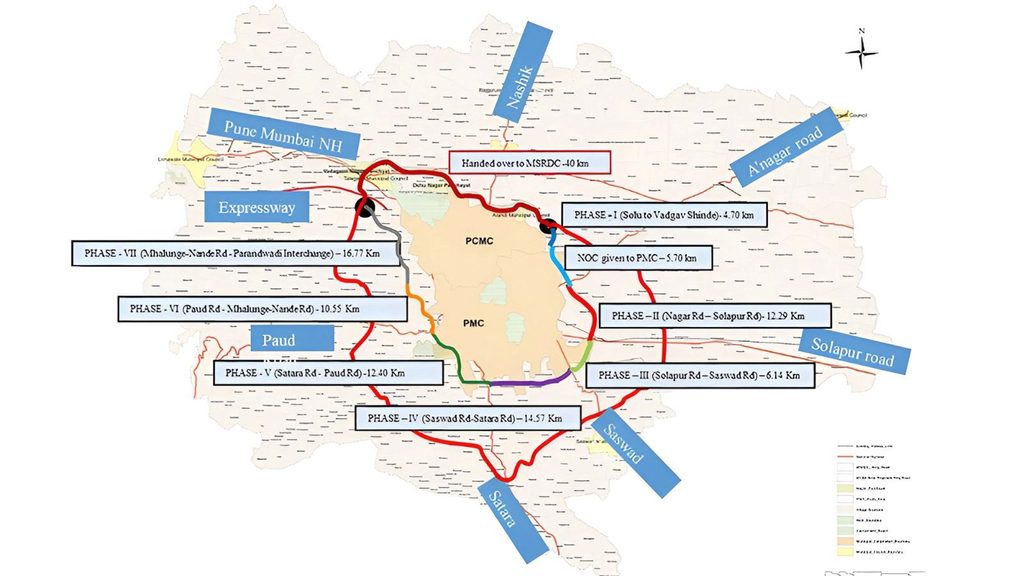
Pune Inner Ring Road is a 83-km PMRDA executed project, designed to run much closer to Pune as compared to the Outer Ring Road, that passes through the distant outskirts of Pune. This project aims to alleviate traffic on the internal roads of Pune, bringing relief during intracity travel. There are seven phases in this project, connecting Lohegaon Airport, Hinjawadi IT Park, Chakan MIDC, Pune-Mumbai Expressway, Pune-Nashik, Pune-Ahilyanagar, Pune-Sholapur and Pune-Satara Highways.
In a recent development in July 2026, CM Fadnavis directed local administration to complete the administrative process within six months.
HCMTR
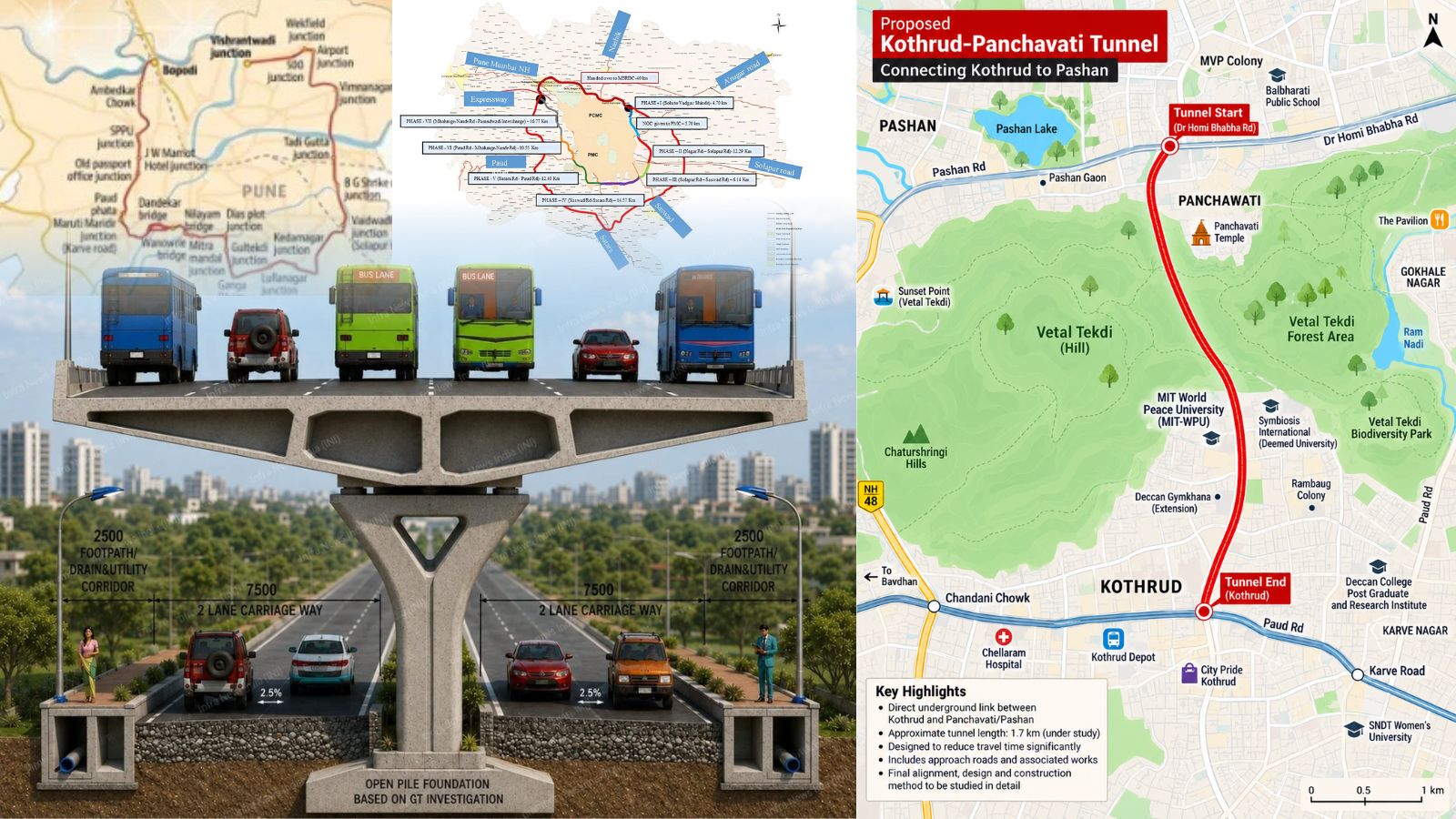
The concept of High Capacity Mass Transit Route (HCMTR) originated in Pune in 1980s, but has been through its share of hurdles and oppositions. However, now it has picked up pace and the 35.96 km elevated corridor is gaining momentum in the government corridors. The six-lane elevated circular corridor is expected to stand on one pillar structures to avoid any obstructions below it, just like metro corridors are built.

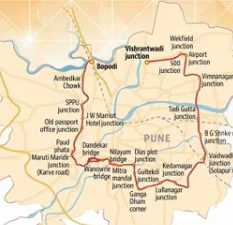
HCMTR will begin at Bopodi and loop through Pune till Vishrantwadi. It will bypass 34 major intersections, removing major traffic bottlenecks in Pune city. It will have interchange ramps at 17 locations to provide easy access.
PMC has already begun the tendering process and by the last quarter of 2026, the tendering process should be completed. The government claims a reduction of 25-30 percent in Pune’s traffic congestion after this project is completed. The areas that could benefit from this project are: Bopodi, Shivajinagar, Kothrud, Karvenagar, Sinhagad Road, Satara Road, Wanowrie, Hadapsar, Sholapur Road, Kalyani Nagar and the Airport/Vishrantwadi side.
Kothrud-Panchvati-Pashan Tunnel
This tunnel aims to cut down the travel time between Paud Road Junction and Pashan-Panchvati Junction from current 40 minutes to 10 minutes. This tunnel will be constructed under the Vetal Tekdi hill from Paud Road Junction to Pashan-Panchvati Junction and is proposed to be approximately 1.7 km long and 24 meter wide.
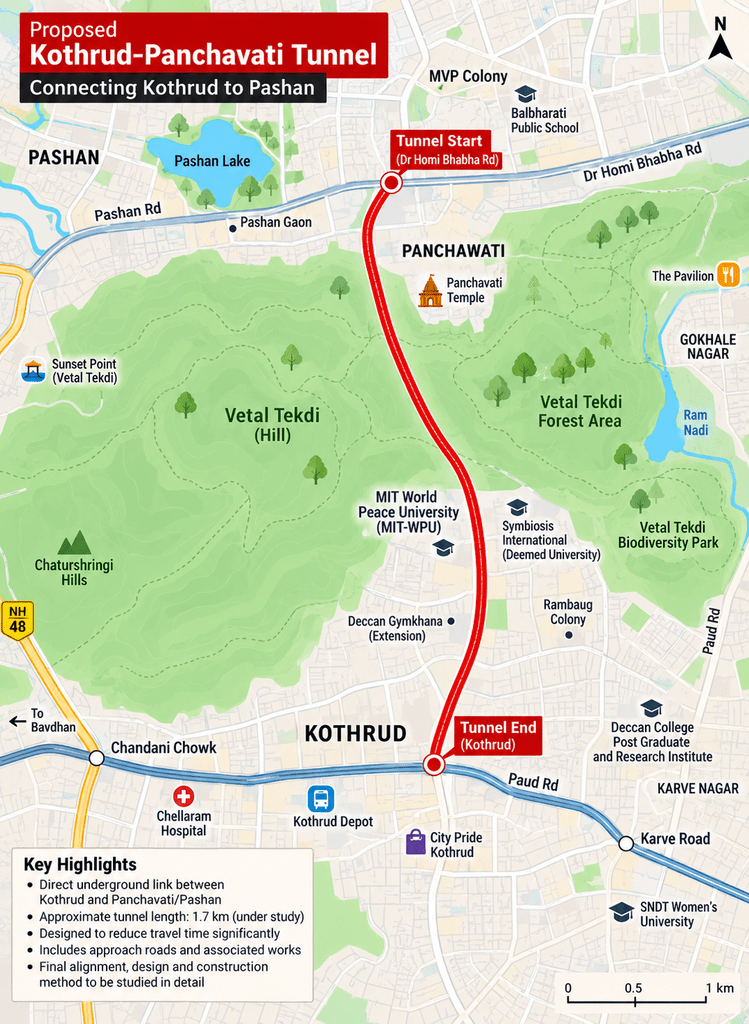
Currently this tunnel project is in feasibility study/DPR stage and PMC is firm on beginning the project as soon as possible. However environmental concerns have surfaced, especially, since the tunnel passes through Vetal Tekdi hill system which is considered to be an ecologically sensitive zone.
Several activists and opposition leaders have time and again opposed this project.
Complimentary Projects
All the four projects discussed above are not isolated projects but an infrastructure system of roads that are designed to complement each other.
The Outer Ring Road (170 km) will form the outermost ring of the system, designed to reroute interstate and intercity traffic away from Pune city while providing connectivity to Punekars to major highways around the city.
The Inner Ring Road (83 km), much closer to city centers, is designed to redistribute traffic across the city centers by reducing critical traffic bottlenecks and facilitate smooth traffic flow across the city.
HCMTR (36-43 km) will provide an alternative high-speed, elevated, circular-ring across the city, bypassing approximately 34 traffic junctions to offer fast commuting within the city, connecting major landmarks like the airport and various IT parks in Pune.
Kothrud-Pashan Tunnel, alongwith some more such tunnels planned aim to reduce wastage of time while commuting from Point A to Point B by navigating around city’s hills currently. These tunnels will pass below hills, providing straight line travel between those two points. This will also reduce traffic on the surface roads.
If we look at the stages of execution of these projects, Outer Ring Road is under construction with 30 percent work already completed and planned to be fully operational by December 2028. The Inner Ring Road is also moving fast with construction expected to begin by the end of 2026.
HCMTR is at the same stage of execution as Inner Ring Road with tendering and DPR in process and construction expected to commence from the end of 2026.
The Kothrud-Pashan Tunnel may take some more time as DPR and tendering has not begun yet and it faces continued opposition from various sections of the society.
However, if a rough timeline is to be given, it looks like all these projects will be available to Punekars for use by 2028-29, around the same time as Purandar International Airport is expected to start operations.

Vineet Gupta is the Founder and Managing Editor of PuneNow, where he leads editorial coverage on Pune’s civic developments, local infrastructure, traffic, and urban governance. With an academic background from the University of Wales and professional experience across journalism, hospitality, finance, and academia, Vineet brings a unique perspective to hyper-local journalism. Based in Pune, he is passionate about empowering residents with accurate, timely news that affects their daily lives, while also offering insightful commentary on mindful living, parenting, and community connection.