El Niño Threat Looms Over Pune: Will the City’s Dams Have Enough Water This Year?
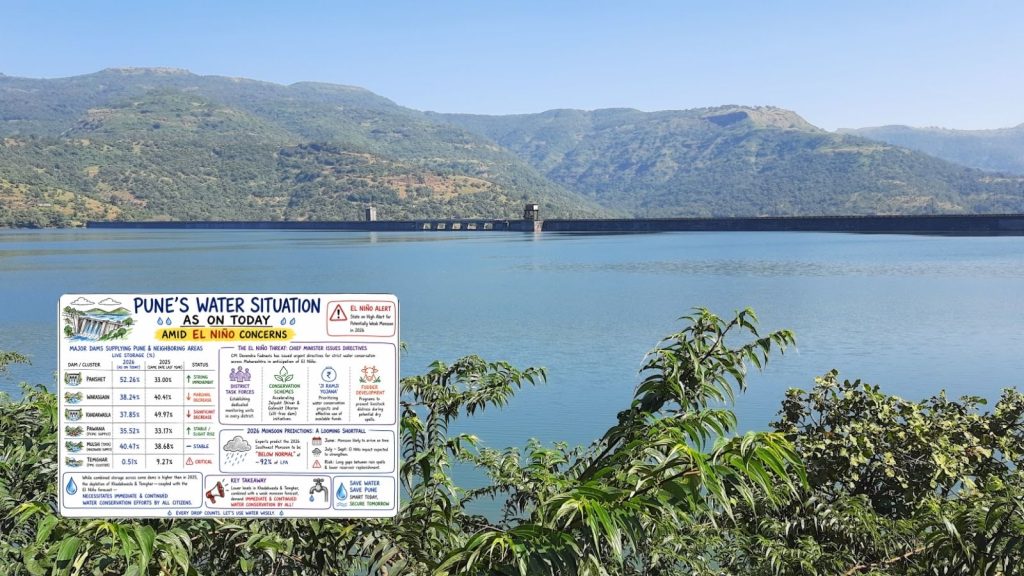

PUNE – As the summer heat intensifies across Maharashtra, the latest water storage data for the major dams supplying Pune and its neighboring industrial hubs reveals a complex picture. While some reservoirs show a significant improvement over last year’s figures, critical supply points for the city are under increasing pressure, especially as the state government braces for a potentially weak monsoon.

Khadakwasla Cluster: A Divided Forecast
The four dams, Khadakwasla, Panshet, Warasgaon, and Temghar, serve as the primary lifeline for the Pune Municipal Corporation (PMC).
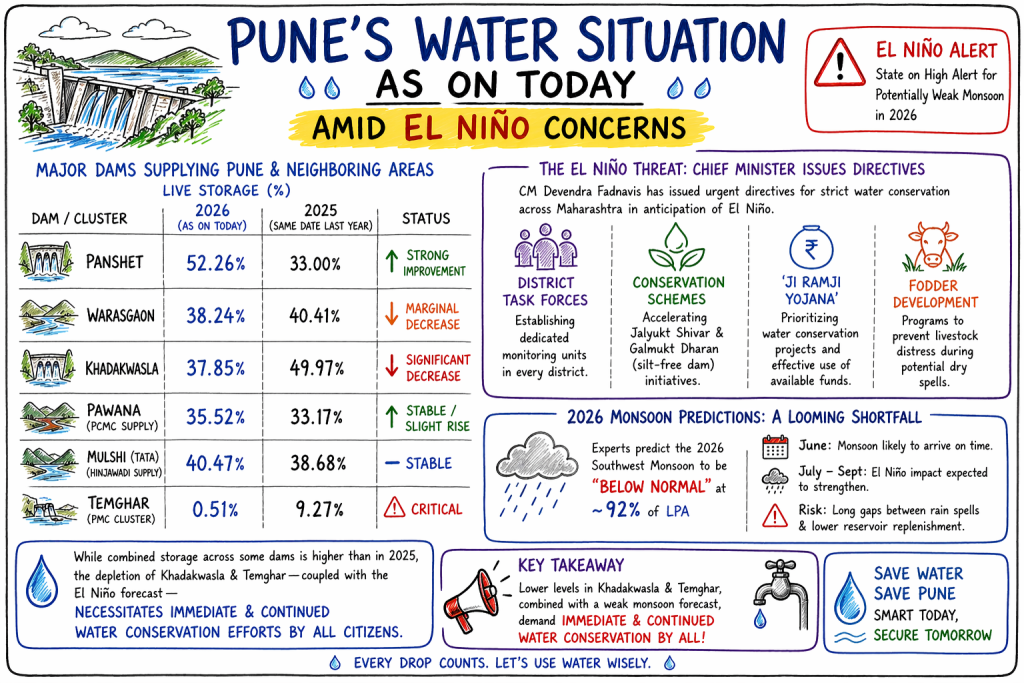
Warasgaon, the largest of the four, currently holds 38.24% of its live storage. While this provides a substantial volume of water, it is a slight dip from the 40.41% it held on the same date last year. Panshet is the standout performer of the cluster, holding 52.26%, a significant jump from last year’s 33.00%.
However, the situation is more precarious at Temghar, which has plummeted to a negligible 0.51% (down from 9.27%). Khadakwasla itself is also lower than the previous year, sitting at 37.85% compared to 49.97% in 2025.
Stability for PCMC and IT Hubs
Residents of Pimpri-Chinchwad can breathe a slight sigh of relief. The Pawana Dam in Lonavala is at 35.52% capacity, slightly edging out last year’s stock of 33.17%. Similarly, the water supply for the Hinjawadi IT corridor remains consistent, with the Mulshi (Tata) reservoir holding steady at 40.47%.
The El Niño Threat: Chief Minister Issues Directives
The current storage levels are being viewed with extreme caution. Following a high-level state cabinet meeting, Chief Minister Devendra Fadnavis has issued urgent directives for strict water conservation across Maharashtra in anticipation of the El Niño phenomenon.
The state government has initiated a comprehensive preparedness plan, including:
- District Task Forces: Establishing dedicated monitoring units in every district.
- Conservation Schemes: Accelerating the Jalyukt Shivar and Galmukt Dharan (silt-free dam) initiatives.
- ‘Ji Ramji Yojana’: Prioritizing water conservation projects and ensuring effective use of available funds.
- Fodder Development: Implementing programs to prevent livestock distress during potential dry spells.
धरणांमध्ये गतवर्षीच्या तुलनेत १०१.७७ टीएमसी अधिकचा पाणीसाठा.
— DIVISIONAL INFORMATION OFFICE, PUNE (@InfoDivPune) April 22, 2026
एल-निनोचा प्रभाव लक्षात घेऊन पाणी जपून वापरण्याचे मुख्यमंत्री @Dev_Fadnavis यांचे राज्य मंत्रिमंडळाच्या बैठकीत निर्देश. pic.twitter.com/ub5N9aePtW
2026 Monsoon Predictions: A Looming Shortfall
The urgency from the administration stems from sobering meteorological forecasts. Experts indicate that the 2026 southwest monsoon is likely to be “below normal” at approximately 92% of the Long Period Average (LPA). While the monsoon may arrive on time in June, the impact of El Niño is expected to strengthen between July and September, potentially leading to long gaps between rain spells and lower reservoir replenishment.
Comparative Analysis at a Glance
| Dam / Cluster | 2026 Live Storage (%) | 2025 Live Storage (%) | Status |
| Panshet | 52.26% | 33.00% | Strong Improvement |
| Warasgaon | 38.24% | 40.41% | Marginal Decrease |
| Khadakwasla | 37.85% | 49.97% | Significant Decrease |
| Pawana | 35.52% | 33.17% | Stable/Slight Rise |
| Temghar | 0.51% | 9.27% | Critical |
While combined storage across some dams is currently higher than in 2025, the depletion of Khadakwasla and Temghar, coupled with the El Niño forecast, necessitates immediate and continued water conservation efforts by all citizens to ensure supply lasts through the summer and a potentially dry monsoon.