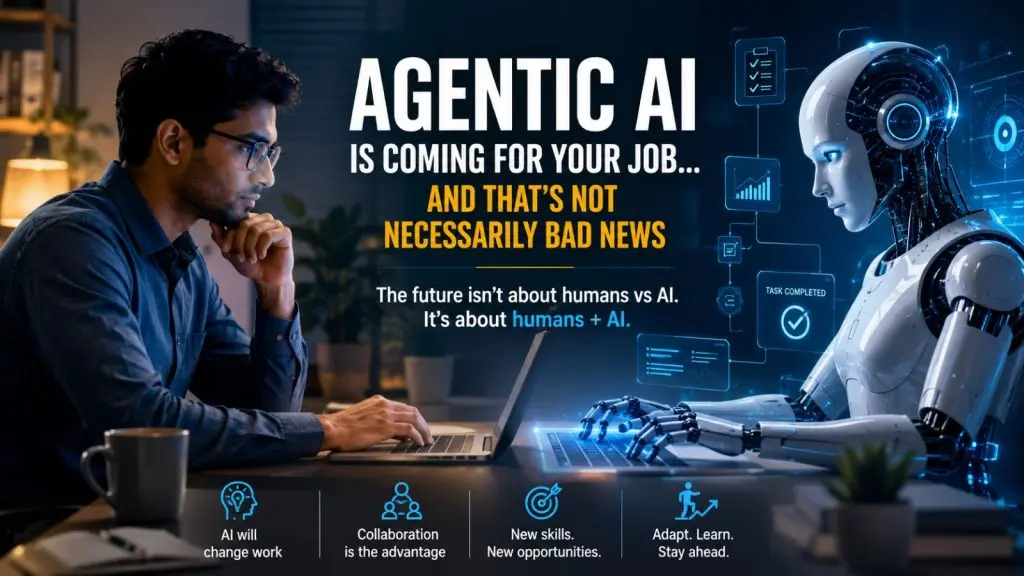
Agentic AI Is Coming for Your Job… and That’s Not Necessarily Bad News

Before I tell you why Agentic AI may change the way you work, study, and build your career, let me tell you where I’m coming from.

Over the last two decades, I’ve had the privilege of working across enterprise technology, digital transformation, cloud computing, cybersecurity, automation, and now artificial intelligence. In that time, I’ve survived, and occasionally enjoyed, multiple waves of technological disruption. I’ve seen people worry that the internet would eliminate jobs, then that outsourcing would eliminate jobs, then that cloud computing would eliminate jobs. Somehow, jobs not just survived, but they evolved.
As a Senior Enterprise Architect, I’ve spent years helping organizations adopt emerging technologies, redesign business processes, and prepare workforces for the future. My role often sits at the intersection of technology, business, and human behaviour, which means I get a front-row seat to both the excitement and the panic that accompany every new technology trend.
Today, Agentic AI is generating a similar mix of fascination, confusion, and anxiety. The observations in this article are not based on science fiction, social media hype, or late-night AI debates. They come from working with real enterprises, real leaders, and real teams that are already figuring out how humans and AI can work together productively.
And if there is one lesson I’ve learned from twenty five – plus years in technology, it is this: technology rarely replaces people who keep learning. It mostly replaces the way things used to be done.
A few years ago, people worried that robots would take over the world. Today, they’re worried that AI will take over their jobs.
The good news? AI isn’t interested in your office chair.
The bad news? It may be interested in the work you’re doing while sitting on it.
Welcome to the age of Agentic AI, a new breed of artificial intelligence that doesn’t just answer questions or generate content. It plans, decides, acts, learns from outcomes, and completes tasks with minimal supervision. Think of it less as a calculator and more as an enthusiastic intern who never sleeps, never asks for coffee breaks, and somehow reads documentation for fun.
So, What Exactly Is Agentic AI?
Traditional AI is like a GPS. It tells you where to go.
Agentic AI is like a chauffeur. It plans the route, navigates traffic, books parking, and occasionally reminds you that you forgot your wallet.
These AI systems can coordinate multiple tasks, use software tools, analyze information, and work toward a goal with limited human intervention. They are already helping software developers write code, assisting businesses in automating workflows, monitoring systems, and even resolving technical issues before humans notice them.
In short, AI is graduating from assistant to a colleague.
Will AI Take Away Jobs?
The honest answer is: some jobs will shrink, many jobs will change, and entirely new jobs will emerge.
History offers reassurance. When ATMs arrived, people predicted the end of bank tellers. Instead, banks hired more people for customer relationships and advisory roles. When spreadsheets arrived, accountants didn’t disappear; they became more productive.
Agentic AI will have a similar effect.
Tasks that are repetitive, predictable, and rule-based are increasingly becoming AI territory. Examples include routine data analysis, basic customer support, repetitive testing, simple accounting activities, and standard reporting.
If your daily work can be described as “copy, paste, repeat,” AI is probably eyeing it already.
But jobs requiring judgment, creativity, context, ethics, persuasion, leadership, and domain expertise are becoming more valuable than ever.
The future belongs not to people who compete with AI, but to those who know how to direct it, work in collaboration with it.
The New Workplace: Human + AI
The professional of the future won’t necessarily be the person who knows the most.
It will be the person who asks the best questions.
Employers are increasingly looking for people who can:
- Frame problems clearly
- Guide AI systems effectively
- Verify AI-generated outputs
- Spot mistakes and hallucinations
- Make ethical decisions
- Combine technology with business understanding
In other words, your value won’t come from memorizing answers. It will come from knowing which questions matter.
Dear friends: Stop Asking “Will AI Replace Me?”
Ask instead:
“How can AI make me better?”
Whether you’re studying engineering, commerce, biotechnology, marketing, law, healthcare, or the arts, AI literacy is becoming as important as digital literacy once was.
You don’t need a PhD in machine learning.
You do need to understand how AI works, where it fails, and how to use it responsibly.
Start experimenting with tools like ChatGPT, Copilot, Claude, and other AI assistants. Learn how to write effective prompts. Challenge the outputs. Verify facts. Ask the AI to explain its reasoning.
Treat AI like a brilliant but occasionally overconfident teammate.
Because that’s exactly what it is.
The Employability Formula for the Next Decade
Many students still believe degrees guarantee jobs.
Employers increasingly believe skills create value.
The strongest candidates will combine three ingredients:
- Domain Expertise – understanding an industry deeply.
- AI Fluency – knowing how to use AI tools effectively.
- Human Judgment – applying critical thinking and ethical reasoning.
Think of it as a career sandwich.
AI is the filling.
Your domain knowledge is one slice of bread and your human skills are the other.
Without either of the slices, things fall apart rather quickly.
A Four-Year Survival Guide for Students
Year 1: Learn the Basics
- Build strong foundations in your chosen field.
- Learn how AI systems and large language models work conceptually. Use AI tools in everyday learning but verify everything they tell you.
- Remember: ChatGPT can be helpful, but it occasionally displays the confidence of a politician and the accuracy of a tired tourist.
Year 2: Find Your Combination
- Choose your specialization.
- AI plus finance.
- AI plus healthcare.
- AI plus marketing.
- AI plus logistics.
- AI plus almost anything.
- Start building small projects and solving real problems.
Year 3: Become an AI-Augmented Problem Solver
- Move beyond theory.
- Build complete solutions.
- Learn about AI ethics, security, governance, bias, and risk.
- Create a portfolio that shows what you’ve built rather than simply listing what you’ve studied.
Year 4: Become Industry Ready
- Focus on impact.
- Employers want evidence.
- Show how AI improved speed, quality, decision-making, customer experience, or cost efficiency.
- A portfolio that demonstrates results will often speak louder than a résumé filled with buzzwords.
The Human Skills AI Can’t Easily Replace
As impressive as AI is becoming, there are still areas where humans hold a significant advantage:
- Critical thinking
- Communication
- Leadership
- Empathy
- Collaboration
- Ethical judgment
- Adaptability
While AI can generate a thousand ideas in seconds, humans still decide which idea is worth pursuing. At least for now.
The Bottom Line
The future isn’t a battle between humans and machines. It’s a partnership.
Agentic AI is changing the nature of work, not eliminating the need for people. The professionals who thrive will be those who learn to collaborate with AI, supervise it, challenge it, and apply it to meaningful problems.
The smartest strategy is not to fear AI. It is to become the person who knows how to make AI useful. As I often tell students and young professionals:
“Don’t tell employers that you know AI. Show them what you’ve built with it.”
Because in the coming decade, employability will not be defined by what you know, it will be defined by what you can achieve, together with AI.

A Global technology leader with 25+ years of experience driving enterprise-scale digital transformation projects related to Infrastructure, Platforms, Security, GRC, Networking, and AI/ML in public and hybrid cloud environments. With proven expertise in Containerization, GenAI & Agentic AI, Data Center Migrations, DevOps, Resiliency, and Governance solutions across Healthcare, BFSI, Airlines, eCommerce, and Oil & Gas sectors, he has earned the distinction of consistently delivering scalable, secure, and cost-optimized solutions that reduce Total Cost of Ownership while maintaining quality, compliance, and delivery excellence.