Into the Arabian Sea at 4 A.M.
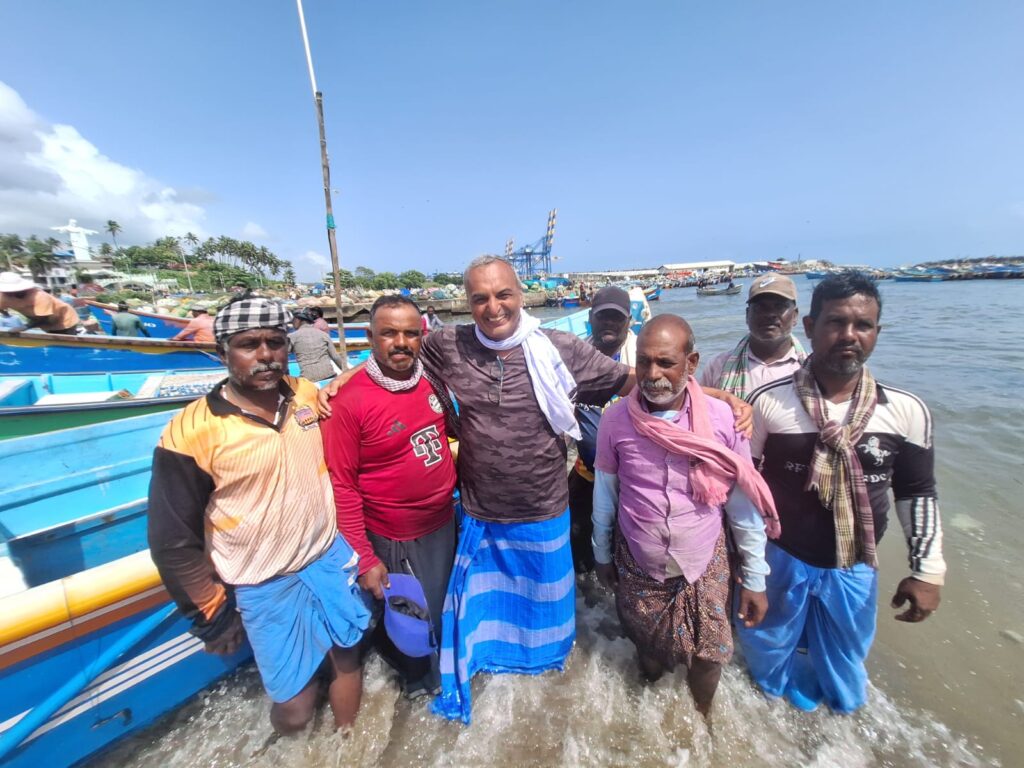

A Day with the Fishermen of Vizhinjam
Into the Arabian Sea at 4 A.M.
A Day with the Fishermen of Vizhinjam
“The sea doesn’t care who you are. It only asks whether you are willing to trust it.”

Until a day before, I had absolutely no plans of going nearly 35 kilometres into the Arabian Sea on a small fishing boat.
Sometimes, the most unforgettable experiences in life are never planned.
I was in Thiruvananthapuram meeting Mr. Thomas Lawrence, CEO of the Save Wetland International Movement (SWIM). As we were discussing climate change, wetlands, coastal ecosystems, and the challenges faced by fishing communities, he casually asked me,
“Would you like to spend a day with fishermen in the deep sea and see how they actually fish?”
It wasn’t an invitation I had ever expected.
Without thinking too much, I smiled and said, “Yes.”
Within minutes, he picked up his phone and called Mr. James, who manages several fishing boats operating from Vizhinjam Harbour. James listened patiently and then simply replied,
“Let him come tomorrow morning.”
That was it.
Less than twenty-four hours later, my alarm rang at 3 a.m.
By four in the morning, I was standing inside the bustling fishing harbour of Vizhinjam.
The harbour was already alive.
Engines roared in the darkness.
Men shouted instructions in Malayalam.
Ice was being loaded.
Fuel drums were being rolled towards boats.
Ropes were being untied.
The smell of diesel mixed with fresh fish and the salty breeze of the Arabian Sea.
This world had already been awake for hours while the city was still asleep.
James greeted me with a warm smile.
But before allowing me onto the boat, he looked at me seriously.
“I have to warn you,” he said.
“This isn’t a tourist boat.”
He pointed towards a relatively small fishing vessel rocking violently with every incoming wave.
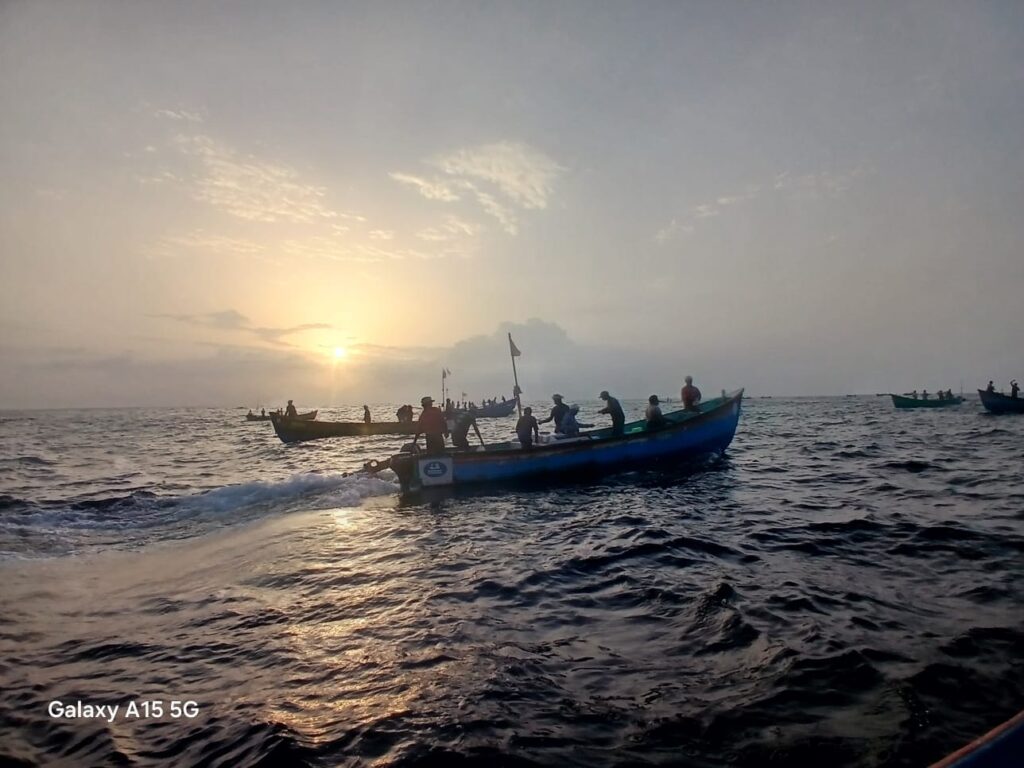
“The boat will climb high with every swell and suddenly drop. Many first-timers become frightened. Some get seasick.”
Then came his second warning.
“You’ll be soaked. Sea water will keep splashing on your face all day.”
His final warning was perhaps the most important.
“We’ll be nearly thirty-five kilometres from the shore. Once we leave, there is no coming back until the fishermen finish their work.”
He paused.
“Are you sure?”
I smiled.
“I’ll be fine.”
Whether I genuinely believed that or was simply hiding my nervousness, even I wasn’t sure.
A few minutes later, I climbed into the boat.
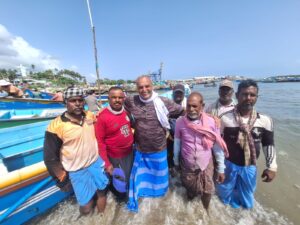
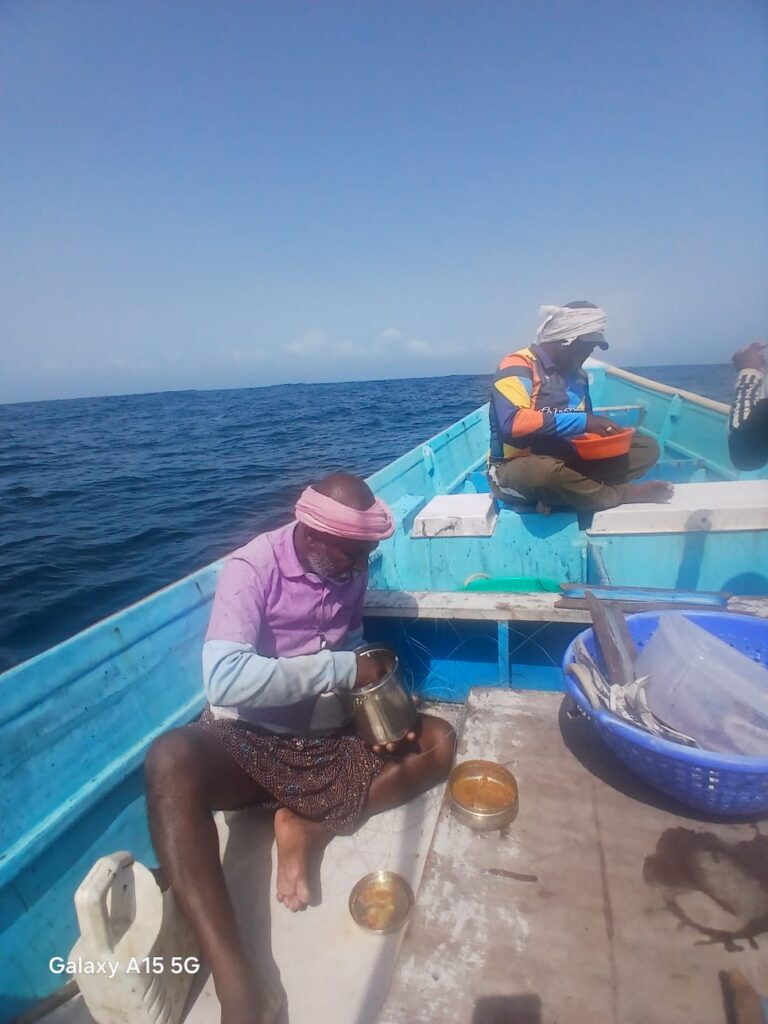
There were five fishermen already preparing for departure.
None of them spoke Hindi or English – Their world existed entirely in Malayalam.
For a brief moment, I wondered whether spending the next eight hours with people with whom I couldn’t communicate was a good idea.
Then I smiled to myself.
During my 20,000-kilometre cycling journey across India’s borders for the cause of Change Before Climate Change, I had often travelled through regions where I shared no common language with the people I met.
Yet kindness had always found its own language.
Just in case, I kept Google Translate ready on my phone.
Not that I expected it to work much in the middle of the sea – but there is always a hope 😊 .
The engines roared to life.
Slowly, the boat pulled away from the harbour.
The lights of Vizhinjam began shrinking behind us.
In the darkness, I could still make out the silhouette of the massive under-construction Vizhinjam International Seaport.
Its giant breakwaters stood like silent walls against the sea.
Beyond them lay the open Arabian Sea.
And somewhere beyond that lay a world I had never experienced.
Darkness has a strange way of amplifying uncertainty.
As the shoreline disappeared behind us, the sea seemed endless.
There were no buildings.
No roads. – No landmarks – Nothing but black water.
The boat rose sharply over each wave before crashing down into the trough.
Every impact sent a jolt through my body.
Sea water repeatedly splashed across my face.
Within minutes, I was completely drenched.
I have always considered myself reasonably adventurous.
I know how to swim.
But somewhere deep inside, another thought quietly emerged.
Swimming means very little when you’re surrounded by kilometres of open sea.
If something were to happen here, survival would depend not on swimming but on the sea’s mercy.
For a while, I questioned my decision.
Was this really necessary?
Had curiosity pushed me too far?
Yet turning back was no longer an option.
So I sat quietly and watched.
The darkness slowly began to change.
Far away on the horizon, the sky softened into shades of deep blue.
Then orange.
Then gold.
It happened so gradually that I hardly noticed when night surrendered to morning.
The Arabian Sea revealed itself.
It was magnificent.
The water shimmered like molten metal.
Gentle waves reflected the first rays of sunlight.
The wind grew warmer.
The fear that had travelled with me since four in the morning quietly disappeared.
I wasn’t thinking about danger anymore.
I was simply witnessing one of the most beautiful sunrises of my life.
Looking back towards the coast, I could still see aircraft taking off from Thiruvananthapuram Airport.
Tiny blinking lights climbed into the sky.
Above them, another moving light caught my attention.
A satellite …. ISS floating at 27000 km /hour in the space.
I found myself wondering how remarkable it was that while I floated on a small fishing boat in the Arabian Sea, human-made machines silently circled hundreds of kilometres above Earth.
Random thoughts wandered through my mind.
Somewhere, I even found myself thinking about how rapidly space technology was changing and how future generations might replace many of today’s satellites.
The sea has a peculiar way of making your mind drift.
By now we had travelled nearly twenty-five kilometres from the shore.
Every direction looked exactly the same.
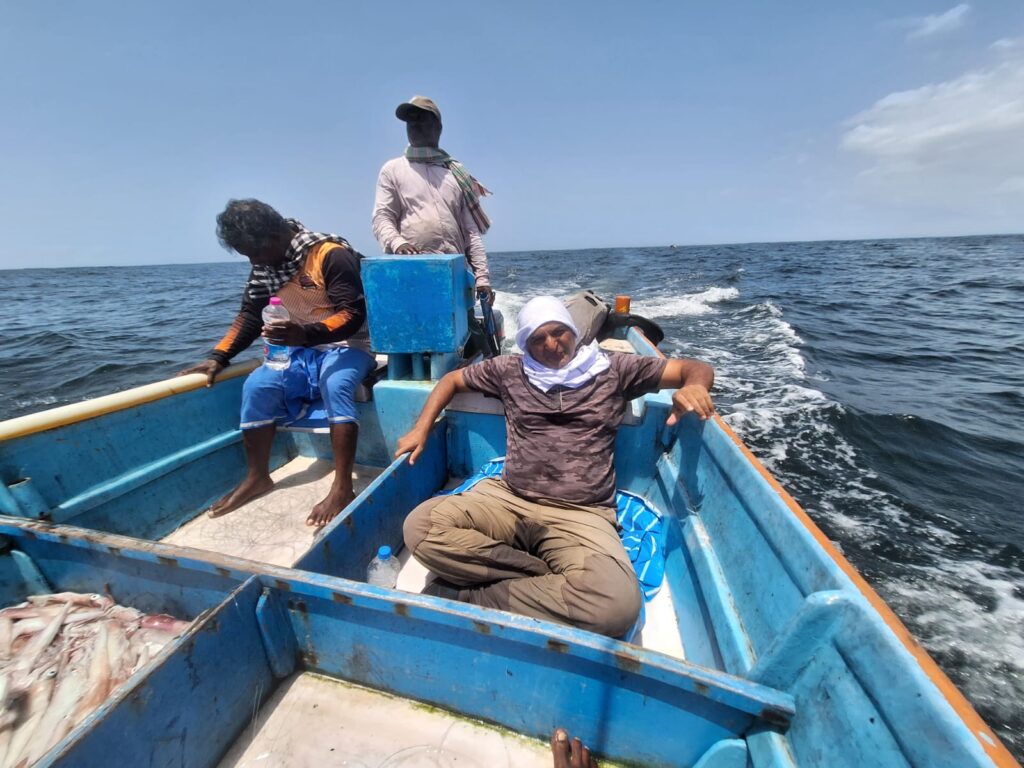
Water.
Sky.
Horizon.
Nothing else.
I found myself wondering how these fishermen navigated.
There were no visible markers.
No mountains.
No towers.
No signboards.
Yet none of them appeared uncertain.
Years of experience had become their compass.
Then something unexpected happened.
As daylight spread, dozens of boats slowly became visible.
Then more.
Soon I could count nearly a hundred fishing boats scattered across the horizon.
Each one was heading towards its own fishing ground.
Oddly enough, seeing those boats comforted me.
Until then, I had felt isolated with five strangers in the middle of an endless sea.
Now it felt like I had unknowingly become part of a much larger floating community.
Hundreds of fishermen.
Hundreds of stories.
All beginning before sunrise.
One of the fishermen looked towards me and smiled.
In hesitant Hindi he asked,
“Naam?” add hindi version
I replied, “Jayant.”
He smiled again.
Me “Sajan.”
We shook hands.
That was all the introduction we needed.
Over the next few hours, language would become increasingly irrelevant.
Their work spoke louder than words.
Without any announcement, the atmosphere on the boat changed.
The men became intensely focused.
Each fisherman picked up what appeared to be a long nylon fishing line attached to specially designed squid hooks unlike anything I had seen before.
There was no shouting.
No confusion.
No instructions.
Each person knew exactly what to do.
Almost simultaneously, the hooks disappeared beneath the water.
Looking around, I noticed every other boat was doing precisely the same thing.
From a distance, it looked like a carefully choreographed dance spread across the Arabian Sea.
Hundreds of boats.
Hundreds of fishermen.
Thousands of hooks descending into the deep blue water together.
The choreography had probably been perfected over generations.
Then came the moment I will never forget.
One fisherman suddenly jerked his line upward.
His hands moved with astonishing speed.
Within seconds, the first squid burst out of the water.
Before I could even process what had happened, it released a cloud of black ink into the air.
The fisherman calmly removed it from the hook and dropped it into a designated section of the boat.
Within moments, another squid emerged.
Then another.
Soon all five fishermen were pulling in squids at incredible speed.
Their movements became almost rhythmic.
Lower.
Pull.
Remove.
Drop.
Repeat.
It was relentless.
The boat slowly began filling with squids of every imaginable colour and size.
Pink ones.
Brown ones.
White ones.
Striped squids.
Occasionally, a large yellowish squid would emerge, drawing smiles from the crew.
Every catch reflected years of skill rather than luck.
I watched the squids carefully.
Unlike many fish that continue struggling for quite some time after being caught, the squids seemed confused.
One moment they were in the deep sea.
The next, they lay on the wooden floor of the boat.
They released ink instinctively, perhaps believing it would help them escape.
But there was nowhere left to go.
Within a surprisingly short time, they became still.
For a brief moment, I found myself torn between two emotions.
I was genuinely happy watching the fishermen celebrate each successful catch.
Every squid represented food on someone’s table, school fees for a child, fuel for the next journey, and another day’s livelihood.
Yet I also couldn’t ignore the quiet tragedy unfolding before my eyes.
Each squid had simply been living its life moments earlier.
Nature has never been sentimental.
Predator and prey have always existed together.
Human beings are also part of that cycle.
Still, witnessing it so closely evokes emotions that no documentary can ever replicate.
I wasn’t there to judge.
Nor was I there merely to admire.
I was there to understand.
And as the Arabian Sea gently rocked our little boat beneath the morning sun, I realised that this journey was about much more than fishing.
It was about entering a world that most of us benefit from every day, yet rarely take the time to truly see.
In Part 2, the story moves beyond the catch and into the human side of the voyage… sharing lunch with the fishermen, seeing dolphins in the open sea, returning to Vizhinjam Harbour, witnessing the lively fish auctions, and discovering the remarkable value chain that begins long before seafood reaches our plates. It also begins to reveal the quiet pride, resilience, and camaraderie of the fishing community.
Life Between the Waves
Lunch, Dolphins and the Journey Back to Shore
By now, nearly three hours had passed since we had left Vizhinjam Harbour.
Something inside me had changed.
The nervous stranger who had cautiously climbed into the boat at four in the morning had quietly disappeared.
In his place was an observer…curious, fascinated, and increasingly comfortable in a world that only a few hours earlier had felt intimidating.
The sea had accepted me.
Or perhaps, I had finally accepted the sea.
The fishermen continued their work with extraordinary discipline. Every movement appeared effortless, yet I knew it was the result of years…perhaps decades…of experience. They rarely spoke while fishing. There was no unnecessary conversation. Every few minutes one of them would lower the squid jig into the water, feel the slightest resistance through the nylon line, and in one swift motion pull another squid from the depths.
Watching them was like watching musicians in an orchestra.
No conductor.
No written score.
No verbal instructions.
Yet every movement was perfectly synchronized.
Each fisherman instinctively knew when to cast, when to retrieve, when to untangle a line, and when to simply wait.
For them, this wasn’t adventure.
It was routine.
This was their office.
Their factory.
Their classroom.
Their livelihood.
And the Arabian Sea was both their employer and their greatest uncertainty.
The waves that had frightened me earlier had now become strangely comforting.
The boat climbed each swell before gently sliding down the other side.
Sometimes the engines would be switched off completely.
Silence would suddenly surround us.
Only the sound of waves gently hitting the wooden hull remained.
Initially, this used to worry me.
Why would anyone switch off the engine in the middle of the open sea?
Soon I realised there was a wisdom I didn’t understand.
The fishermen knew the sea far better than any GPS could.
They understood the currents.
They understood the wind.
They knew when nature itself could do the work.
Instead of fighting the sea, they allowed it to carry them.
The engines remained silent while the currents slowly nudged the boat into position.
Not a drop of diesel was wasted unnecessarily.
I couldn’t help thinking that perhaps modern society has forgotten something these fishermen still remember.
We constantly try to dominate nature.
They work with it.
By late morning the sun had climbed high above us.
Its reflection on the water was dazzling.
The breeze remained pleasant, but the heat was steadily increasing.
One of the fishermen handed me a thorthu…the traditional cotton towel used across Kerala.
I had also carried a kaila, the traditional garment wrapped around the waist, as a small gift for each member of the crew before we left the harbour.
The gifts had unexpectedly delighted them.
Every now and then another fishing boat would pass close to ours.
The fishermen would shout something in Malayalam.
My companions would proudly hold up the folded kaila and thorthu, smiling like children showing a newly received prize.
I didn’t understand a single word being exchanged.
But I understood every smile.
One fisherman pointed towards me with obvious pride.
Although I couldn’t understand the conversation, I later gathered that he was telling the others,
“This man has come all the way from Mumbai to spend a day with us.”
It humbled me.
In reality, I was the fortunate one.
I had come seeking an experience.
They had welcomed a complete stranger into their workplace without hesitation.
The language barrier slowly dissolved.
One fisherman pointed towards me.
“Family?”
I smiled.
“Yes.”
Another asked,
“Work?”
I tried explaining in broken English mixed with gestures.
“I teach… university… students.”
Blank expressions.
I tried again.
“Teacher.”
Suddenly every face lit up.
“Teacher!”
The word required no translation.
Then came another question.
“Why… fishing?”
I paused.
How does one explain curiosity?
How do you explain spending twenty thousand kilometres cycling around India to understand climate change?
How do you explain believing that learning happens outside classrooms?
I simply smiled.
“Learning.”
One of them nodded.
Perhaps he understood.
Or perhaps he was simply being polite.
Either way, the answer seemed enough.
By afternoon, fishing slowed down.
The boat had accumulated several hundred squids.
The excitement gradually gave way to fatigue.
Hands that had moved tirelessly for hours finally rested.
Lunch boxes emerged from different corners of the boat.
My contribution looked rather unimpressive.
A few bananas.
Some apples.
A bottle of water.
The fishermen, however, had come prepared.
Steel tiffin carriers were opened.
The aroma immediately filled the salty air.
Rice.
Spicy fish curry.
A fiery mango chutney.
Simple food.
Honest food.
Food earned through labour.
Without a second thought they invited me to share their meal.
I hesitated only briefly before accepting.
Eating on a fishing boat turned out to be far more challenging than I had imagined.
The boat never stopped moving.
Each wave gently shifted the floor beneath us.
Balancing a plate while trying not to spill curry into the sea became an art in itself.
By then I was beginning to feel slightly nauseous.
Not enough to ruin the experience.
Just enough to remind me that the sea was still in charge.
Even so, I was determined not to miss this moment.
There are some meals in life whose taste comes less from the ingredients and more from the company.
This was one of them.
I shared my bananas and apples.
They shared their lunch.
No common language.
No formal introductions.
Yet somehow we understood one another perfectly.
After lunch, the dishes were washed using sea water.
Fish bones went back into the ocean.
Banana peels followed.
Everything biodegradable returned to the ecosystem that had provided the meal in the first place.
Nothing felt wasteful.
Nothing felt artificial.
It was a quiet reminder of a circular relationship with nature that many modern lifestyles have almost forgotten.
The afternoon sun became relentless.
The thorthu now proved invaluable.
I wrapped it around my head like the fishermen did.
Every few minutes I poured sea water over it.
The wind passing over the wet cloth created a remarkably cooling effect.
It felt almost like wearing a natural air conditioner.
Simple knowledge.
Born not from laboratories but from generations of experience.
Around two in the afternoon the fishermen looked at one another.
Without saying much, they knew it was time to return.
The engines started again.
This time something surprised me.
During fishing they had used only one engine at low speed.
Now both engines roared simultaneously.
The boat surged forward with astonishing power.
Spray flew high into the air.
The shoreline, invisible all day, slowly began returning to the horizon.
The journey back felt entirely different.
The uncertainty of the morning had been replaced by familiarity.
The sea no longer seemed endless.
It felt almost welcoming.
About ten kilometres from the coast, something extraordinary happened.
One of the fishermen suddenly pointed towards the water.
Everyone looked in the same direction.
For a brief moment I saw nothing.
Then the sea exploded.
A magnificent dolphin rose gracefully above the surface before disappearing again beneath the waves.
Seconds later it surfaced once more.
Closer this time.
Larger than I had ever imagined.
Until then, dolphins had existed for me only in documentaries and wildlife films.
Seeing one in its natural habitat was profoundly different.
There was no background music.
No narrator.
No dramatic camera angles.
Just a magnificent wild animal effortlessly moving through the Arabian Sea.
For a few precious seconds, all six of us simply watched.
No one spoke.
Some moments deserve silence.
Gradually the coastline of Kerala grew clearer.
Buildings emerged.
Fishing boats became more frequent.
Then, rising prominently above everything else, I saw the massive structures of the Vizhinjam International Seaport.
Its breakwaters stretched confidently into the sea.
Huge cranes stood against the skyline.
It looked modern.
Impressive.
Powerful.
A symbol of India’s aspirations as a global maritime nation.
Yet as we approached the harbour, conversations with James and some of the fishermen echoed in my mind.
They believed the construction had altered local wave patterns and currents, making fishing in nearby waters more difficult.
Whether every change could scientifically be attributed to the port or whether multiple environmental factors were interacting, one thing was undeniable.
The fishermen perceived that their sea had changed.
And perception matters because livelihoods depend upon it.
The harbour itself was a spectacle unlike anything I had witnessed before.
Boats arrived almost simultaneously from different directions.
Each carried a completely different catch.
One boat unloaded crabs.
Another carried pomfrets.
Some returned with tuna.
Others with sardines.
Our boat was filled almost entirely with squid.
As soon as we docked, the pace of activity became astonishing.
Large plastic baskets were quickly loaded.
Strong men lifted them effortlessly onto their shoulders.
Within seconds they disappeared into the auction area.
I followed.
What unfolded before me was one of the most fascinating marketplaces I had ever seen.
Every species had its own group of buyers.
Auctioneers stood beside baskets overflowing with the day’s catch.
In rapid-fire Malayalam they announced the type of fish and called out opening prices.
The crowd responded instantly – Voices rose from every direction.
One bidder shouted a price – Another immediately increased it.
The auctioneer repeated the highest bid with remarkable speed.
Within minutes a deal was struck.
The basket changed hands.
The next basket arrived.
And the process began all over again.
There was no confusion despite the apparent chaos.
Everyone knew exactly what they were doing.
Watching closely, I realised that the fishing boat represented only the very first step in a remarkably sophisticated value chain.
Long before seafood reaches restaurants, supermarkets, or dining tables, countless invisible hands contribute to the journey.
The fishermen brave uncertain seas before dawn.
Auctioneers connect supply with buyers.
Wholesalers distribute the catch.
Transporters ensure freshness through cold chains.
Retailers reach neighbourhood markets.
Restaurants transform the harvest into meals.
Consumers finally enjoy what began as a long day in the Arabian Sea.
We often see only the final plate.
Rarely do we appreciate the extraordinary human effort behind every bite.
Standing in the middle of that bustling auction yard, surrounded by voices, baskets, ice, seawater, and relentless activity, I felt something I hadn’t expected.
Respect.
Not just for the fishermen who had welcomed me onto their boat.
But for an entire community whose labour remains largely invisible to those of us living comfortably inland.
The day had begun as an adventure.
It ended as an education.
I had boarded the boat hoping to understand how fishermen catch squid.
I returned having glimpsed something far more valuable.
I had witnessed a way of life built on skill, patience, trust, community, and an intimate relationship with the sea…one that feeds millions of people every day, yet is increasingly threatened by forces far beyond the control of those who depend on it.
As I walked away from the harbour that afternoon, I knew the story wasn’t really about fishing anymore.
The deeper story was about people.
And about a sea that is quietly changing.
.
When the Sea Begins to Change
The Invisible Crisis Facing Vizhinjam’s Fishermen
As I walked through the bustling fish auction at Vizhinjam Harbour, watching baskets of squid disappear within minutes, I couldn’t stop thinking about a conversation I had with James before we left for sea.
He had said something that sounded simple.
“This year, there is very little fish.”
He wasn’t angry.
He wasn’t complaining.
He simply stated it as a fact.
Then he added something that stayed with me throughout the day.
“By this time of the year, we should have landed fish worth crores. This year… it is much less.”
I asked him why.
He shrugged.
“It is hotter.”
“There is less fish.”
“We don’t know why.”
That answer perfectly captures the reality of thousands of small-scale fishermen across India’s coastline.
They are experiencing the consequences.
They are living the changes.
But they do not always know the science behind those changes.
Ironically, they probably understand the sea better than most scientists.
Yet climate change is altering the rules of a game they have mastered over generations.
The Sea They Knew Is No Longer the Same
For centuries, fishing communities have depended upon an intimate understanding of nature.
They know when certain fish arrive.
They know how currents behave.
They know how the wind changes before a storm.
They know the colour of water that indicates the presence of squid.
Their knowledge is not written in books.
It is written in memory.
Passed from one generation to another.
But climate change is disrupting that memory.
The Arabian Sea is warming faster than it did a few decades ago. Marine scientists have documented an increase in marine heatwaves—extended periods during which sea surface temperatures remain unusually high. These warming events alter plankton productivity, change fish migration routes, reduce dissolved oxygen in some areas, and affect breeding cycles. Even species that have followed predictable seasonal patterns for generations are beginning to behave differently.
For a fisherman, this means something very practical.
The fishing ground that reliably produced squid or mackerel for twenty years may suddenly produce almost nothing.
Not because the fisherman forgot his skill.
But because the fish have moved.
When El Niño Meets the Arabian Sea
Climate scientists often speak about El Niño.
For most urban residents, it is just another weather term.
For fishermen, it can determine whether their families have enough income that season.
El Niño changes sea surface temperatures across the Pacific Ocean, but its influence extends into the Indian Ocean through complex atmospheric and oceanic interactions.
These changes can weaken monsoon systems, increase marine temperatures, alter nutrient upwelling, and reduce ocean productivity.
If plankton decreases, smaller fish decline.
When smaller fish decline, larger fish move elsewhere.
Eventually, fishermen find themselves travelling farther from the coast while spending significantly more on diesel, labour and time.
The fish have not disappeared.
They have simply changed their address.
Marine Heatwaves: A Silent Disaster
Unlike cyclones or tsunamis, marine heatwaves have no dramatic headlines.
The sea looks perfectly normal.
There are no giant waves.
No destruction visible to the naked eye.
Yet beneath the surface, ecosystems are under immense stress.
Marine heatwaves influence coral reefs, plankton communities, squid, sardines, mackerel, tuna and many commercially important species.
The eastern Arabian Sea, including the Kerala coast, has emerged as one of the hotspots for these warming events, with researchers linking long-term warming trends to anthropogenic climate change while also recognising the influence of natural climate variability such as El Niño.
The fishermen may not know the phrase “marine heatwave.”
But when they say,
“The sea has become hotter.”
they are describing exactly what science is measuring.
The Numbers Tell the Same Story
What I heard on the boat is increasingly reflected in official fisheries data.
According to the ICAR-Central Marine Fisheries Research Institute (CMFRI), India’s marine fish landings declined from 3.53 million tonnes in 2023 to 3.47 million tonnes in 2024, a reduction of about 2%. Kerala’s marine landings fell from approximately 6.33 lakh tonnes to 6.10 lakh tonnes, a decline of nearly 4%. Researchers linked these changes to multiple factors, including cyclones, increased marine heat, changing ocean conditions and shifts in species availability.
The decline was not uniform across all species.
Some species increased.
Others declined sharply.
Indian mackerel landings in Kerala dropped significantly, while catches of cephalopods…. including squid in several regions….. also showed reductions at the national level.
These numbers may appear modest.
Four percent.
Two percent.
But imagine a small fisherman whose earnings already fluctuate dramatically with weather, fuel prices and market demand.
A four percent decline in catch can translate into a much larger decline in household income.
Development and the Sea: A Difficult Conversation
As we approached Vizhinjam Harbour, the massive breakwaters of the new international port dominated the skyline.
From an engineering perspective, it is an extraordinary achievement.
India’s first deep-water transshipment port has the potential to reduce dependence on foreign ports, create employment, improve logistics and strengthen India’s maritime economy.
These are important national objectives.
But every large infrastructure project also changes landscapes.
And when that landscape is the coastline, even subtle alterations in wave patterns, sediment transport and coastal currents can become deeply significant for nearby communities.
Many fishermen in Vizhinjam believe that the port has changed local currents, affected traditional fishing grounds and accelerated coastal changes in some locations.
Scientists continue to study these issues. CMFRI itself has undertaken long-term monitoring of fish landings and ecological conditions around the Vizhinjam project area specifically to understand whether and how port-related activities influence marine fisheries.
The important point is not to reduce the discussion to “the port caused everything” or “the port caused nothing.”
Reality is more complicated.
Climate change.
Coastal infrastructure.
Changing currents.
Fishing pressure.
Pollution.
Extreme weather.
All interact with one another.
For the fisherman, however, the outcome is simple.
The sea he depends upon is becoming less predictable.
The Competition They Never Asked For
Climate change is only one challenge.
Another arrives every morning from the horizon.
Industrial fishing.
The fishermen with whom I spent the day represent India’s artisanal fishing tradition.
Their boats are modest.
Their crews are small.
Their catches depend upon skill rather than technology.
But across many parts of India’s coastline, industrial fleets equipped with larger vessels, sophisticated navigation systems, sonar, refrigeration facilities and powerful gear operate on an entirely different scale.
While mechanised fishing contributes substantially to India’s seafood economy, concerns have long been raised about excessive fishing effort in some coastal waters, bycatch, habitat disturbance from certain fishing methods and growing competition for nearshore resources. Sustainable fisheries management has therefore become a major focus of fisheries policy and research.
The imbalance is evident.
One side fishes to live.
The other often fishes to maximise volume and market efficiency.
Neither is inherently “good” or “bad.”
Both respond to economic incentives.
Yet the ecological consequences are not always equal.
Small-scale fishermen cannot compete indefinitely with larger, more capital-intensive operations if fish stocks continue to decline.
More Fuel. More Risk. Less Return.
Every additional kilometre travelled into the sea has a cost.
Fuel.
Time.
Engine maintenance.
Food.
Labour.
Safety.
If fish move farther offshore because of warming waters or changing ecological conditions, fishermen are forced to chase them.
That increases operational costs while exposing them to greater weather risks.
The irony is painful.
Climate change is making fishing more expensive precisely when catches are becoming less predictable.
Many families find themselves caught in an economic trap.
Higher costs.
Lower certainty.
The sea demands more.
The market pays little more.
The Knowledge We Risk Losing
During my journey, I was deeply impressed by how these fishermen read the sea.
They understood currents without instruments.
They interpreted waves without satellite data.
They could predict subtle changes invisible to me.
This traditional ecological knowledge is itself a valuable national resource.
But what happens when nature changes faster than inherited knowledge can adapt?
What happens when the sea no longer behaves as it did for previous generations?
Perhaps the greatest loss would not simply be fewer fish.
It would be losing a culture built around understanding the rhythms of nature.
As our conversations on the boat echoed in my mind, I realised something profound.
The fishermen of Vizhinjam are not asking for sympathy.
They are asking for a future in which they can continue doing what their families have done for generations.
They do not oppose development.
They simply hope development does not come at the cost of their survival.
They do not deny progress.
They simply ask that progress also includes those whose lives are woven into the sea.
Standing on the harbour that evening, watching one auction after another conclude within minutes, I realised that every basket of fish represented far more than a commercial transaction.
It represented uncertainty.
Hope.
Generations of knowledge.
And an increasingly fragile relationship between human ambition and the natural systems upon which all economies ultimately depend.
The greatest challenge facing Vizhinjam’s fishermen is therefore not merely declining fish catches.
It is learning to navigate an ocean whose currents are changing—not only because of nature, but also because of the choices humanity is making on land.
This part intentionally presents a balanced perspective. It acknowledges the economic importance of the Vizhinjam Port while avoiding unsupported claims that it alone is responsible for changes in fish catches, reflecting the current state of scientific evidence.
Here’s the concluding part, bringing together your lived experience, your cycling journey, and a broader reflection on humanity’s relationship with nature.
Change Before Climate Change
What the Arabian Sea Taught Me
As I drove away from Vizhinjam Harbour that evening, my clothes had dried, but my thoughts had not.
I had set out early that morning believing I was going on a fishing trip.
Instead, I had returned from a classroom.
The teachers were five fishermen.
The classroom was the Arabian Sea.
And the lesson was about much more than fish.
Throughout my 20,000-kilometre cycling journey across India’s borders for the cause of Change Before Climate Change, I have often found myself asking a simple question:
What does development really mean?
Is development measured only by the number of highways we build?
The number of ports we construct?
The size of our airports?
The height of our buildings?
The growth of our GDP?
Or should development also be measured by the health of our rivers, forests, wetlands, coastlines, and oceans?
Should it also be measured by whether the people who have lived in harmony with nature for generations can continue to live with dignity?
This question followed me throughout my journey across India.
I saw rivers that had become drains.
Forests fragmented into isolated patches.
Mountains blasted for roads.
Wetlands reclaimed for real estate.
Plastic reaching villages where modern healthcare had not yet reached.
Everywhere I travelled, I met people adapting to environmental changes they had never caused.
The fishermen of Vizhinjam are one more chapter in that larger story.
During my cycling journey, I often met communities who could not explain climate science.
They had never heard terms like “marine heatwaves,” “anthropogenic emissions,” or “ocean acidification.”
But they knew something had changed.
Farmers told me that rains no longer arrived when they once did.
Herders spoke of drying grasslands.
People living in the Himalayas described shrinking glaciers.
Forest communities noticed flowering seasons shifting.
And now, on the Arabian Sea, fishermen quietly told me,
“There are fewer fish.”
Science gives us the explanation.
Communities give us the evidence.
The two stories are remarkably similar.
Human activities—particularly the burning of fossil fuels, changes in land use and unsustainable patterns of production and consumption—are warming the planet and altering ecosystems on which livelihoods depend.
Yet there is another question that this journey forced me to confront.
Who is really consuming nature?
It is easy to point fingers at industries.
Governments.
Corporations.
Policies.
But every supply chain ultimately begins with a consumer.
Someone buys.
Someone demands.
Someone wants more.
Our economy is remarkably successful at encouraging us to consume.
Consume faster.
Consume newer.
Consume bigger.
Consume endlessly.
Economic growth has lifted millions out of poverty and created opportunities that previous generations could scarcely imagine.
That progress matters.
But when growth becomes disconnected from ecological limits, we begin to mistake extraction for prosperity.
Nature, however, has never functioned according to quarterly business results.
The sea follows seasons.
Fish breed according to ecological rhythms.
Mangroves grow at their own pace.
Coral reefs cannot be rushed.
No amount of investment can persuade a fish population to recover before nature is ready.
There is a profound difference between harvesting nature and exhausting it.
Somewhere along the way, humanity has begun confusing the two.
Watching those fishermen, I realised something that deeply humbled me.
They are not merely extracting resources from the sea.
Every morning, they place their lives in the hands of nature.
The sea decides whether they return with abundance.
Or almost nothing.
Every wave reminds them that human beings are never fully in control.
Perhaps that is why they respect the sea in ways many of us no longer understand.
Modern society often behaves differently.
We straighten rivers.
Level mountains.
Drain wetlands.
Build over floodplains.
Construct ports.
Expand cities.
Increase production.
Increase consumption.
Increase waste.
Then, when nature responds with floods, droughts, coastal erosion or declining biodiversity, we describe these events as disasters.
But perhaps many of them are also conversations.
Nature responding to the choices we have collectively made.
This is not an argument against development.
India needs better infrastructure.
Modern ports are vital for trade.
Efficient logistics strengthen the economy.
Employment opportunities matter.
Communities deserve prosperity.
The question is not whether development should happen.
The question is how it should happen.
Can we design development that works with nature instead of against it?
Can engineers, ecologists, economists, local communities and policymakers sit at the same table before decisions are made?
Can environmental impact assessments become living processes rather than regulatory formalities?
Can the people who know the sea best—the fishermen themselves—be recognised not merely as stakeholders, but as knowledge holders?
Progress and ecology should never be seen as opposing forces.
The future belongs to societies that learn to integrate both.
Another thought stayed with me long after I returned.
Every squid that reached my dinner plate that evening had travelled through an extraordinary journey.
It had lived in the deep Arabian Sea.
A fisherman had located it.
A family had depended on that catch.
It had been auctioned.
Transported.
Stored.
Sold.
Cooked.
Consumed.
We rarely think about this invisible chain.
Food appears in supermarkets wrapped in plastic.
Fish arrives neatly arranged on ice.
The labour disappears.
The uncertainty disappears.
The ocean disappears.
Perhaps that is why we have become disconnected from the true value of what we consume.
When we no longer see the effort behind our consumption, consumption itself becomes effortless.
And effortless consumption often becomes excessive consumption.
Research increasingly points to overconsumption as one of the underlying drivers of environmental degradation, alongside the energy systems and economic structures that support it. Many experts argue that solving the climate crisis requires not only cleaner technologies but also more thoughtful patterns of production and consumption. (NRDC)
As I reflect upon that day in the Arabian Sea, I no longer remember only the dolphins.
Or the sunrise.
Or the squid.
Or even the exhilaration of travelling thirty-five kilometres into open water.
What I remember most are the smiles.
The fishermen proudly showing their kaila and thorthu to neighbouring boats.
The simple lunch we shared.
The broken conversations that somehow communicated far more than fluent language ever could.
Their quiet dignity.
Their resilience.
Their faith that tomorrow they would once again venture into the sea before sunrise.
Those moments reminded me that sustainability is not merely about carbon emissions or renewable energy.
It is about people.
It is about livelihoods.
It is about preserving knowledge accumulated over generations.
It is about ensuring that communities who have lived closest to nature are not pushed furthest from the future.
My journey of 20,000 kilometres taught me one lesson over and over again.
Whether I was cycling through the Himalayas, the deserts of Rajasthan, the forests of the Northeast, the wetlands of Kerala or now sailing across the Arabian Sea, nature keeps repeating the same message.
Everything is connected.
A warmer ocean influences fish.
Fewer fish affect fishermen.
Struggling fishermen affect coastal economies.
Changing coastlines affect communities.
Unsustainable consumption affects the climate.
And the climate eventually affects every one of us.
Climate change is not merely an environmental issue.
It is an economic issue.
A social issue.
A cultural issue.
A food security issue.
A public health issue.
Above all, it is a relationship issue.
It asks one fundamental question:
Can humanity learn to live as a part of nature rather than behaving as though it exists apart from it?
As I left Vizhinjam Harbour, one thought stayed with me.
Perhaps the greatest lesson the fishermen taught me was not how to catch squid.
It was how to recognise that the sea is not simply a resource to be exploited.
It is a living system that feeds us, protects us and sustains us.
If we continue to consume without respecting its rhythm, we may eventually discover that the greatest scarcity is not fish.
It is wisdom.
And perhaps that is why my journey continues to carry the same message it did when I first set out on a bicycle to travel around India’s borders:
Change Before Climate Change.
Because once nature is forced to change beyond its limits, humanity will spend generations trying to recover what we failed to protect.
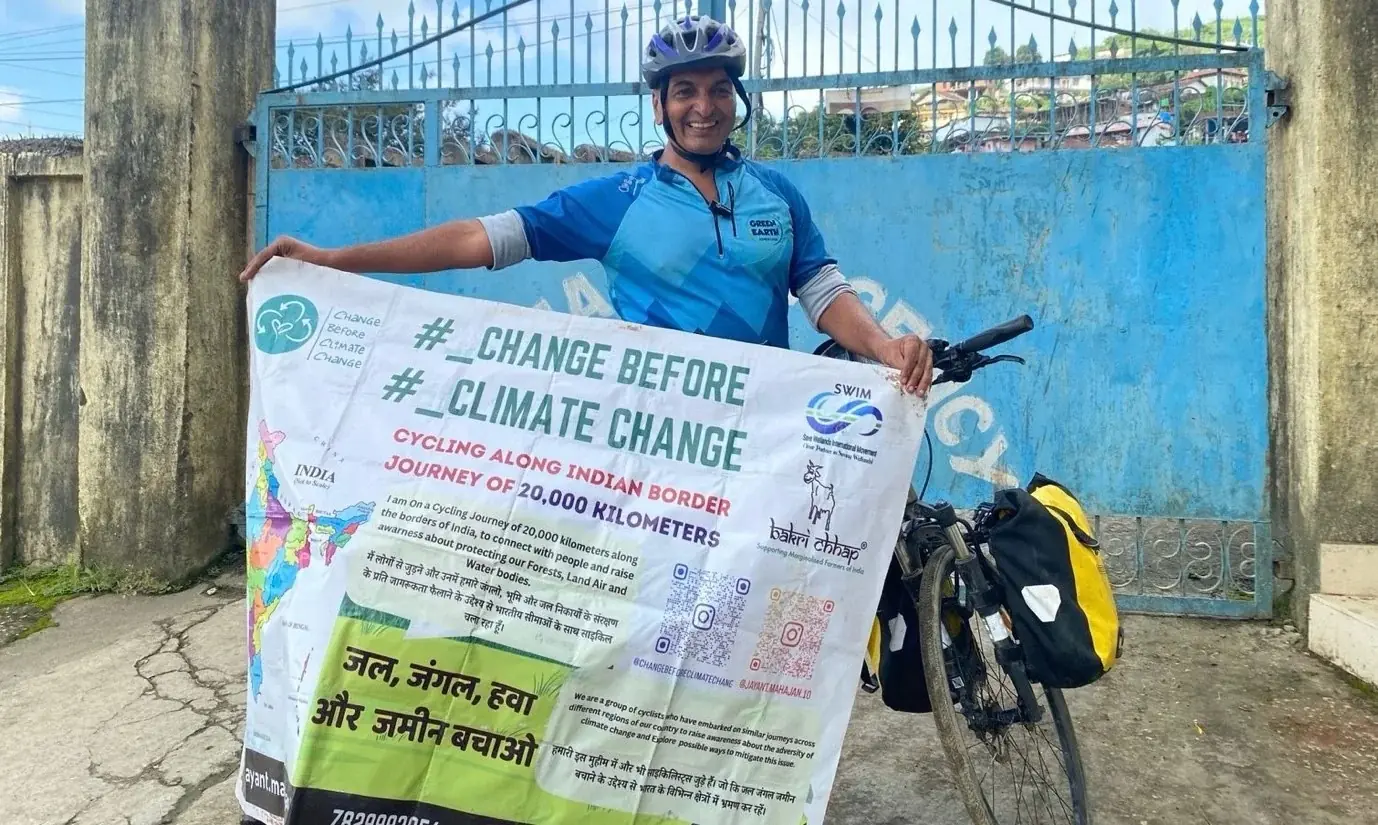
Jayant Mahajan is a writer and contributor at PuneNow, covering the intersection of technology, climate action, and urban governance across Pune. With an extensive background in business management, digital transformation, and academia, Jayant brings real-world insight to local sustainability issues, from civic infrastructure to smart city data ethics. As an educator and founder of the Change Before Climate Change mission, he focuses on how Pune’s institutions and businesses can build future-ready, sustainable systems. Through his columns, Jayant bridges policy, technology, and practical action to help Punekars navigate a rapidly changing urban climate.