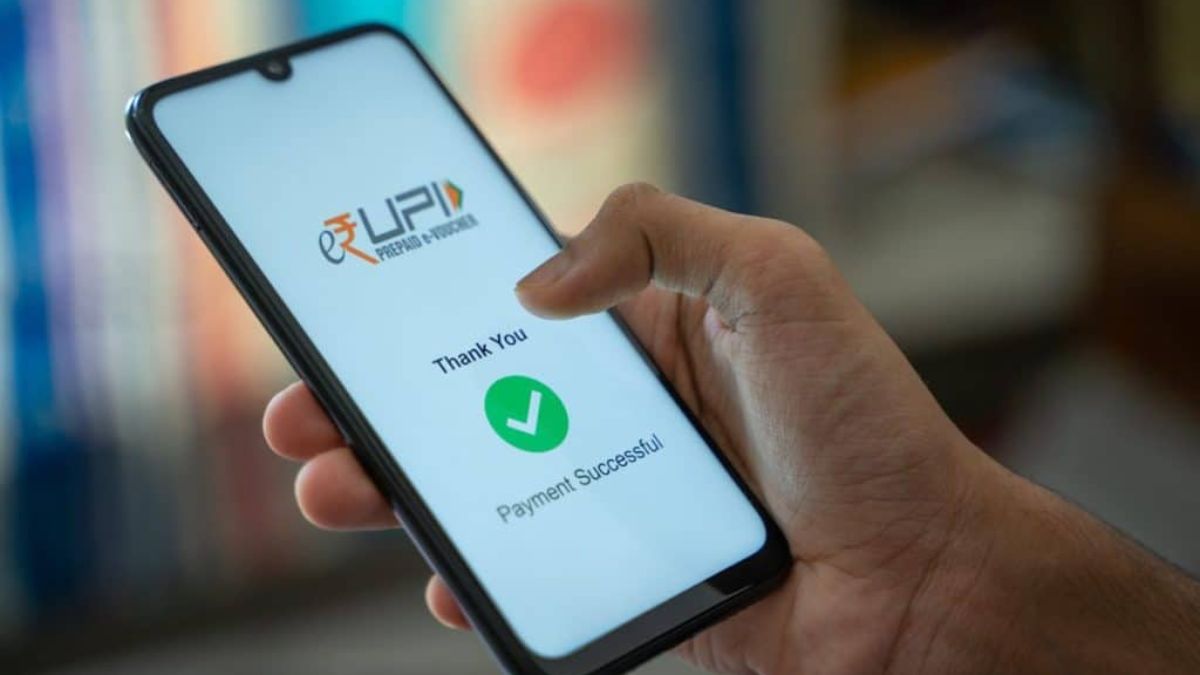

New Delhi: The Central government has formally notified that no bank or payment system provider can levy any charge, either directly or indirectly, on UPI transactions of up to Rs 2,000, bringing clarity after a recent amendment to the Payment and Settlement Systems Act during the monsoon session of the Parliament had triggered concern over the possible return of charges on digital payments.

The notification, issued by the Ministry of Finance’s Department of Financial Services on September 14, specifies two electronic payment modes under Section 10A of the Payment and Settlement Systems Act, 2007 — debit cards powered by RuPay and Unified Payments Interface (UPI) transactions up to Rs 2,000.
Crucially, the notification states that no bank or system provider can impose “whether directly or indirectly” any charge on a person making or receiving payments through these specified modes. This means UPI transactions up to Rs 2,000 will continue to remain free for both the person making the payment and the person receiving it.
The wording is significant because the amendment to Section 10A had caused widespread confusion and anticipatory concern over whether the government was preparing the ground for the introduction of a Merchant Discount Rate (MDR) on UPI transactions.
The Amendment Bill was passed by Parliament during the Monsoon Session, which concluded on August 13, 2026. The amendment provided an enabling framework for imposing MDR on payments made through UPI and other notified electronic payment modes.
Following the passage of the Bill, the government had said that the UPI and Services Steering Committee, headed by the National Payments Corporation of India (NPCI), would decide the MDR rates. This had raised questions over whether India’s long-standing zero-charge regime for UPI merchant payments was set to change.
The government had also explained the rationale for allowing charges, saying that the exponential growth in transaction volumes required significant and continuous investment in cybersecurity, fraud prevention and payment infrastructure.
The September 14 notification now provides an important distinction. While the amended law created an enabling framework relating to charges, the government has used its powers under Section 10A to specifically protect UPI transactions up to Rs 2,000 from such charges.
See the gazette order below:
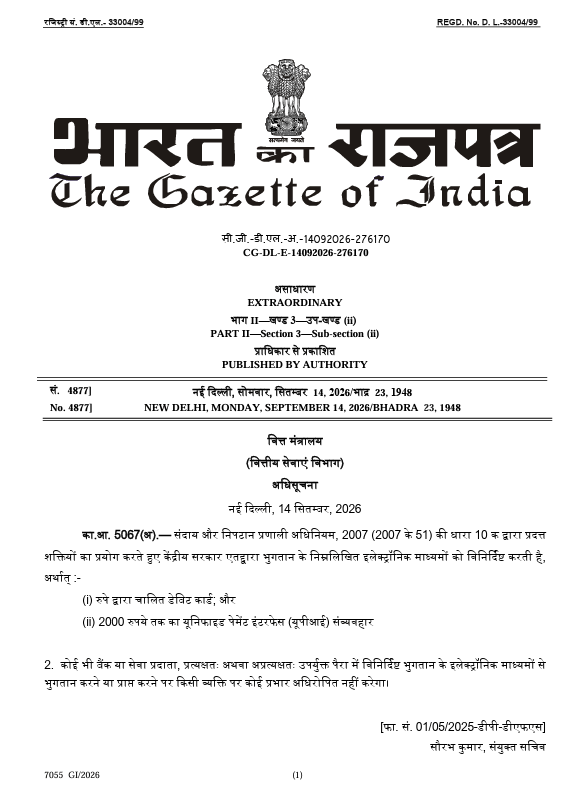
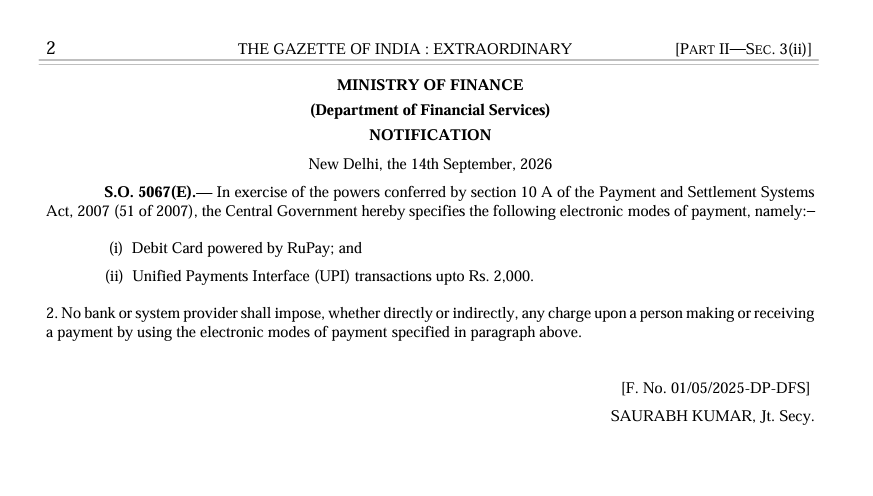
The Rs 2,000 threshold is particularly important. The Gazette notification explicitly covers “Unified Payments Interface (UPI) transactions upto Rs. 2,000”, rather than UPI transactions generally.
This means the notification should not be read as a blanket declaration that every UPI transaction, irrespective of value, is protected from charges. It specifically guarantees the no-charge provision for transactions up to Rs 2,000. The notification itself does not specify what charging regime, if any, will apply to UPI transactions above that amount.
RuPay debit card payments have also been included in the protected category. The notification says banks and system providers cannot directly or indirectly charge a person for making or receiving payments using RuPay-powered debit cards.
For ordinary UPI users and small merchants, the notification therefore settles one of the immediate questions created by the amendment: UPI payments of Rs 2,000 or less cannot attract a charge from a bank or system provider under the notified framework.
However, the position on UPI payments exceeding Rs 2,000 remains an important issue to watch. The Gazette notification does not announce an MDR rate for such transactions, nor does it state that a charge will automatically apply above Rs 2,000. Any such conclusion would go beyond what has actually been notified.
The notification, numbered S.O. 5067(E), was issued on September 14, 2026, by the Department of Financial Services under the Ministry of Finance.