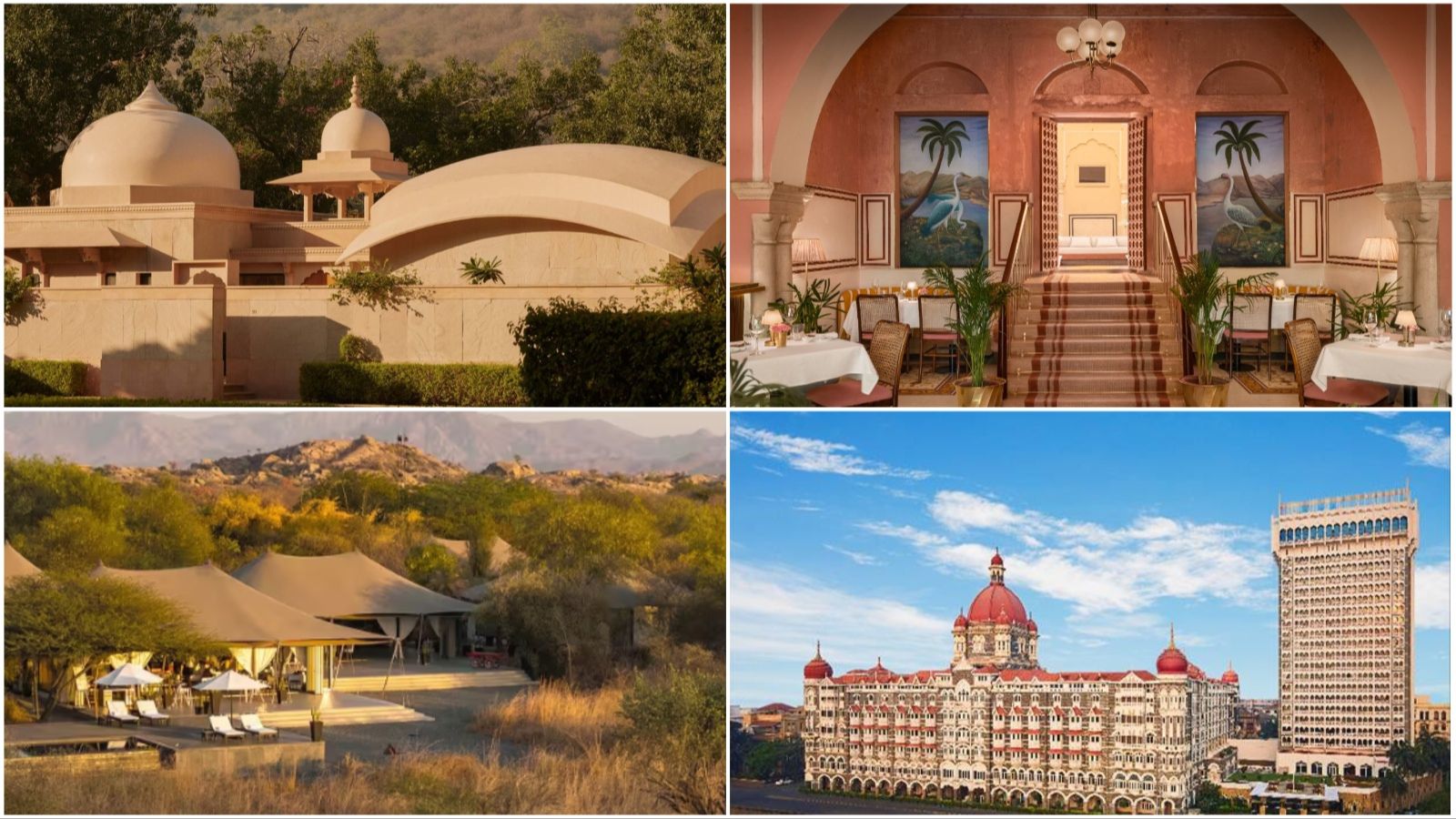

Four Indian hotels have found a place among the world’s top 100 in The World’s 50 Best Hotels 2025 rankings, with Mumbai’s iconic The Taj Mahal Palace leading the Indian contingent at No. 38.

The other three Indian properties appear in the newly introduced extended 51-100 ranking. Suján Jawai in Rajasthan is ranked No. 91, The Johri in Jaipur is at No. 93, while Amanbagh in Ajabgarh completes the list at No. 100.
At the top of the global ranking is Rosewood Hong Kong, which was named The World’s Best Hotel 2025. Four Seasons Bangkok at Chao Phraya River is ranked second and Capella Bangkok third, giving Asian hotels all three top positions.
India’s highest-ranked hotel: The Taj Mahal Palace at No. 38
The Taj Mahal Palace in Mumbai entered the 2025 list at No. 38, making it the only Indian hotel to feature in the main Top 50.
Opened in 1903 by industrialist Jamsetji Tata, the hotel was India’s first Indian-owned luxury hotel and became the starting point of the Taj hospitality group. Over more than a century, the Mumbai landmark has hosted Indian royalty, British viceroys, international dignitaries and prominent names from Hollywood and Bollywood.
Its architecture remains one of its defining features. The building, completed by English architect W.A. Chambers, is crowned by its distinctive 240-foot Florentine red dome and combines Indian, Moorish, Oriental and Renaissance influences.
Inside, the heritage character continues through marble floors, onyx columns, grand staircases, intricate latticework, hand-knotted carpets, silk drapes and crystal chandeliers.
The hotel combines its historic Palace wing with the more contemporary Tower wing and offers several restaurants, including Golden Dragon for Sichuan and Cantonese cuisine, Loya for North Indian food and Souk for Middle Eastern and Mediterranean cuisine. It is also home to The Harbour Bar, described by the hotel as Mumbai’s first licensed bar.
The 50 Best citation describes The Taj Mahal Palace as the “soul of Indian hospitality” and highlights its history, architecture and more than century-old legacy.
Three Rajasthan properties make the extended Top 100
The 2025 edition marked an important expansion of The World’s 50 Best Hotels. For the first time, the organisation published an additional ranking covering hotels placed from No. 51 to No. 100.
Three Indian properties made this inaugural extended list, and all three are in Rajasthan.
At No. 91 is Suján Jawai, a luxury tented safari camp in the Jawai wilderness. Founded by Jaisal and Anjali Singh, the property combines luxury hospitality with wildlife and conservation experiences.
Its location in the granite landscape of Jawai is known for leopard sightings. Guests can take guided wildlife drives and wilderness rides on Kathiawari and Marwari horses, while the food places an emphasis on local and seasonal ingredients. The property has built its identity around combining high-end accommodation with the landscape, wildlife and communities of the region.
At No. 93 is The Johri, a very different kind of property in the heart of Jaipur.
The boutique hotel occupies a restored 19th-century haveli in Johri Bazaar, Jaipur’s historic jewellery district. It has just five suites, with the gemstone theme of the surrounding market carried into the hotel’s interiors.
Designed by Naina Shah, the suites are named after precious stones, including Manek for ruby, Neelam for sapphire and Moti for pearl. Traditional craftsmanship, latticework and Indian art are incorporated into the interiors.
Completing India’s representation is Amanbagh, ranked No. 100.
Located at Ajabgarh in Rajasthan’s Aravalli Hills, Amanbagh occupies an area that was once used by the Maharajah of Alwar as a base for tiger hunts. The present-day retreat is characterised by rose-coloured, Mughal-inspired architecture, landscaped gardens, cupolas and vaulted entrances.
Its food programme includes North Indian and Rajasthani cuisine as well as dishes drawing on Ayurvedic traditions and locally rooted recipes.
Together, the four Indian entries are notably diverse: a 123-year-old metropolitan landmark in Mumbai, a wildlife camp in Jawai, a five-suite haveli in a busy Jaipur bazaar and a secluded luxury retreat in the Aravalli Hills.
Who publishes The World’s 50 Best Hotels?
The ranking is organised and compiled by William Reed, the UK-based company behind the broader 50 Best platform.
The hotel ranking is relatively new, having been launched in 2023, but it follows the model developed for the organisation’s established hospitality rankings, including The World’s 50 Best Restaurants and The World’s 50 Best Bars.
Rather than using hotel inspectors who award marks against a fixed checklist, The World’s 50 Best Hotels is based on votes submitted by an international academy of experienced travellers and hospitality professionals.
For the 2025 era, the academy comprised more than 800 experts drawn from around the world. The organisation divides the world into 13 geographical regions, each headed by an Academy Chair responsible for selecting voters for that region.
The panel is gender-balanced, and at least 25% of its membership is refreshed every year. Apart from the Academy Chairs, voters remain anonymous.
This makes the list different from star classifications issued by governments or inspection-based rating systems. It is essentially an expert-voted global ranking of hotel experiences rather than an official certification of hotel quality.
How are the world’s best hotels selected?
There is no fixed checklist of facilities that a hotel must provide to qualify. A small boutique property can compete for votes alongside a large international luxury resort or a century-old city hotel.
Academy members vote for seven hotels and rank their choices in order of preference. Voters must have personally stayed at the hotels they nominate within the permitted voting period and are asked to provide proof of their visit.
There are also safeguards intended to limit conflicts of interest. Voters cannot vote for hotels they own or in which they have a financial interest. Hotels cannot simply apply to enter the ranking, and properties do not have to buy products from the ranking’s commercial partners to qualify.
A hotel must also receive votes from more than one country, territory or special administrative region before it can appear in the final ranking.
The absence of fixed judging criteria means the final position reflects the collective personal judgement of the Academy rather than a numerical assessment of factors such as room size, number of restaurants, service levels or facilities.
The voting process and results are independently adjudicated by professional services firm Deloitte, which is given access to the voting process and data to perform checks on the integrity and authenticity of the results.
The ranking should therefore be viewed as an influential industry and travel reference based on expert voting, rather than as an official regulatory classification.
Which hotels topped the 2025 global ranking?
Rosewood Hong Kong took the No. 1 position in 2025 after previously finishing No. 2 in 2023 and No. 3 in 2024.
The Top 10 for 2025 is:
- Rosewood Hong Kong — Hong Kong
- Four Seasons Bangkok at Chao Phraya River — Bangkok
- Capella Bangkok — Bangkok
- Passalacqua — Lake Como
- Raffles Singapore — Singapore
- Atlantis The Royal — Dubai
- Mandarin Oriental Bangkok — Bangkok
- Chablé Yucatán — Chocholá, Mexico
- Four Seasons Firenze — Florence
- Upper House Hong Kong — Hong Kong
The results underline Asia’s strong presence in the luxury hospitality sector. Six of the Top 10 hotels are in Asia or the Middle East, including three properties in Bangkok alone.
The wider Top 50 includes several other internationally recognised properties such as Hôtel de Crillon in Paris at No. 23, Aman Tokyo at No. 25, The Connaught in London at No. 29, La Mamounia in Marrakech at No. 30 and Raffles London at The OWO at No. 31.
Against this international field, The Taj Mahal Palace’s No. 38 position gives India a place in the main World’s 50 Best Hotels ranking, while Suján Jawai, The Johri and Amanbagh extend India’s representation across the full Top 100.
The four properties also show that India’s appeal in high-end hospitality is not confined to conventional luxury hotels. The country’s entries range from historic urban hospitality and restored heritage architecture to wildlife tourism and secluded destination resorts — four very different interpretations of the Indian luxury travel experience.