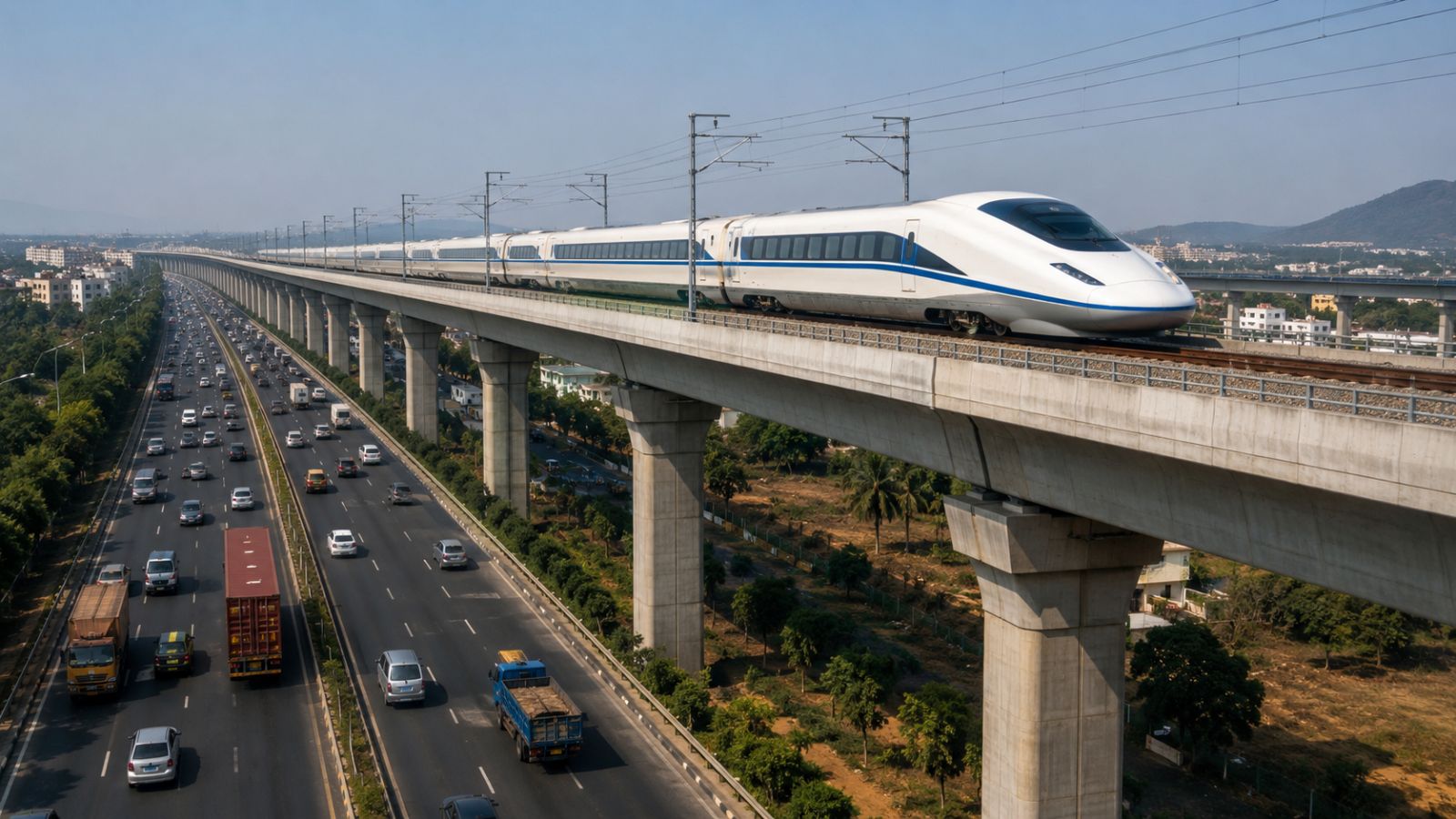

PUNE: An engineering marvel designed to redefine inter-state travel, the proposed Mumbai–Pune–Hyderabad High-Speed Rail (HSR) corridor will run directly above a major national highway.

A major bullet train station is set to be constructed right over National Highway 65 (NH65) near Loni, on the outskirts of Pune. This multi-tiered infrastructural development will enable high-speed bullet trains operating at speeds up to 320 km/h to zoom past traffic on the busy highway below, connecting 10 major urban, agricultural, and industrial centers across Maharashtra, Karnataka, and Telangana.
Once operational, the 671 km corridor will shrink the grueling 14-hour journeys between Mumbai and Hyderabad to a mere 2 hours and 55 minutes.
Loni Interchange: Where Highways and Bullet Trains Intersect
The strategic selection of Loni Kalbhor near Pune introduces a complex multi-modal transit node. The elevated station above NH65 will also intersect with the planned Hadapsar–Yavat elevated corridor, creating an integrated transit hub that minimizes land acquisition while maximizing regional mobility.
Highlights of the Loni Station Alignment:
- Elevated Structure: Station and tracks situated directly above NH65.
- Double-Corridor Crossing: Vertical crossing point with the proposed Hadapsar–Yavat elevated road.
- Minimal Land Disruption: Utilizing highway median space to reduce private land acquisition requirements.
Here is the Route Overview section formatted in text and bullet points:
Route Overview: List of Cities Covered Across 3 States
The proposed 671 km high-speed rail corridor creates a strategic transit spine connecting major commercial, industrial, and cultural hubs across Maharashtra, Karnataka, and Telangana.
Maharashtra
- Mumbai (BKC): The western economic terminal of the corridor.
- Navi Mumbai: Planned integration point near important commercial hubs and transit networks.
- Lonavala: A transit stop connecting the Western Ghats region.
- Pune (Pimpri-Chinchwad): Essential stop catering to the major automotive and industrial belt.
- Pune (Loni): Multi-modal interchange hub featuring the elevated station above NH65.
- Baramati: High-speed connection for the regional agricultural and educational hub.
- Pandharpur: High-speed rail accessibility for millions of pilgrims visiting the shrine city.
- Solapur: Major station serving the textile, manufacturing, and logistics sector.
Karnataka
- Kalaburagi: Primary commercial and educational hub connecting northern Karnataka to the high-speed network.
Telangana
- Vikarabad: Gateway transit node in western Telangana.
- Hyderabad (Kokapet / Shamshabad area): The eastern terminal connecting into Telangana’s major technology and economic hubs.
Boost for Regional & Pilgrimage Hubs
- Pandharpur: The pilgrimage city will gain seamless high-speed accessibility for millions of devotees nationwide.
- Solapur & Baramati: Solapur’s textile industry and Baramati’s agricultural-industrial belt will benefit from rapid freight-adjacent human capital mobility.
Projected Travel Times: Bullet Train vs. Conventional Rail
The 320 km/h commercial operating speed will alter regional transit times dramatically:
- Mumbai to Pune: Approx. 48 to 50 minutes (down from 3–4 hours)
- Pune to Solapur: Approx. 45 to 55 minutes (down from 4–5 hours)
- Pune to Hyderabad: Under 2 hours (down from 8–9 hours)
- Mumbai to Hyderabad: 2 hours 55 minutes (down from 12–14 hours)
Current Project Status and Next Steps
The Mumbai–Hyderabad High-Speed Rail Corridor is currently in its Detailed Project Report (DPR) refinement phase. Aligned with India’s broader high-speed rail vision following the Mumbai–Ahmedabad corridor, final alignment approvals and environmental impact assessments will pave the way for civil bidding.
Once completed, this corridor will serve as an economic backbone connecting India’s financial capital with its premier technology hub.

Jayant Mahajan is a writer and contributor at PuneNow, covering the intersection of technology, climate action, and urban governance across Pune. With an extensive background in business management, digital transformation, and academia, Jayant brings real-world insight to local sustainability issues, from civic infrastructure to smart city data ethics. As an educator and founder of the Change Before Climate Change mission, he focuses on how Pune’s institutions and businesses can build future-ready, sustainable systems. Through his columns, Jayant bridges policy, technology, and practical action to help Punekars navigate a rapidly changing urban climate.