Pune: PMC’s Anti-Encroachment Drive Continues for 9th Day; Record 2.11 Lakh Sq. M. Cleared in One Day, Tough Fines and FIRs
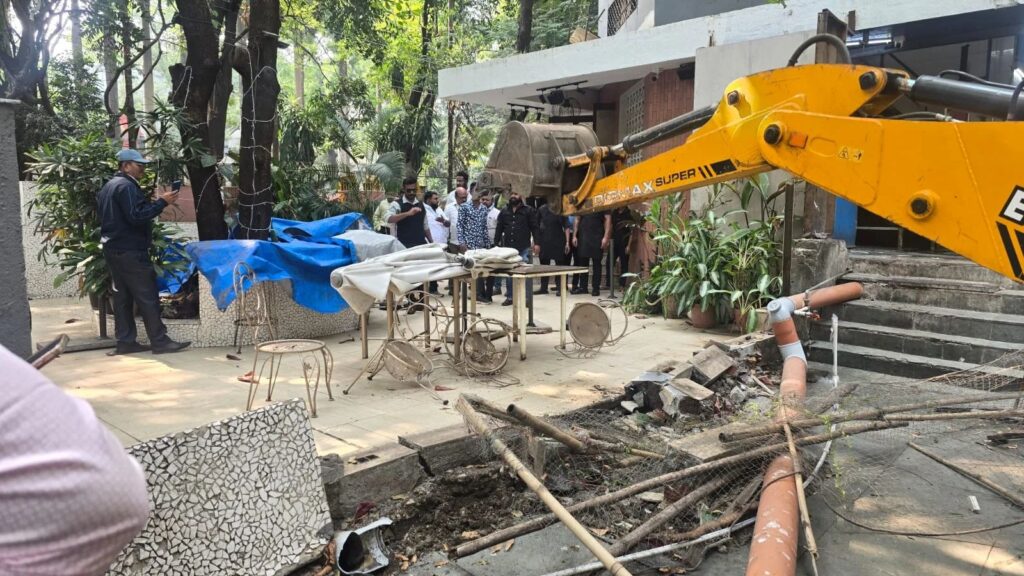

PUNE: The Pune Municipal Corporation (PMC) has intensified its city-wide anti-encroachment campaign, combining large-scale demolition drives with stricter penalties for garbage violations, illegal commercial activity and unauthorised advertisements. The campaign, which began on November 16, reached a major milestone on November 23, when the civic body cleared 2,11,650 square metres of encroached space in a single day across nine zonal jurisdictions.

The crackdown has covered roads, footpaths, commercial establishments, private vacant plots, building front and side margins, and other public spaces occupied by unauthorised structures. Joint teams comprising officials from the encroachment, building development, hoarding, health and electricity departments have been conducting operations across different parts of Pune.
Alongside the physical removal of encroachments, the PMC has introduced a series of administrative measures that increase the consequences of civic violations. These include fines of up to ₹1 lakh for repeated sanitation violations, sealing of commercial establishments, cancellation of street vending licences, recovery of plot-cleaning expenses through property tax bills, and registration of criminal First Information Reports (FIRs) against those responsible for unauthorised banners and hoardings.
The enforcement campaign is continuing across several parts of the city, with municipal teams undertaking fresh operations even as the civic body implements its new penalty framework.
PMC Commissioner Naval Kishore Ram has said the campaign is intended not only to reclaim public spaces but also to improve road capacity, ease traffic congestion and establish greater civic discipline.
PMC’s City-Wide Anti-Encroachment Drive: A Day-by-Day Account
The enforcement campaign has covered multiple municipal jurisdictions, with teams moving between major roads, commercial areas, residential neighbourhoods and traffic bottlenecks.
November 16: Drive begins in Vishrantwadi
The campaign commenced in Vishrantwadi under the Nagar Road–Wagholi Regional Office. Municipal teams removed obstructions along major public roads and pedestrian pathways as part of the initial effort to reclaim public space.
November 17: Action in Shivajinagar, FC Road and eastern Pune
The following day, enforcement teams targeted Shivajinagar, Fergusson College Road (FC Road), Mantra Society and Keshavnagar under the Hadapsar–Manjri Zonal Office.
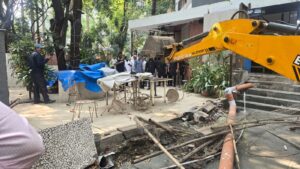
The operation resulted in the demolition of approximately 24,500 square feet of unauthorised permanent and temporary structures. Commercial stalls, handcarts and sheets were seized, along with nearly 10 truckloads of material.
November 18: City-wide removal of unauthorised structures
PMC teams continued their operations across the city, removing illegal commercial stalls, handcarts and unauthorised structures. Seized materials were cleared from roadsides to free up traffic lanes and improve movement.
November 19: Commissioner personally monitors Kothrud operation
A major joint enforcement operation was conducted at the City Pride complex in Kothrud, where Commissioner Naval Kishore Ram personally monitored action against unauthorised constructions in front and side margins, as well as on private land.
The operation was conducted under the guidance of Deputy Commissioner Vijaykumar Thorat (Circle No. 3), Assistant Commissioner Asmita Tambe, Building Development officers from Zone 6 and regional encroachment staff. The focus was on enforcing compliance with building regulations and removing unauthorised structures.
Simultaneous operations were also undertaken across 12 zonal offices. These included Nagar Road–Wagholi, Dhanakawadi–Katraj–Ambegaon, Aundh–Baner, Chhatrapati Shivajinagar–Ghole Road, Kondhwa–Undri, Bibwewadi, Wanowrie and Hadapsar–Manjri, among other jurisdictions.
November 20: Five zonal offices continue enforcement
The campaign continued across five principal zonal offices: Chhatrapati Shivajinagar–Ghole Road, Wanwadi, Warje–Karvenagar, Aundh–Baner and Kondhwa–Undri.
The operations formed part of the PMC’s continuing effort to remove unauthorised structures and obstructions from public spaces.
November 21: Action along major roads and commercial corridors
On November 21, simultaneous operations began at 8 am across several parts of Pune.
On Sinhagad Road, teams removed encroachments at Veer Bajipasalkar Chowk and the Ganga Bhagyoday area.
Under the Nagar Road–Wagholi and Yerwada jurisdictions, joint teams cleared obstructions along Bakori Road and the Wagholi–Bakori junction. The weekly market along Nagar Road was also inspected as part of the drive.
In Balewadi, unauthorised commercial tempos were impounded. Meanwhile, health and hoarding teams in Warje removed illegal flex banners and promotional boards.
The Katraj–Navale Bridge corridor also came under scrutiny, with systematic inspections of service roads along the national highway. Penalties were imposed on shopkeepers for maintaining unsanitary conditions. Marble vendors were also penalised for illegally storing heavy materials on pedestrian footpaths.
In Aundh–Baner, action was taken against unauthorised street vendors along Pancard Club Road.
November 22: Six divisions targeted in special drive
The next day’s special eviction operation covered six municipal divisions: Wanwadi, Nagar Road–Wagholi, Aundh–Baner, Hadapsar–Manjri, Dhanakawadi–Katraj–Ambegaon and Bibwewadi.
The Dhanakawadi–Katraj–Ambegaon jurisdiction recorded the removal of 42,200 square feet of illegal sheds and structures.
Additional operations were conducted at Vadgaon, Kondhwa–Undri, Dhole Patil Road, Warje, Vriddheshwar–Siddheshwar Ghat, Apollo Talkies Chowk and 15 August Chowk.
November 23: PMC clears 2,11,650 square metres in one day
The campaign reached a major operational milestone on November 23, with the PMC reporting the clearance of 2,11,650 square metres of encroached space across nine zonal jurisdictions.
The day’s operations covered:
- Kondhwa–Undri: Action at Chintamani Nagar, JSPM Chowk, Satav Nagar, Handewadi Road, Shriram Chowk and Handewadi Chowk.
- Warje–Kothrud: Encroachment removal at Khandoba Baba Chowk and Law College Road.
- Aundh–Baner: Action against violations involving building front setbacks at multiple locations.
- Vishrambaugwada: Clearance operations at Hirabag and areas surrounding the zonal office.
- Wanowrie: Joint enforcement operations involving multiple municipal departments.
- Bibwewadi: Operations focused on the Kasba Peth and Vishrambaugwada sectors.
- Nagar Road–Wagholi: A broad enforcement drive across the zonal office’s jurisdiction.
- Dhanakawadi–Katraj: Demolition of unauthorised sheds and commercial stalls.
- Shivajinagar–Ghole Road: Clearance operations around Congress Bhavan and Sangamwadi Road.
The reported clearance of more than 2.11 lakh square metres in a single day marks the scale of the ongoing campaign. However, the PMC’s stated objective goes beyond removing existing encroachments. The administration is also attempting to prevent their recurrence through stricter enforcement and financial penalties.
Anti-Encroachment Operations Continue Across Pune
The PMC’s zonal offices are continuing their encroachment removal operations to keep public roads, footpaths and open spaces free of obstructions.
At the time of writing this report, joint enforcement teams from the Building Department, Encroachment Removal Department, Hoardings Department and Health Department were conducting operations at several locations across the city.
The ongoing operations include:
- Aundh–Baner: Joint action by the Building Department, Hoardings Department, Encroachment Removal Department and Health Department.
- Karishma Chowk, Kothrud: Encroachment removal operations in the area.
- Dhanori–Lohegaon Road: Joint action by the Encroachment Removal, Hoardings and Building Departments under the Nagar Road–Wagholi Zonal Office.
- Undri Chowk to Khadnagar Road, Undri: Encroachment removal operations.
- Shastri Road, Sadashiv Peth and Navi Peth: Action to remove encroachments.
- Kondhwa Khurd, Old Boundary–Kausarbagh: Encroachment removal operations.
- Lohegaon–Dhanori Road: Anti-encroachment action.
- Baner: Encroachment removal drive underway.
The ongoing operations underline that the PMC’s enforcement campaign is not restricted to the locations covered in the earlier rounds. Different zonal offices are continuing to identify and remove obstructions through coordinated departmental action.
The civic body has reiterated that the drive will continue to ensure that public spaces, roads and footpaths in Pune remain open and safe for citizens.
The PMC has described its objective through the campaign slogan: “Encroachment-free Pune, safe Pune.”
Private Vacant Plot Owners Face Three-Day Deadline to Clean Properties
In a significant extension of the cleanliness drive, the PMC has made private owners responsible for preventing garbage accumulation on vacant plots.
Under Circular No. Atima(E)/4407, dated November 23, 2026, the civic body has directed private vacant plot owners to ensure that their properties remain clean and properly enclosed.
According to the PMC circular, the directions have been issued under the Solid Waste Management Rules, 2016, and provisions of the Maharashtra Municipal Corporations Act, 1949, including Chapter 14 and Sections 3(a), 4, 244, 245 and 365.
Owners who receive an official municipal notice will have three days to clean their plots and construct a complete compound wall or fencing.
Failure to comply within the stipulated period will allow the PMC to undertake the cleaning work using its own personnel and machinery. The expenses incurred will be recovered from the property owner, along with applicable monetary penalties.
Importantly, the civic body has stated that unpaid dues will be added directly to the owner’s property tax bill, providing it with a mechanism to recover the costs through municipal taxation.
The administration has also made geo-tagged photographs mandatory for official records. Photographs taken before and after the cleaning work will serve as documentation of the property’s condition and the action undertaken.
The measure places a clear responsibility on private landowners, particularly those who leave vacant plots unattended, allowing them to become dumping grounds for garbage.
Shops and Street Vendors Face Fines of Up to ₹1 Lakh, Followed by Sealing or Licence Cancellation
The PMC has also introduced an escalating penalty structure for sanitation violations by commercial establishments and authorised street vendors operating in designated vending zones.
According to the civic body’s directions, shop owners, tenants and authorised street vendors must segregate their waste into separate wet and dry bins. They are also responsible for keeping the areas surrounding their establishments and vending spaces clean.
Shopkeepers will be given a one-day notice to clear accumulated waste. Continued violations will attract progressively higher penalties.
The prescribed structure is as follows:
| Violation | Fine or action |
|---|---|
| First offence | ₹10,000 |
| Second offence | ₹20,000 |
| Third offence | ₹50,000 |
| Fourth offence | ₹1,00,000 |
| Fifth offence | Shop sealing or vending licence cancellation |
The fifth violation carries consequences beyond a monetary penalty. In the case of commercial shopkeepers, the PMC can seal the establishment. For street vendors, the action can extend to permanent cancellation of the hawker vending licence.
The progressive structure makes repeated sanitation violations considerably more expensive and places the responsibility for maintaining cleanliness directly on those operating commercial establishments and vending spaces.
It also signals a shift towards enforcement measures that can affect the ability of a business or vendor to continue operating, rather than relying solely on warnings and routine fines.

Unauthorised Banners and Hoardings to Attract FIRs and Criminal Prosecution
The PMC has separately tightened its enforcement against unauthorised advertisements, flex banners, posters and other forms of public display.
Under Notice No. 1/1215, dated November 23, 2026, issued by the Sky Sign and Licensing Department, the civic body has reiterated that no person or organisation can display flexes, banners, hoardings, posters, flags, arches or cut-outs without prior written municipal permission.
The prohibition applies to both public and private properties. It specifically covers street poles, trees, bridges, walls and road dividers, in addition to other locations.
According to the PMC notice, the action is based on Section 245 of the Maharashtra Municipal Corporations Act, 1949, and Section 3 of the Maharashtra Prevention of Defacement of Property Act, 1995.
More importantly, the civic body has warned that violations will lead to criminal prosecution and registration of First Information Reports (FIRs).
The notice refers to a Bombay High Court directive dated January 31, 2016, in the Suvrajya Public Interest Litigation.
As stated in the PMC notice, FIRs will be registered under the Bharatiya Nyaya Sanhita (BNS), 2023. The responsibility will not be limited to the person physically putting up an unauthorised display.
Those displaying the advertisements, named beneficiaries, event organisers and commercial printers can also face action. Printers who fail to provide the required printing credentials may be charged as abettors.
The penalties specified in the PMC notice include imprisonment of up to three months, a fine of up to ₹2,000, or both.
The civic body has also made it clear that unauthorised displays can be removed immediately, without prior notice, with the entire removal cost recovered from the violator.
Those seeking permission for lawful displays must apply through the civic body’s official online platforms:
- PMC official website: https://www.pmc.gov.in
- PMC online services: https://services.pmc.gov.in
Citizens Can Report Unauthorised Flexes Through ‘Bhau Flex Kadha’
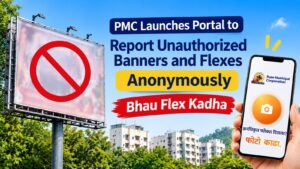
The PMC has also introduced a dedicated citizen-reporting facility called Bhau Flex Kadha to encourage residents to report unauthorised flex banners and other displays causing visual pollution in the city.
Through the portal at https://bhauflexkadha.pmc.gov.in/, citizens can photograph an unauthorised flex and submit a complaint. The system automatically captures the location, enabling the municipal corporation to identify the site and initiate removal action.
The reporting process involves three simple steps: photograph the unauthorised display, allow the location to be captured automatically, and submit the complaint for municipal action.
The PMC has stated that the reporting facility is anonymous and that the identity of the complainant will never be disclosed. Citizens can also use the portal’s complaint-tracking facility to check the status of their reports.
The initiative is intended to make residents active participants in identifying and reporting unauthorised advertisements, while holding organisers, advertisers, beneficiaries and commercial printers accountable for the unauthorised use of public spaces.
Commissioner Naval Kishore Ram: Drive Aimed at Reclaiming Road Space and Easing Congestion
Explaining the rationale behind the campaign, PMC Commissioner Naval Kishore Ram has emphasised the need to reclaim front margins and parking spaces to improve road capacity and reduce traffic bottlenecks.
The administration’s focus is on removing unauthorised structures and obstructions that restrict the available road space, particularly in busy commercial and residential areas.
Ram has also underlined that municipal enforcement alone cannot achieve the broader objective of keeping Pune clean.
“Without citizens’ participation, no city in the world can achieve the goal of making the city clean,” he said.
His statement reflects the administration’s position that cleanliness and civic discipline require cooperation from residents, businesses, property owners and street vendors, alongside regular municipal action.
Commissioner Hits Back at Criticism from Retired Civic Officials
The Commissioner has also responded strongly to criticism of the administration’s actions on social media by some retired senior civic officials.
In a detailed response, Ram defended the administration’s efforts to improve civic facilities and questioned the timing and nature of the criticism.
“The administration is constantly striving to ensure that citizens receive as many facilities as possible,” he said.
He went on to allege that some retired officials who had held senior positions in the PMC were criticising every administrative decision despite having had opportunities to address the city’s civic problems during their own tenure.
Ram said that if appropriate steps had been taken at the right time, Pune would not have reached its present situation.
He urged residents not to be influenced by what he described as publicity-seeking criticism from retired civil servants.
The remarks indicate that the Commissioner is defending the ongoing enforcement campaign not only as an immediate civic intervention but also as an attempt to address problems that have accumulated over several years.
Additional Municipal Commissioner Conducts Inspections Across Key City Corridors
The PMC has also stepped up supervisory monitoring of the campaign.
Additional Municipal Commissioner (General) Pavneet Kaur conducted personal inspections at Nehru Road, Apollo Cinema, Rasta Peth and the stretch between Gangadham Chowk and Lullanagar.
During these visits, she issued direct instructions to field teams regarding the execution of the enforcement drive.
The inspections are intended to ensure that the action taken on the ground is consistent with the administration’s directions and that municipal departments coordinate their work.
PMC Commissioner Reviews Enforcement with Senior Departmental Officials
Commissioner Naval Kishore Ram also chaired a comprehensive review meeting with senior officials from the engineering, building, roads, projects and administrative departments.
Those present included:
- City Engineer: Aniruddha Pawaskar
- Chief Engineer (Roads): Bankar
- Chief Engineer (Projects): Dinkar Gojare
- Chief Engineer (Buildings): Bipin Shinde
- Deputy Commissioners: Avinash Sakpal, Asha Raut, Vijaykumar Thorat, Sandeep Kadam and Arvind Mali
- Other senior officials: Prasad Katkar and regional zonal officers.
The meeting reviewed the progress of the ongoing enforcement operations and coordination between the departments involved.
The PMC administration has reiterated that joint action will continue until public spaces, footpaths and roadways are cleared of illegal structures and encroachments.
The Bigger Question: Can Pune Keep Its Public Spaces Free of Encroachments?
The scale of the current campaign, particularly the clearance of 2,11,650 square metres in a single day, points to a substantial enforcement effort by the PMC. But the effectiveness of the drive will ultimately depend on whether the cleared spaces remain free of encroachments after the municipal teams move on.
Pune’s recurring problems with obstructed footpaths, unauthorised commercial structures, illegal parking, roadside dumping and banners have made the use of public spaces a persistent civic concern. Removing an encroachment is one part of the task. Preventing it from returning requires consistent monitoring and action across municipal jurisdictions.
The new penalty structure also broadens the scope of the campaign. Private vacant plot owners, shopkeepers, tenants, street vendors, event organisers, advertisers and commercial printers now face clearly defined responsibilities and potential consequences for violations, as specified in the PMC’s notices and circulars.
The introduction of property-tax recovery for vacant plot cleaning, sealing of repeat-offender shops, permanent cancellation of vending licences and FIRs for unauthorised advertisements gives the PMC a wider set of enforcement measures.
However, the real test will be consistency. Citizens will need to see whether the same standards are applied across commercial establishments, residential areas and prominent roads, and whether enforcement continues beyond the initial high-intensity campaign.
Anti-encroachment operations were ongoing across Aundh–Baner, Kothrud, Undri, Dhanori, Lohegaon, Sadashiv Peth, Navi Peth and Kondhwa at the time of writing this report, indicating that the civic body’s action is continuing beyond the initial clearance operations.
For Pune residents, the objective is straightforward: unobstructed footpaths, usable roads, cleaner neighbourhoods and public spaces that remain accessible to everyone.
The PMC has made its enforcement position clear. The challenge now is to ensure that the results of this city-wide crackdown last.
Encroachment-free Pune, safe Pune.

Jayant Mahajan is a writer and contributor at PuneNow, covering the intersection of technology, climate action, and urban governance across Pune. With an extensive background in business management, digital transformation, and academia, Jayant brings real-world insight to local sustainability issues, from civic infrastructure to smart city data ethics. As an educator and founder of the Change Before Climate Change mission, he focuses on how Pune’s institutions and businesses can build future-ready, sustainable systems. Through his columns, Jayant bridges policy, technology, and practical action to help Punekars navigate a rapidly changing urban climate.