

PMC Plans 31-Km Underground Tunnel Network Linking Bhosari, Undri and Western Pune
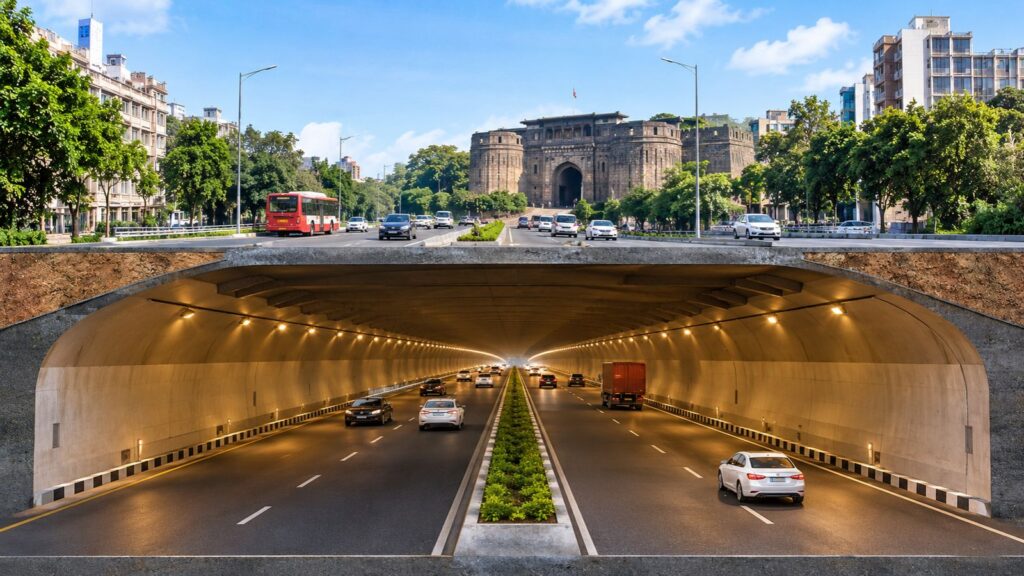
AI-generated image for representation.

The Pune Municipal Corporation (PMC) is evaluating a 31-kilometre underground road tunnel network across Pune to create alternative traffic routes and ease congestion. The proposed network, part of the Maharashtra government’s ‘Patal Lok’ initiative announced by Chief Minister Devendra Fadnavis, will comprise two primary corridors connecting Bhosari to Undri and Bhugaon to Erandwane.

PMC Commissioner Naval Kishore Ram has approved the appointment of expert consultants to conduct Detailed Feasibility Studies (DFS) and prepare Detailed Project Reports (DPRs) for the proposed corridors.
The project is currently at the preliminary planning stage, with its implementation subject to technical, financial, environmental and traffic feasibility assessments. (Pune News)
The longer of the two proposed corridors will stretch approximately 23 km from Bhosari to Undri. The route will run from Bhosari on the Old Mumbai-Pune Highway through Sangamwadi, Dhobighat in the Pune Cantonment area and Kondhwa before reaching Undri on the Solapur Highway bypass.
The corridor is expected to provide a north-south underground connection across Pune and could also serve as an access route towards the proposed Purandar International Airport.
The second corridor, approximately 8 km long, will connect the Ram River area in Bhugaon to D.P. Road in Erandwane through Dukkar Khind. It is intended to provide an alternative route for western Pune, bypassing the geographical bottleneck around Dukkar Khind.
Separately, PMC is also pursuing a proposed four-lane underground tunnel between Shaniwarwada and Saras Baug to address traffic congestion on Bajirao Road and Shivaji Road. The proposal followed demands by Kasba Peth MLA Hemant Rasane to provide an alternative route that bypasses the congested marketplace areas. Consultants are being appointed to prepare its DPR and assess its impact.
Other routes under consideration include a tunnel connecting Ramnadi on the Mumbai-Pune Highway to Rajaram Bridge on Sinhagad Road, and another between Hingne on Sinhagad Road and Padmavati on Satara Road. Pune Metro is also planning a tunnel between Wadki and the proposed Purandar Airport.
However, not all earlier tunnel proposals have progressed. The Pune Metropolitan Region Development Authority’s (PMRDA) proposed underground tunnel between Yerawada and Katraj was shelved after preliminary studies found it unfeasible.
For the new network, PMC has used travel and traffic data to identify potential alignments. These include TomTom origin-destination data, Google’s real-time traffic intelligence, inputs from the Comprehensive Mobility Plan (CMP), travel pattern studies and traffic police assessments of major junctions and bottlenecks.
The feasibility studies will also examine how the proposed tunnels can connect with other planned infrastructure, including the High-Capacity Mass Transit Route (HCMTR), Inner Ring Road, Outer Ring Road, existing and proposed flyovers, and river bridges. Coordination with MahaMetro and MSIDC metro corridors, along with bus feeder services connecting to metro stations, will also be examined.
Implementation will require coordination among several government agencies because the proposed routes pass through areas under the Pune Municipal Corporation, Pimpri-Chinchwad Municipal Corporation, Pune Cantonment Board and Ministry of Defence. Joint approvals will be required for land access, defence clearances, funding, project ownership, construction schedules and future operations and maintenance.
Several important project details remain undecided. The estimated construction cost, funding arrangements and any proposed toll structure have not been specified. The DPRs will also need to address tunnelling technology, geological and groundwater conditions, ventilation and emergency evacuation systems.
The expected vehicle capacity, travel-time savings and the proportion of surface traffic that could shift to the underground network have also not been disclosed.
The proposed 31-km network therefore remains a planning exercise rather than an approved construction project. Its eventual implementation will depend on the findings of the detailed feasibility studies and project reports. (Pune News)