

Pune’s Metro Atlas: From 56 km Today to 111 km Proposed, Existing Routes, New Lines and 100+ Stations Explained
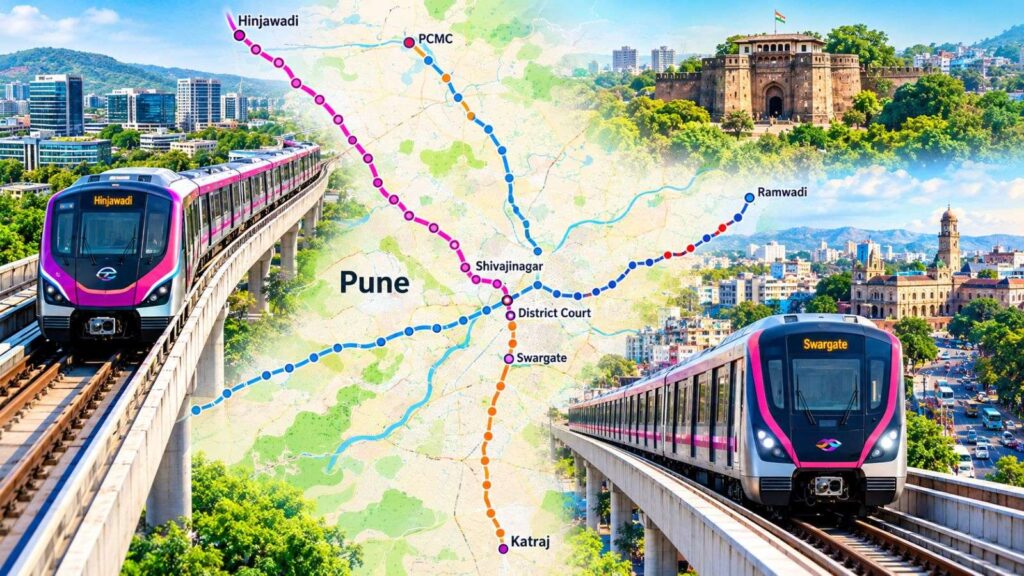

Pune’s Metro network is entering a major expansion phase, with new corridors set to connect more residential neighbourhoods, IT hubs, commercial centres and developing suburbs across Pune and Pimpri-Chinchwad. From the existing PCMC-Swargate and Vanaz-Ramwadi routes to the newly operational Hinjawadi-Shivajinagar Pink Line, the network is gradually changing how people travel across the city.

The expansion plans are equally ambitious. New corridors will extend Metro connectivity towards Nigdi, Katraj, Chandani Chowk and Wagholi, while the proposed Kharadi-Khadakwasla corridor will connect several important parts of eastern, southern and western Pune. Further proposals could take the network towards Kondhwa, NIBM, Yewalewadi, Pirangut and Pune Airport.
The objective is to create an integrated public transport system that reduces dependence on private vehicles, eases road congestion and provides faster, safer and more comfortable travel for commuters.
Here is a comprehensive look at Pune’s existing Metro network, operational routes, approved expansions and proposed future corridors.
Pune Metro Network at a Glance
Pune’s Metro network currently comprises two different project systems: the original Metro network developed by Maharashtra Metro Rail Corporation Limited (Maha Metro) and Line 3, developed by the Pune Metropolitan Region Development Authority (PMRDA).
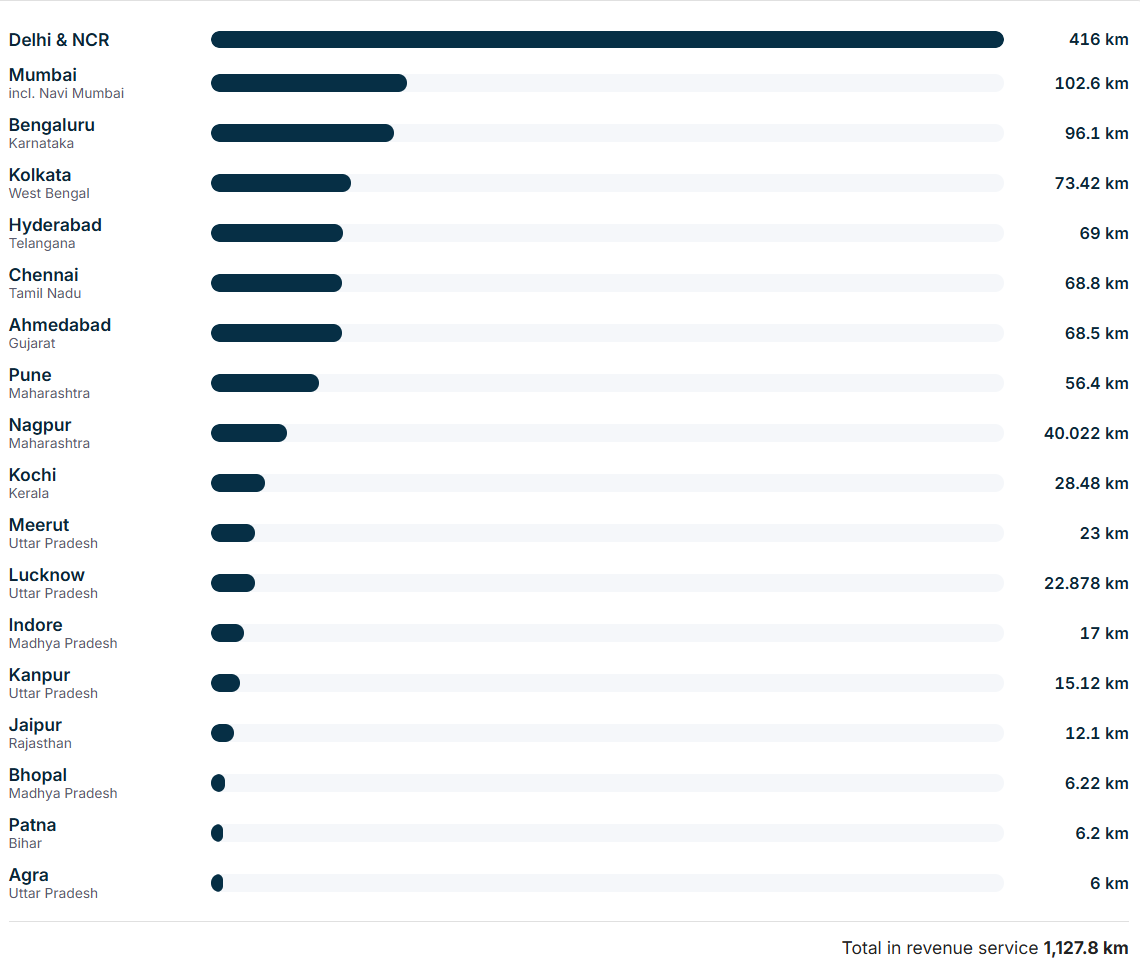
The original Phase 1 network covers 33.1 km. The addition of the 23.203 km Hinjawadi-Shivajinagar corridor takes the total length of the operational Metro corridors to approximately 56.3 km.
With the recent addition of Pink Line (Pune Metro Line 3), Pune now ranks at No. 8 across Indian cities with metro network.
Length of Operational Metro Corridors in India
The next expansion programme will add another 54.7 km, taking the potential network length to approximately 111 km once all the identified extensions and new corridors are completed.
| Particulars | Network length |
|---|---|
| Original Phase 1 network (Lines 1 and 2) | 33.1 km |
| Hinjawadi-Shivajinagar (Line 3) | 23.203 km |
| Total operational corridor length | 56.3 km |
| Phase 1 extensions | 10.31 km |
| Phase 2 corridors | 44.39 km |
| Total approved expansion programme | 54.7 km |
| Potential total network after expansion | Approximately 111 km |
The 54.7 km expansion programme includes six corridors: four extensions to existing Metro lines and two new corridors, with a total of 49 additional stations.
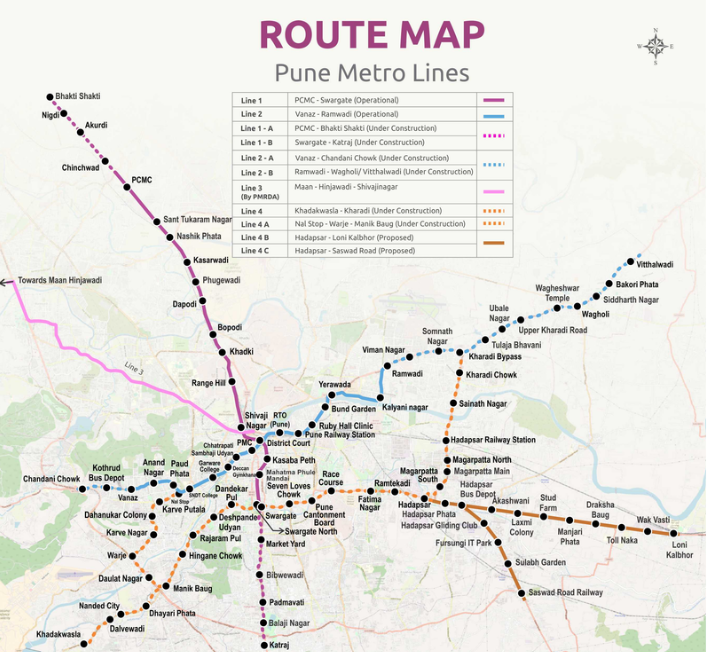
The expansion programme should not be confused with the length currently under construction. The individual projects are at different stages of implementation, including preparatory work, surveys, design and construction planning.
Who Is Developing Pune Metro?
The original Pune Metro project has been undertaken by Maharashtra Metro Rail Corporation Limited (Maha Metro), a special purpose vehicle (SPV) jointly established by the Government of India and the Government of Maharashtra.
Its objective is to develop a modern, safe, secure, comfortable and integrated public transport system for Pune and Pimpri-Chinchwad. The project also aims to incorporate the city’s rich cultural heritage into the design of Metro stations and surrounding areas.
Metro Line 3, connecting Hinjawadi with Shivajinagar, is a separate project undertaken by PMRDA under the Public Private Partnership (PPP) model.
Together, these projects form the foundation of Pune’s expanding Metro network.
Existing Pune Metro Routes
The original Pune Metro Phase 1 project consists of two corridors covering 33.1 km and serving 30 stations.
Line 1: PCMC to Swargate
Line 1 connects Pimpri-Chinchwad with central Pune through a 17.4 km corridor with 14 stations. The route includes five underground and nine elevated stations.
It connects important residential and commercial areas in Pimpri-Chinchwad with the city centre and provides access to major transport and commercial locations.
The stations are:
- PCMC
- Sant Tukaram Nagar
- Bhosari (N.P.)
- Kasarwadi
- Phugewadi
- Dapodi
- Bopodi
- Khadki
- Range Hill
- Shivajinagar
- District Court
- Kasba Peth-Budhwar Peth
- Mandai
- Swargate
Line 2: Vanaz to Ramwadi
Line 2 is a 15.7 km elevated corridor connecting western and eastern Pune. It has 16 stations and provides Metro connectivity to important residential, commercial and educational areas.
The route serves Kothrud, Deccan, Shivajinagar, Yerawada, Viman Nagar and other locations along the corridor.
Together, Lines 1 and 2 form the original Metro network and provide interchange facilities at important locations, including the District Court station.
Pune Metro Phase 1 Extensions
To extend the reach of the existing network, Maha Metro has taken up plans for extensions to both Line 1 and Line 2.
PCMC to Nigdi Extension (Line 1A)
The 4.413 km extension from PCMC to Nigdi will take Metro connectivity further into Pimpri-Chinchwad.
The proposed elevated corridor will have four stations:
- Chinchwad
- Akurdi
- Nigdi
- Bhakti Shakti
The extension will provide residents of these areas with access to the existing PCMC-Swargate corridor, improving connectivity to Pune city.
Swargate to Katraj Extension (Line 1B)
The proposed 5.46 km Swargate-Katraj extension will extend the underground Metro corridor towards south Pune.
It will have three underground stations:
- Market Yard
- Padmavati
- Katraj
The extension is expected to benefit residents of Katraj, Padmavati and surrounding neighbourhoods by providing a connection to the wider Metro network through Swargate.
Pune Metro Phase 2: Extensions Towards Chandani Chowk and Wagholi
One of the important components of Pune Metro’s expansion programme is the extension of Line 2 in both western and eastern directions.
The two corridors, Line 2A and Line 2B, will cover a combined distance of approximately 12.75 km with 13 stations.
Line 2A: Vanaz to Chandani Chowk
The 1.12 km western extension will connect Vanaz with Chandani Chowk through two stations:
- Kothrud Bus Depot
- Chandani Chowk
The corridor will improve Metro connectivity towards Chandani Chowk and the rapidly developing residential areas along the western side of Pune.
Line 2B: Ramwadi to Wagholi/Vitthalwadi
The 11.63 km eastern extension will connect Ramwadi with Wagholi and Vitthalwadi through 11 stations.
The proposed stations are:
- Viman Nagar
- Somnath Nagar
- Kharadi Bypass
- Tulaja Bhavani
- Ubale Nagar
- Upper Kharadi Road
- Wagheshwar Temple
- Wagholi
- Siddharth Nagar
- Bakori Phata
- Vitthalwadi
This extension is particularly important for eastern Pune, where residential development, commercial establishments and IT businesses have expanded rapidly.
The corridor will improve connectivity to Kharadi and Wagholi, including employment centres, educational institutions and residential neighbourhoods.
The Union Cabinet approved the two corridors in June 2025 at an estimated cost of Rs 3,626.24 crore. Their development is intended to increase Metro ridership and provide a continuous east-west public transport connection between Chandani Chowk and Wagholi.
Pune Metro Line 3: Hinjawadi to Shivajinagar Pink Line
The Hinjawadi-Shivajinagar Metro corridor, popularly known as the Pink Line, is one of Pune’s most significant public transport projects.
The 23.203 km elevated corridor connects Rajiv Gandhi Infotech Park in Hinjawadi with Shivajinagar District Court through 23 stations.
Prime Minister Narendra Modi inaugurated the corridor on November 3, 2026, and passenger services commenced on November 4.
The project was undertaken by the Pune Metropolitan Region Development Authority (PMRDA) to address traffic congestion in Hinjawadi and surrounding areas, particularly the daily commute of IT professionals travelling between their workplaces and residential neighbourhoods.
Unlike the original Maha Metro corridors, Line 3 is being implemented under the Public Private Partnership (PPP) model in accordance with the Central Government’s New Metro Rail Policy, 2017. The project follows the Design, Build, Finance, Operate and Transfer (DBFOT) model.
The project was awarded to a joint venture of TRIL Urban Transport Pvt Ltd and Siemens Project Ventures GmbH. A special purpose vehicle, Pune IT City Metro Rail Limited, was established to execute the project.
The estimated project cost, including land acquisition and utility shifting, is Rs 8,313 crore.
The corridor connects important locations including Maan, Hinjawadi, Wakad, Mahalunge, Balewadi, Baner, Aundh and Shivajinagar.
Its 23 stations include:
Maan, Maan-MIDC Circle Phase II, Maan Bus Depot, Hinjawadi Phase II-Circle II, Hinjawadi Phase II-Circle I, Padmabhushan Chowk, Shree Shiv Chhatrapati Shivaji Maharaj Chowk, Hinjawadi Phase I, Wakad Chowk, Shree Shiv Chhatrapati Sports Complex, Mahalunge, Mitcon Balewadi, R K Laxman Museum Balewadi, Aundh, Sakal Nagar, Savitribai Phule Pune University, Agriculture College and District Court, along with the remaining stations serving the Baner and Balewadi stretches.
At the initial launch, passenger services commenced at 17 of the 23 stations. The remaining six stations were scheduled to become operational in stages as the necessary facilities and finishing work were completed.
The Pink Line is expected to provide a significant alternative to road travel for IT professionals and other commuters. It will also improve connectivity between Hinjawadi, Wakad, Balewadi, Baner, Aundh and central Pune.
The project is expected to reduce travel time, ease congestion on major roads and encourage more people to use public transport.
Line 4 and Line 4A: Kharadi to Khadakwasla and Warje
The next major addition to Pune’s Metro network will be Line 4 and its spur corridor, Line 4A.
Together, these corridors will cover approximately 31.64 km and have 28 elevated stations.
Line 4: Kharadi to Khadakwasla
The main corridor will cover 25.52 km and connect Kharadi in eastern Pune with Khadakwasla in the south-western part of the city.
It will provide Metro connectivity to several important residential and commercial areas, including Kharadi, Magarpatta, Hadapsar, Swargate, Manik Baug and Nanded City.
The corridor will also connect Pune Cantonment and other important locations along its route.
The Metro line will run along some of Pune’s busiest roads, including Solapur Road, Magarpatta Road, Sinhgad Road, Karve Road and the Mumbai-Bengaluru Highway.
Line 4A: Nal Stop to Warje and Manik Baug
The 6.12 km spur corridor will connect Nal Stop with Warje and Manik Baug through six elevated stations.
It will provide additional connectivity to residential areas in western and south-western Pune and integrate with the main Metro network.
The Union Cabinet approved Line 4 and Line 4A in November 2025, with an estimated combined project cost of Rs 9,857.85 crore.
The project is expected to be completed within five years of its approval.
The two corridors are designed to connect residential clusters, IT hubs, commercial areas and educational institutions. They will also provide interchange facilities with existing Metro corridors and other transport systems.
Proposed Pune Metro Extension Towards Kondhwa, NIBM and Yewalewadi
South Pune is another area seeking better Metro connectivity, particularly as residential development and traffic volumes continue to increase.
Residents of Kondhwa, NIBM, Undri, Wanowrie and Fatima Nagar have been demanding faster implementation of the proposed Metro expansion towards these areas.
The proposed corridor forms part of a 20 km extension connecting Shivajinagar with Yewalewadi through Camp, Pulgate and Kondhwa. A spur from NIBM Junction to Undri is also proposed.
According to Maha Metro director (works) Atul Gadgil, the Detailed Project Report (DPR) for the proposed Kondhwa-NIBM-Yewalewadi extension is expected after the pending road-widening details are received from the Pune Municipal Corporation.
Consultants have been appointed, and surveys and alignment studies are underway.
Road widening along the proposed elevated corridor remains an important requirement. Maha Metro has sought the necessary road-width information from the Pune Municipal Corporation and Pune Cantonment Board before finalising the DPR.
The report will subsequently require approvals from the concerned civic bodies, the state government and the Central government.
If the DPR, road-widening measures and statutory approvals proceed as scheduled, the project could be targeted for completion by 2030-31.
However, the corridor remains at the planning and DPR stage and should not be confused with the approved Phase 2 expansion programme.
Proposed Metro Corridor Between Chandani Chowk and Hinjawadi Via Pirangut
Another proposed Metro corridor could improve connectivity between western Pune, Pirangut and the Hinjawadi IT hub.
The proposed Chandani Chowk-Ghotawade Phata-Pirangut-Hinjawadi corridor is expected to be taken forward through the preparation of a Detailed Project Report.
Union Minister of State Murlidhar Mohol directed officials to prepare the DPR during a meeting of the District Development Coordination and Monitoring Committee (DISHA) held at the Pune District Collector’s Office.
NCP (SP) MP Supriya Sule also supported the proposal during the meeting, stating that the corridor was necessary for the region.
The preparation of a DPR will help establish the proposed alignment, project requirements and financial implications. The corridor is still at the proposal stage and does not form part of the 54.7 km approved expansion programme.
Proposed Pune Airport Metro Connectivity
Improving public transport connectivity to Pune Airport is another infrastructure priority.
During the DISHA meeting, officials were directed to complete the DPR for the proposed Lohegaon Airport Metro connectivity within the stipulated timeline.
The proposed connection is intended to improve access to the airport and provide passengers with another public transport option.
The airport corridor is still under planning and should not be counted as part of the approved Metro expansion length.
Frequently Asked Questions
Pune Metro has approximately 56 km of operational routes, including the PCMC-Swargate corridor, Vanaz-Ramwadi corridor and Hinjawadi-Shivajinagar Line 3.
Pune Metro’s network is expected to expand to approximately 111 km after the approved extensions and new corridors are completed.
The planned network includes more than 100 stations across the existing lines, Line 3 and the approved extensions and corridors.
The operational network includes PCMC-Swargate (Line 1), Vanaz-Ramwadi (Line 2) and Hinjawadi-Shivajinagar (Line 3). Line 3 services initially began with 17 of its 23 stations.
The planned extensions include PCMC-Nigdi, Swargate-Katraj, Vanaz-Chandani Chowk and Ramwadi-Wagholi. Phase 2 also includes Kharadi-Khadakwasla and Nal Stop-Warje-Manik Baug.
The expanded network is planned to connect areas including Nigdi, Katraj, Chandani Chowk, Wagholi, Kharadi, Khadakwasla, Warje and Manik Baug, extending connectivity across a wider part of Pune.
What Will Pune’s Metro Network Look Like in the Future?
Pune’s Metro expansion programme is expected to transform connectivity across the metropolitan region.
The original PCMC-Swargate and Vanaz-Ramwadi corridors have established the foundation of the network. Line 3 has added an important connection between the Hinjawadi IT hub and central Pune.
The approved expansion programme will add another 54.7 km through extensions to existing corridors and the development of new lines.
Once these projects are completed, the combined Metro network could extend to approximately 111 km, excluding additional corridors that may be approved in the future.
The proposed connections towards Kondhwa, NIBM, Yewalewadi, Pirangut and Pune Airport could further expand the network, depending on the outcome of feasibility studies, DPRs and government approvals.
However, expanding the rail network alone will not be enough to solve Pune’s traffic problems. Effective integration with PMPML buses, feeder services, suburban railway, pedestrian pathways and other modes of transport will be equally important.
Convenient interchange facilities, adequate parking, last-mile connectivity and reliable train services will determine how many commuters choose Metro over private vehicles.
Pune’s Metro network is still evolving, but the direction of expansion is clear. Over the coming years, the city is expected to move from a limited two-corridor system towards a much wider network connecting its major residential, commercial, industrial and IT centres.

Vineet Gupta is the Founder and Managing Editor of PuneNow, where he leads editorial coverage on Pune’s civic developments, local infrastructure, traffic, and urban governance. With an academic background from the University of Wales and professional experience across journalism, hospitality, finance, and academia, Vineet brings a unique perspective to hyper-local journalism. Based in Pune, he is passionate about empowering residents with accurate, timely news that affects their daily lives, while also offering insightful commentary on mindful living, parenting, and community connection.