Pune Water Storage Significantly Lower Than Last Year; No Alarm But Conservation Must
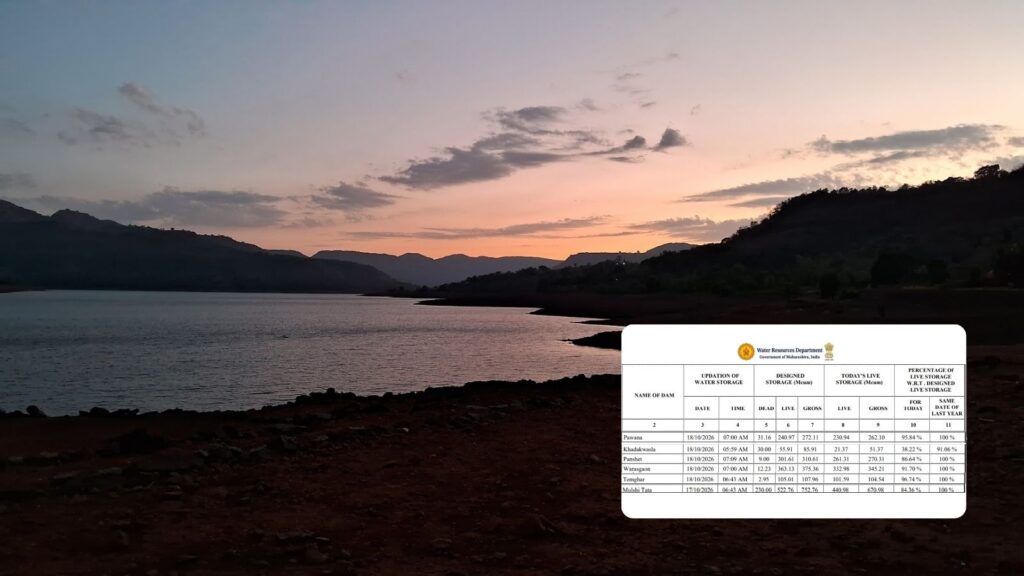

Pune’s water storage levels are worryingly lower than last year at the start of October, with the Khadakwasla dam chain holding 86.87% of its designed live storage, compared with 99.39% on the same day last year.

With October marking the first month after the monsoon and the next monsoon still seven to eight months away, the storage position remains an important indicator for the city’s water supply outlook.
The Khadakwasla dam chain, comprising Khadakwasla, Warasgaon, Panshet and Temghar dams, currently holds 25.33 thousand million cubic feet (TMC) of water (86.87%) against its designed live storage capacity of 29.16 TMC. Same day last year, this storage stood at 99.39%.
Khadakwasla Dam has the lowest storage level among these four dams, at 38.22% of its designed live storage of 1.97 TMC. Its current live storage stands at 0.75 TMC, compared with 91.06% on the same day last year.
Warasgaon Dam is at 91.70% storage, with 11.76 TMC against a capacity of 12.82 TMC. Panshet Dam holds 9.23 TMC against 10.65 TMC, representing 86.64% storage. Temghar Dam is at 96.74%, with 3.59 TMC against its designed live storage capacity of 3.71 TMC. All three dams were at 100% storage on the same day last year.
The Khadakwasla dam chain supplies water to areas under the Pune Municipal Corporation (PMC). Its combined storage position is therefore particularly relevant to the city as it enters the post-monsoon period, when water stored in the dams must support demand until the next monsoon replenishes supplies.

Outside the Khadakwasla chain, Pawana Dam, which supplies water to areas under the Pimpri-Chinchwad Municipal Corporation (PCMC), is at 95.84% storage. It holds 8.16 TMC against a designed live storage capacity of 8.51 TMC, compared with 100% storage on the same day last year.
Mulshi Dam, whose water is associated with the Tata hydroelectric system and feeds the Mula River, is at 84.36% storage. Its live storage stands at 15.57 TMC against a designed capacity of 18.46 TMC, compared with 100% on the same day last year. The Mula River passes through Pune and joins the Mutha River, which flows from the Khadakwasla dam chain. This river system is also relevant to parts of Hinjawadi.
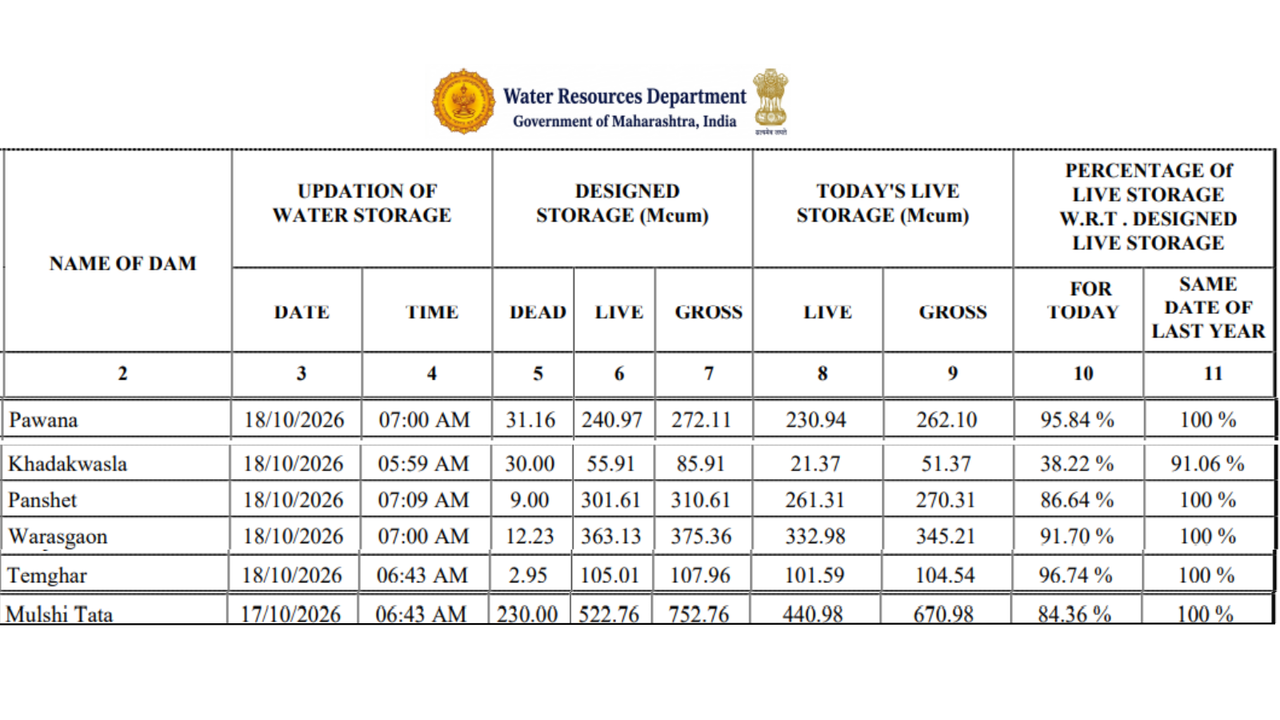
The figures show that storage across all six dams is below the corresponding levels recorded last year. While Warasgaon, Temghar and Pawana remain above 90% capacity, the lower level at Khadakwasla stands out. The combined Khadakwasla dam chain is at 86.87%, leaving 3.83 TMC below its designed live storage capacity.
With several months to go before the next monsoon, the current storage levels provide a snapshot of Pune and the surrounding region’s water reserves entering the post-monsoon season.