HAL HF-24 Marut: How India Built a Supersonic Fighter Jet 65 Years Ago
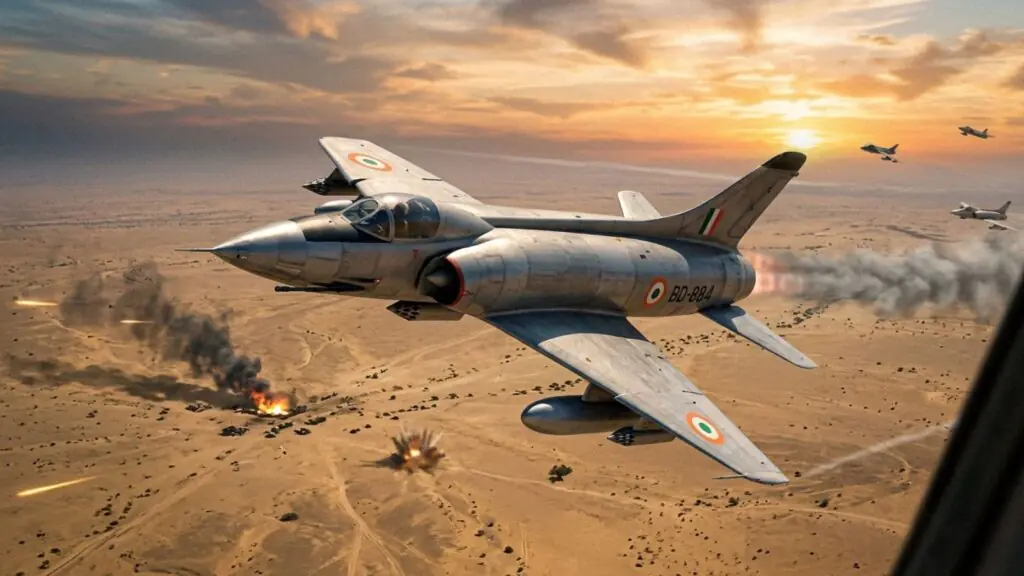

India’s first indigenously designed fighter aircraft, the HAL HF-24 Marut, was built to reach twice the speed of sound.

Designed by German aeronautical engineer Kurt Tank and manufactured by Hindustan Aeronautics Limited (HAL) in India, the Marut went on to serve the Indian Air Force (IAF) and saw combat during the 1971 India-Pakistan War.
The Marut made its maiden flight over Bangalore in June 1961, with records citing June 17 and June 24 as the date. Named after the Vedic storm deities associated with Indra, it marked a major milestone in India’s efforts to develop its own military aircraft after independence.
The project began in 1956, when the Indian Air Force laid down requirements for an indigenous fighter capable of reaching Mach 2, operating at altitudes of up to 60,000 feet and performing interception, bombing and ground-attack missions. The aircraft was also expected to have potential for naval operations from INS Vikrant.
At the time, HAL lacked a dedicated aircraft design department, specialised prototype facilities and supersonic wind tunnels. To bridge the technological gap, India recruited Kurt Tank, who had previously led aircraft development at Germany’s Focke-Wulf. He arrived in Bangalore in February 1956 with 18 German engineers and worked to establish the design capabilities needed to develop the fighter.
Tank’s team designed the Marut with swept wings, an aerodynamically shaped fuselage and a twin-engine configuration. A full-scale wooden glider prototype, designated HAL X-241, first flew on April 3, 1959. Towed behind a Douglas C-47 Dakota, it completed 86 test flights to assess the aircraft’s aerodynamic characteristics before powered flight testing.
However, the programme’s biggest challenge was its engine.
The Marut was designed around two Bristol Siddeley Orpheus BOr.12SR afterburning turbojets, each expected to deliver approximately 8,150 pounds of thrust. These engines were intended to provide the power required for Mach 2 performance.
The engine programme lost its primary funding after NATO selected the Fiat G.91 for its light-strike requirement. Bristol Siddeley offered to continue development with financial assistance from India, but the government declined to provide the proposed £13 million.
HAL consequently fitted the Marut with two non-afterburning Orpheus Mk 703 engines, each producing around 4,850 pounds of thrust. The resulting power deficit restricted its maximum speed in level flight to Mach 0.93, although it could reach Mach 1.02 in a steep dive.
Between 1961 and 1972, India explored several alternatives, including Soviet, American and Egyptian engine options. A proposed collaboration with Egypt to test the Brandner E-300 engine ended after the 1967 Six-Day War, when an Israeli attack destroyed the Egyptian airbase where the test aircraft was stationed. HAL also developed an afterburner for the existing engine, but the limited thrust improvement proved insufficient.
Despite its performance limitations, the Marut was adapted into a dedicated ground-attack fighter with substantial firepower. Its armament included four 30 mm ADEN cannons, a retractable belly-mounted pack carrying 50 unguided rockets and four underwing pylons capable of carrying up to 1,814 kg of bombs or other stores. However, it lacked airborne interception radar, electronic countermeasures and guided air-to-air missiles.
The aircraft entered IAF service on April 1, 1967, initially with No. 10 Squadron. It later served with Nos. 220 and 31 Squadrons. HAL eventually built 147 aircraft, comprising 129 single-seat fighters and 18 two-seat trainers.
The Marut established its combat credentials during the 1971 India-Pakistan War, completing more than 300 combat sorties over the Rajasthan and Sindh sectors. During the Battle of Longewala on December 5, Maruts joined Hawker Hunters in attacking Pakistani armour, supply columns and artillery.
On December 7, Squadron Leader K.K. Bakshi of No. 220 Squadron shot down a Pakistani F-86 Sabre with the Marut’s 30 mm cannons during a low-level strike mission near Naya Chor in Sindh. It was the aircraft’s only recorded air-to-air victory.
No Marut was lost in air-to-air combat during the war, and some aircraft returned safely despite sustaining heavy ground fire and losing an engine. Three to four Maruts were lost to anti-aircraft fire, while another was destroyed on the ground at Uttarlai by a Pakistani F-104. Three Marut pilots received the Vir Chakra for gallantry.
The aircraft also faced operational and design challenges. HAL chief test pilot Group Captain Suranjan Das died on January 10, 1970, when a prototype crashed during testing following a cockpit canopy malfunction and an engine flameout. Test pilots also raised concerns about aspects of the flight-control system and cockpit ergonomics.
Following the 1971 war, proposals to upgrade the Marut with more powerful engines and modern radar did not lead to a major modernisation programme. High manufacturing costs, the availability of imported fighter aircraft and the loss of key design personnel weakened the case for continued production.
Production ended in 1977, and the IAF gradually phased out the aircraft during the 1980s before officially retiring it in 1990.
Although the Marut never achieved its intended supersonic performance, its contribution extended beyond its combat record. The programme helped India develop aircraft-design expertise, testing facilities and engineering capabilities that would support later indigenous aviation projects, including the HAL Tejas and subsequent fighter development programmes.
No airworthy Maruts remain today. Around 12 to 20 airframes are reported to survive in museums and static displays, including the Indian Air Force Museum in New Delhi and the HAL Heritage Centre and Aerospace Museum in Bangalore. One aircraft is preserved at the Deutsches Museum Flugwerft Schleissheim near Munich, Germany, following a gift from the Indian government in honour of Kurt Tank.
The HF-24 Marut remains a landmark in Indian aviation history: an ambitious fighter that fell short of its original performance goals but demonstrated that India could design and manufacture its own combat aircraft.

Vineet Gupta is the Founder and Managing Editor of PuneNow, where he leads editorial coverage on Pune’s civic developments, local infrastructure, traffic, and urban governance. With an academic background from the University of Wales and professional experience across journalism, hospitality, finance, and academia, Vineet brings a unique perspective to hyper-local journalism. Based in Pune, he is passionate about empowering residents with accurate, timely news that affects their daily lives, while also offering insightful commentary on mindful living, parenting, and community connection.