CJP Calls Off September 5 March After Supreme Court Quashes FIRs Against Student Protesters
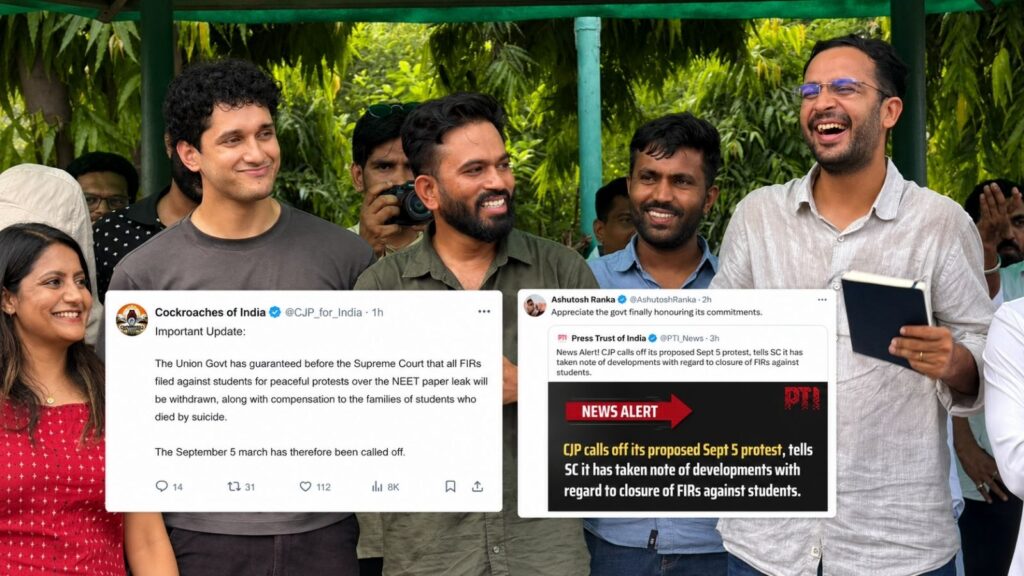

The September 5 protest in Delhi is off. The Cockroach Janata Party (CJP) on Tuesday withdrew its planned march after the Supreme Court intervened on FIRs registered against students who took part in the July protests.

CJP co-convener Saurav Das told a bench headed by Chief Justice of India Surya Kant that the organisation had decided to withdraw the call for the march following the Centre’s assurances and the Supreme Court’s order on the cases against protesters.
Why did CJP call off the September 5 march?
The CJP had announced the September 5 protest after accusing the Centre of failing to honour commitments made when its earlier agitation was called off on July 25.
The proposed march was to begin at India Gate and proceed towards the New Delhi Police Headquarters. Families of students who died by suicide in connection with the NEET 2026 controversy, along with students and alleged victims of police action, were expected to participate.
A key demand was the withdrawal of FIRs registered against protesters during the July 20-25 agitation.
The issue was taken up by the Supreme Court after the Centre moved applications seeking closure of the cases.
Supreme Court quashes FIRs against NEET protesters
On Tuesday, the Supreme Court invoked its extraordinary powers under Article 142 of the Constitution to quash FIRs linked to the protests in Delhi, Bihar, Maharashtra, West Bengal and Assam.
The court also directed that similar FIRs relating to the protests in other states and Union Territories should not be pursued or investigated.
The bench comprising CJI Surya Kant, Justice Joymalya Bagchi and Justice V. Mohana further directed that no fresh FIRs be registered in connection with the protests held between July 20 and July 25.
The court said the decision was taken keeping in view the future prospects of young protesters who had participated in the demonstrations.
Centre assures action on student cases and compensation
Solicitor General Tushar Mehta told the Supreme Court that the Centre remained committed to the assurances made to the CJP leadership.
The government assured that FIRs relating to the July protests would not be pursued and that no fresh cases would be registered in connection with those protests.
The Centre also committed to compensation for families of students who died by suicide in connection with NEET 2026. The Supreme Court directed the government to formulate a pan-India compensation policy within three months.
Exception for protesters with criminal antecedents
The Supreme Court order does not provide a blanket shield in cases involving serious criminal antecedents.
The Centre said it would continue prosecution against 2,873 people in Delhi identified as having serious criminal antecedents. The court allowed Delhi Police to register a single fresh FIR against them, but limited the investigation to allegations involving bodily harm and destruction of property.
Supreme Court had refused to stop September 5 march
The development comes just a day after the Supreme Court declined to pass an immediate order stopping the CJP’s proposed September 5 march.
On August 31, the court said there was no basis at that stage to presume that the demonstration would result in an untoward incident. It left the responsibility for maintaining law and order with the authorities.
The Centre’s subsequent move to seek closure of the protest-related FIRs changed the situation.
CJP withdraws Delhi protest
After the Supreme Court passed its order and the Centre reiterated its assurances, CJP co-convener Saurav Das informed the bench that the September 5 march had been withdrawn.
Chief Justice Surya Kant welcomed the decision and said that issues could be resolved if both sides acted in good faith and remained open to discussion.
With the FIR issue addressed through the Supreme Court’s intervention and the Centre’s commitments on compensation, the CJP’s planned September 5 mobilisation in Delhi will therefore not take place.