
Pune: Maharashtra Chief Minister Devendra Fadnavis has directed officials to fast-track three of Pune’s biggest transport infrastructure projects, the High Capacity Mass Transit Route (HCMTR), the Pune Inner Ring Road and a new tunnel network, with the aim of easing traffic congestion across Pune and Pimpri-Chinchwad.

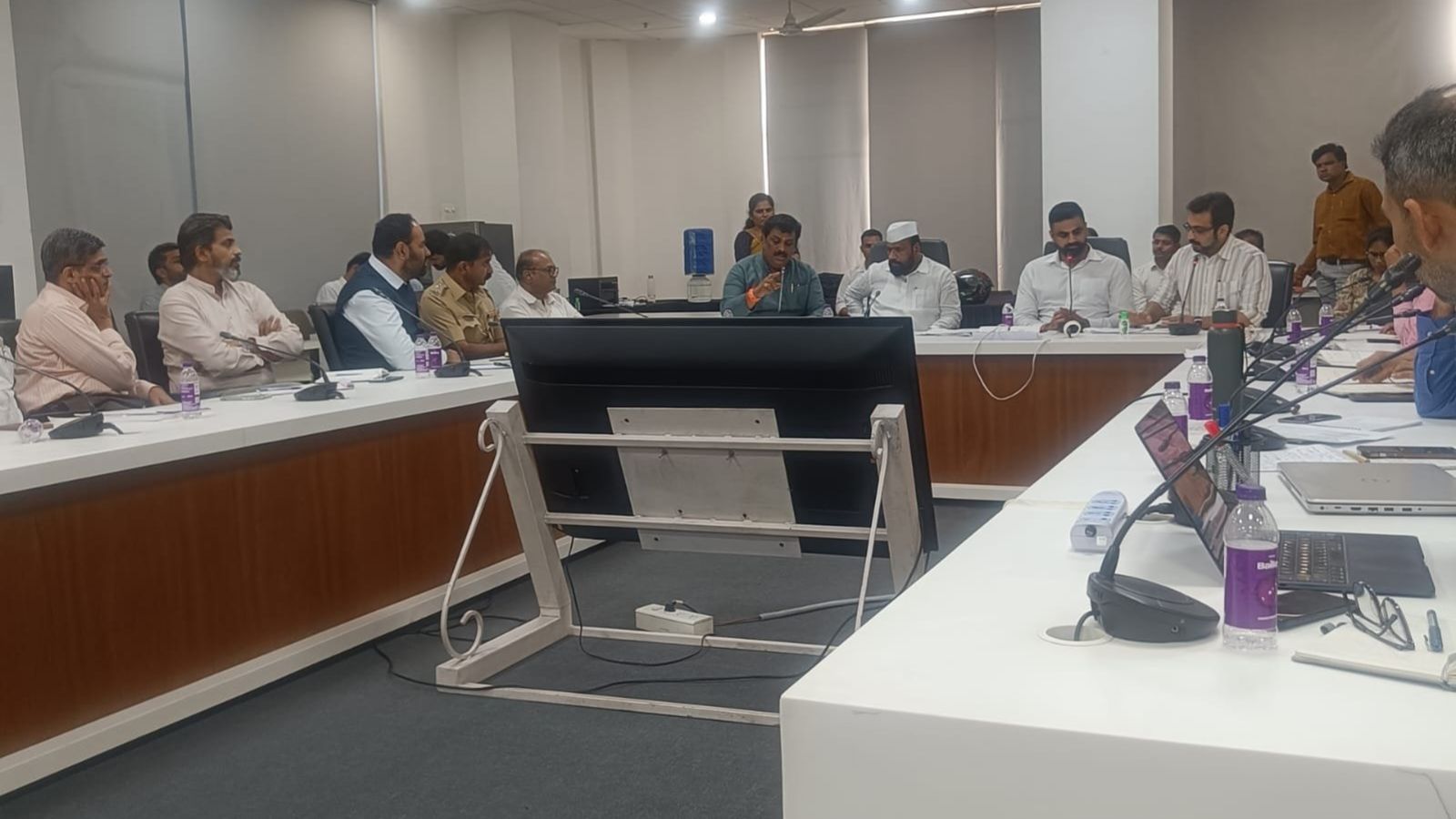
The directions were issued during a meeting of the high-powered committee constituted for the planning, financial management, implementation and monitoring of major urban transport projects in Pune. The meeting was held at Sahyadri Guest House in Mumbai on Monday.
Deputy Chief Ministers Eknath Shinde and Sunetra Ajit Pawar, Minister of State Madhuri Misal and senior government officials attended the meeting.
HCMTR to Be Completed by 2028
Calling the High Capacity Mass Transit Route (HCMTR) a transformative project for Pune’s long-term development, Chief Minister Fadnavis instructed officials to begin work at the earliest and complete the project by 2028. He also directed that a financial model be prepared and submitted for approval.
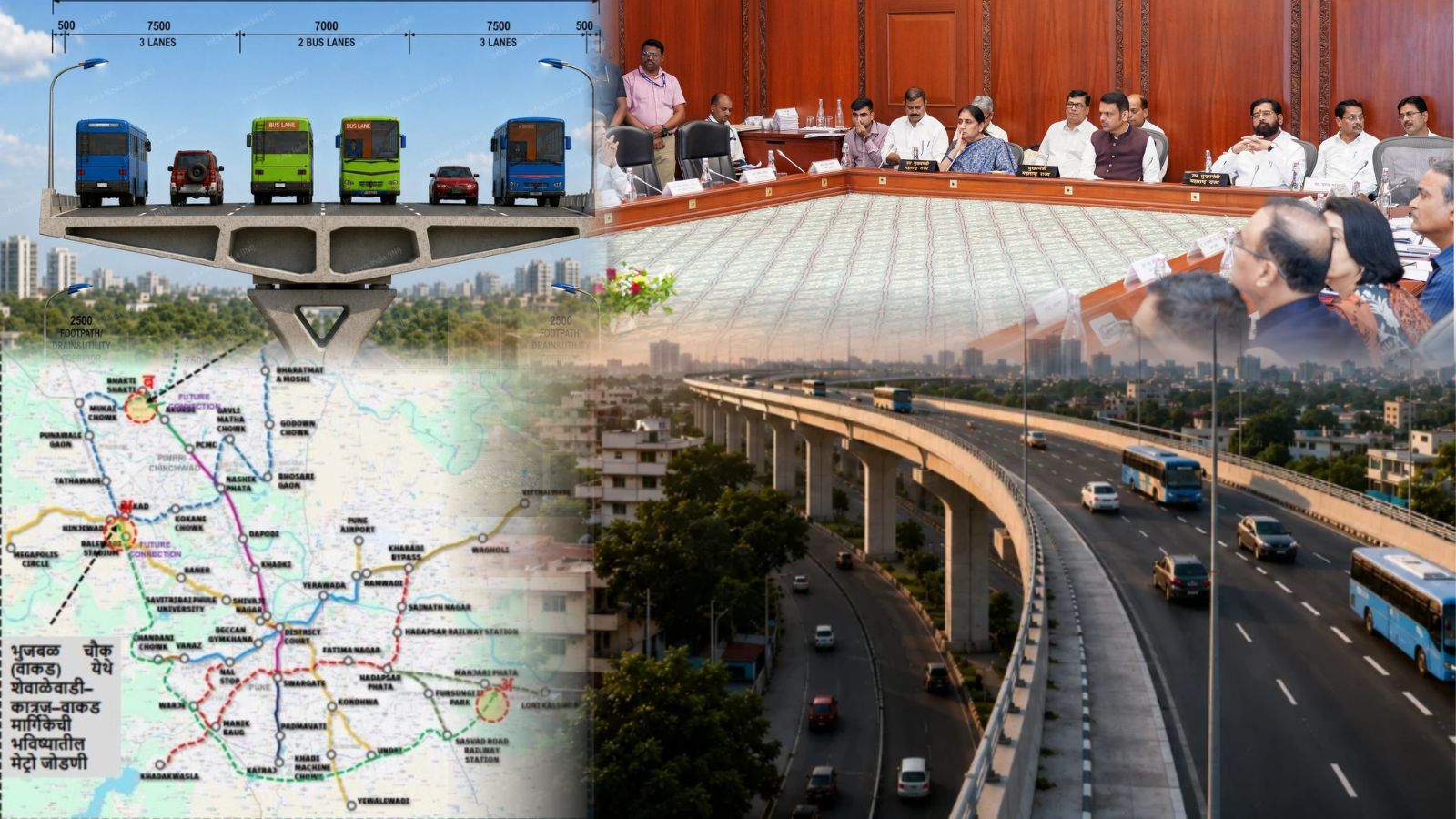
The 43.60-km HCMTR is expected to reduce traffic congestion in Pune by 25 to 30 per cent. The project will integrate all Metro corridors while significantly increasing road capacity and improving connectivity across the city.
The project is estimated to cost around ₹9,000 crore for construction, with another ₹3,000 crore required for land acquisition.
The HCMTR will include an advanced six-lane corridor passing through Pune’s central urban areas and will be executed in four packages:
- Bopodi to Sinhagad Road (10.5 km)
- Sinhagad Road to Solapur Road (13.2 km)
- Solapur Road to Airport Chowk (10.21 km)
- Airport Chowk to Bopodi (9.17 km)
The Chief Minister directed officials to prepare a joint government resolution to transfer the required government land to the Pune Municipal Corporation (PMC) and Pune Metropolitan Region Development Authority (PMRDA) for implementation of the HCMTR, Ring Road and tunnel projects.
PMRDA Inner Ring Road to Be Completed in Five Phases
The meeting also reviewed the progress of the PMRDA’s 83.12-km Inner Ring Road project, which will pass through 44 villages.
Chief Minister Fadnavis instructed officials to complete all administrative processes within the next six to seven months and directed that acquisition of private land be carried out through cash compensation.
The estimated cost of the project is ₹25,159.88 crore and it will be implemented in five phases:
- Phase 1: Solu Interchange to Vadgaon Shinde (Municipal Corporation limits) – 4.70 km, and Lohegaon (Municipal Corporation limits) to Wagholi – 7.56 km
- Phase 2: Wagholi to Kadamwak Wasti – 9.36 km
- Phase 3: Kadamwak Wasti to Jambhulwadi – 21.48 km
- Phase 4: Jambhulwadi to Bhugaon – 14.21 km
- Phase 5: Bhugaon to Parandwadi – 25.80 km
‘Patal Lok’ Tunnel Network Under Study
To address congestion within the city, the state government also reviewed plans for the proposed ‘Patal Lok’ tunnel network.
The proposal includes three major corridors:
- Bhosari to Undri via the proposed New Airport, spanning 36 km, including 10 km of elevated road.
- Ramnadi-Bhugaon to Rajaram Bridge, spanning 8 km.
- Taljai Hill to Padmavati-Hingne, spanning 1.65 km.
The Chief Minister directed officials to conduct a comprehensive technical survey through expert institutions before moving ahead with the tunnel network.
Government Land and Land Acquisition to Be Expedited
Fadnavis instructed officials to coordinate advance possession of government land, complete land acquisition and speed up all project-related administrative approvals to avoid delays.
Government land required for the HCMTR, Ring Road and tunnel projects will be transferred to PMC and PMRDA through a joint government resolution, while acquisition of private land for the Ring Road will be completed through cash compensation.
PMRDA Town Planning Schemes Also Reviewed
The committee also discussed the proposed Town Planning Schemes (TPS) prepared by PMRDA.
A total of 15 Town Planning Schemes proposed by PMRDA and the Pune Municipal Corporation came up for discussion. The Chief Minister directed PMRDA to prepare and submit a proposal regarding their cancellation for the government’s consideration.
Pune Metro Expansion Gains Fresh Momentum
Alongside the road infrastructure review, the state government also reviewed the future expansion of the Pune-Pimpri-Chinchwad Metro network.
The Metro journey has steadily expanded over the past decade:
- 2016: Metro project concept for Pimpri-Chinchwad initiated.
- 2019: Work on Pune Metro’s first phase connecting Sant Tukaram Nagar and Swargate gained momentum.
- 2021-22: Demand gathered pace to extend the Metro up to Nigdi.
- 2024: Pimpri-Chinchwad Municipal Corporation requested MahaMetro to prepare the Detailed Project Report (DPR) for Pune Metro Phase 2 covering Bhakti Shakti-Wakad-Nashik Phata-Chakan.
- 3 July 2024: UMTC appointed as consultant for preparing the DPR.
- 5 May 2025: Draft DPR for a 42.262-km corridor with 31 stations presented.
- 21 September 2025: Chief Minister Devendra Fadnavis, then Deputy Chief Minister, directed that the alignment be revised through Telco Road.
- 25 September 2025: PUMTA recommended the revised alignment.
- 26 February 2026: Revised DPR presented for a 45.295-km corridor with 34 stations.
- 27 July 2026: The DPR presentation included proposals for a Ring Metro, Nigdi-Chakan ‘Missing Link’ Metro, Integrated Double-Decker Corridor and Multimodal Transport Hubs.
The proposed Phase 2 Metro corridor is estimated to cost ₹12,937.23 crore and will cover 45.295 km with 34 stations.
The corridor will provide integrated connectivity with:
- Bhakti Shakti
- Wakad Chowk
- Nashik Phata
- Sant Tukaram Nagar
New Metro Corridors Proposed
The meeting also discussed proposals for several future Metro corridors aimed at creating a citywide network over the next five decades.
The proposed corridors include:
- An underground Hinjawadi-Chikhali Metro via Bhumkar Chowk, Dange Chowk, Thergaon, Rahatni, Pimpri Camp, Chapekar Chowk and Chinchwad Railway Station, with connectivity to the proposed Moi Bullet Train Station.
- Nigdi-Wagholi Metro via Chikhali, Moshi and Charholi.
- Airport Metro extension from Pune Airport to Vishrantwadi, Dighi, Charholi and Alandi.
- Revision of the PCMC HCMTR into an integrated Ring Road and Neo Metro corridor.
Ring Metro, Double-Decker Corridor and Multimodal Hubs Proposed
As part of the future transport blueprint for Pimpri-Chinchwad, key recommendations presented include:
- Development of a Nigdi-Talwade IT Park-Chakan ‘Missing Link’ Metro corridor.
- Creation of a Ring Metro network connecting Pimpri-Chinchwad, Hinjawadi and Chakan.
- Construction of an Integrated Double-Decker Corridor on the Talegaon-Chakan-Shikrapur route, carrying both an elevated road and Metro.
- Development of four multimodal transport hubs at Bhakti Shakti Chowk (Nigdi), Bhujbal Chowk (Wakad), Vallabh Nagar and Moshi, integrating Metro, BRT, PMPML, ST and other public transport services.
Proposed Timeline for Metro Phase 2
The proposed implementation schedule includes:
- July 2026: Approval of DPR by PCMC
- November 2026: State government approval
- July 2027: Final approval from the Central Government
- December 2027: Commencement of construction
- August 2032: Proposed launch of Metro services
Towards a Future-Ready Pune
The meeting underlined the state’s focus on developing an integrated transport network combining roads, tunnels and Metro systems to meet Pune and Pimpri-Chinchwad’s mobility needs over the next several decades.
Chief Minister Devendra Fadnavis emphasised scientific, sustainable and inclusive planning while directing officials to ensure timely execution of projects that are expected to improve connectivity, reduce congestion and strengthen the region’s long-term urban infrastructure.