The Anatomy of Public Anger and the Cost of Delay: How Protests Evolve and How Authority Collapses


Protests or public unrests are not as chaotic as they seem to be. In fact, their lifecycle is highly systematic and influenced by external inputs at various stages of their evolution. They don’t just happen out of the blue. Like a volcano, public unrest gives many signals before it explodes into a large-scale revolution.

The consequences of these public unrests can vary from being amicably resolved to being suppressed using force, or even leading to the toppling of governments.
In this article, I attempt to take a peek into the core of public unrest throughout its lifecycle and examine the various strategies that can be employed during the stages of its evolution by the targeted authority or government to control it.
The evolution of public unrest can best be described using an inverted pyramid structure, small at the bottom, getting broader as it grows and gains strength. On the other hand, the set of options available to the targeted authority can be described with an upright pyramid, broad at the bottom, denoting many available options, and becoming progressively narrower as options run out, eventually leading to a point where hardly any options are left.
In order to understand both sides of this dynamic, let us first examine the inverted pyramid structure, the evolution of public unrest, and its various stages.
The Lifecycle of Public Unrest (The Inverted Pyramid)
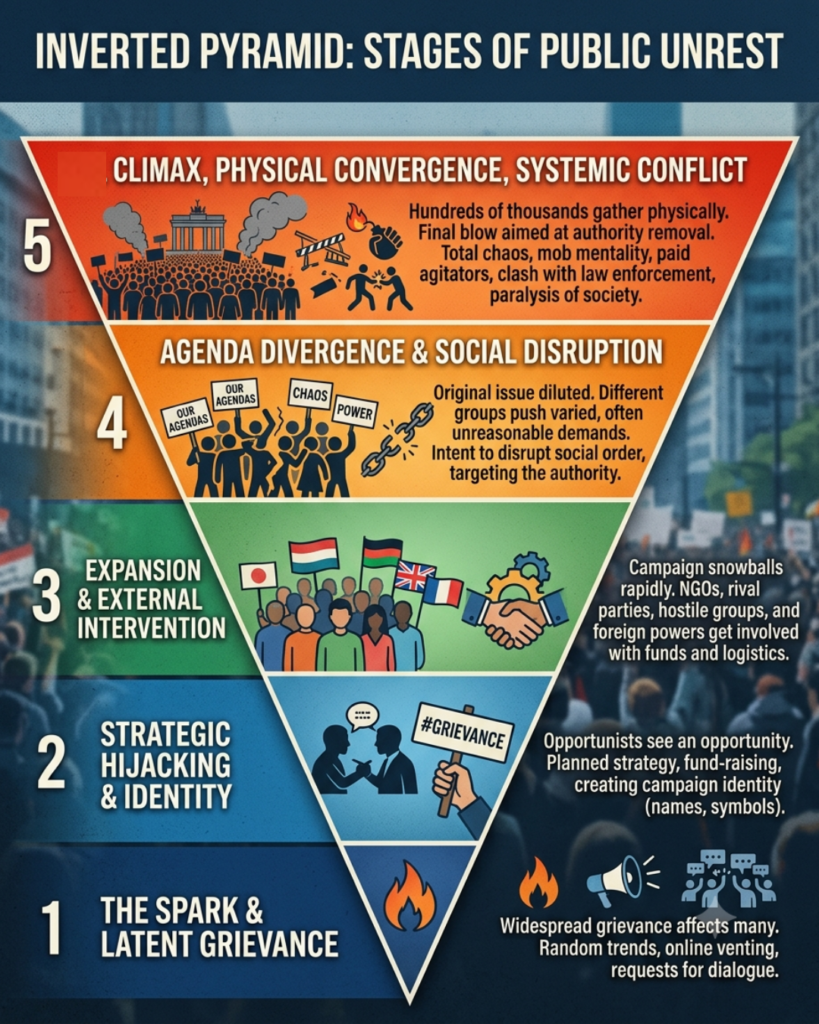
1. The Spark and Latent Grievance
An issue arises within the domain of a government that affects a large section of the population across religions, castes, classes, and geographies. Examples of issues with the potential to metamorphose into public unrest include job and educational reservations, controversial laws, unpunished crimes, government compensation disputes, and similar triggers. These issues, by either their absence or presence, can ignite public anger. When they occur, there is an underlying public dissatisfaction, generally manifested on social media platforms or in small public gatherings.
However, at this moment, the public is only voicing its frustrations and calling upon the government to address the issue. The discussions trend randomly without strategic planning from any organized entity.
2. Strategic Hijacking and Identity Creation
As public opinion converges and mention of the issue gains traction, an opportunist will begin to view the situation as a political or personal entry point. This individual or group usually is not directly affected by the core issue, but has been actively looking for an opportunity to build a campaign, eventually leveraging it to kickstart a political career or build a strong social media presence. They track the buildup of anger among the masses, analyzing how popular the issue is and how much traction it could gain if properly amplified. This is how they select the right issue among alternatives, sometimes waiting patiently across long intervals of time for the ideal moment to strike.
Once they identify the right opportunity, they initiate a well-planned strategy to blow up the issue on social media and through small gatherings. To champion the cause, they may even fund the campaign out of their own pockets and put significant effort into rallying people behind them. They project themselves as deeply moved by the cause, showcasing their determination to force a favorable resolution.
At this stage, a name, specific hashtags, and recognizable faces are added to give the campaign a distinct identity.
3. Expansion and External Intervention
As the campaign picks up pace and gains traction (though in many cases it fails to reach this point), it catches the attention of larger opportunistic powers, such as rival political parties, NGOs, hostile outfits, or foreign entities. They queue up to get involved. Initially, they announce their support in principle and gradually make inroads by assisting the campaign with funds, media support, and logistics. This is when the campaign starts to grow exponentially, backed by established powerhouses.
From this stage onward, the campaign becomes a snowball, rapidly gathering momentum and mass. Participants descend from various sections of society, some only remotely connected, or not connected at all, to the original issue.
4. Agenda Divergence and Social Disruption
As the campaign spreads nationally, it quickly becomes a vehicle for diverse stakeholders to push forward their own agendas under the guise of the initial cause. Demands become divergent and often unreasonable. The approach shifts from resolving the original grievance to transforming the movement into an unstoppable juggernaut that aims for the complete disintegration of the authority, whether that be a government, corporate management, or a local administration. Different supporting factions hold conflicting demands, and clear, unified direction vanishes. This marks the beginning of broad social disruption.
As the movement surges, disgruntled individuals, groups with nefarious designs, opposition parties, and veterans of previous unsuccessful campaigns see an opportunity to avenge past defeats or foster anarchy. Foreign powers and hostile nations view this stage as a prime opportunity to destabilize a rival country. Funding increases manifold, and money becomes the primary engine powering the campaign. In the digital age, capital is heavily deployed to shape the narrative through paid promotions on influencer handles.
Things rapidly begin to spiral out of control.
5. Climax, Physical Convergence, and Systemic Conflict
This is the final stage of public unrest. As the campaign reaches its peak, the organizers ready themselves to deal the final blow. Hunger strikes, self-immolations, or high-stakes stunts are deployed to build an emotional epicenter for the movement. Hundreds of thousands of supporters physically converge on this location.
An ultimatum is issued to the governing authority: accept the demands or face total disruption. The demands, however, have completely transformed, leaving the initial grievance far behind and presenting impossible choices. The authority is surrounded, with no easy retreat.
A crucial development at this juncture is that the initial champions and the original issue itself have been sidelined; the campaign now demands the total removal of the authority. Furthermore, the crowds are increasingly populated by individuals unconnected to the original cause, drawn instead by personal frustrations and looking for a scapegoat to vent their anger upon. Mob mentality takes over, blaming the establishment for every societal ill.
Organizers may even deploy paid agitators to project artificial strength and trigger law-enforcement breaches. On the decisive day, the dynamic resembles two opposing forces standing face-to-face. Protesters have been mobilized, and in some cases radicalized, to break barricades, damage public property, and defy state directives as they march toward core institutions such as Parliament, executive residences, or broadcasting hubs.
The protest becomes a self-fueling system with no single group maintaining central control. It devolves into sheer chaos, forcing law enforcement to strike back, often leading to violent exchanges and bringing society to a complete standstill.
The Outcomes
When an unrest reaches this terminal point, only two outcomes generally remain, dictated by raw leverage:
- Suppression and Attrition: If authorities manage to contain and disperse the crowd, they will swiftly suspend communication channels to prevent reigniting the movement, enforce arrests, and impose curfews. If successful, the government maintains physical suppression to wear the protesters down while offering backchannel concessions to key pillars of the movement to restore baseline normalcy.
- Collapse and Overthrow: The authority fails to contain the protest, and the crowds overrun state structures, often accompanied by law enforcement standing down or joining the movement. In this case, the government dissolves, leading to its exile, arrest, or in extreme cases, violent retribution at the hands of the mob.
Strategies to Control Social Unrest (The Upright Pyramid)
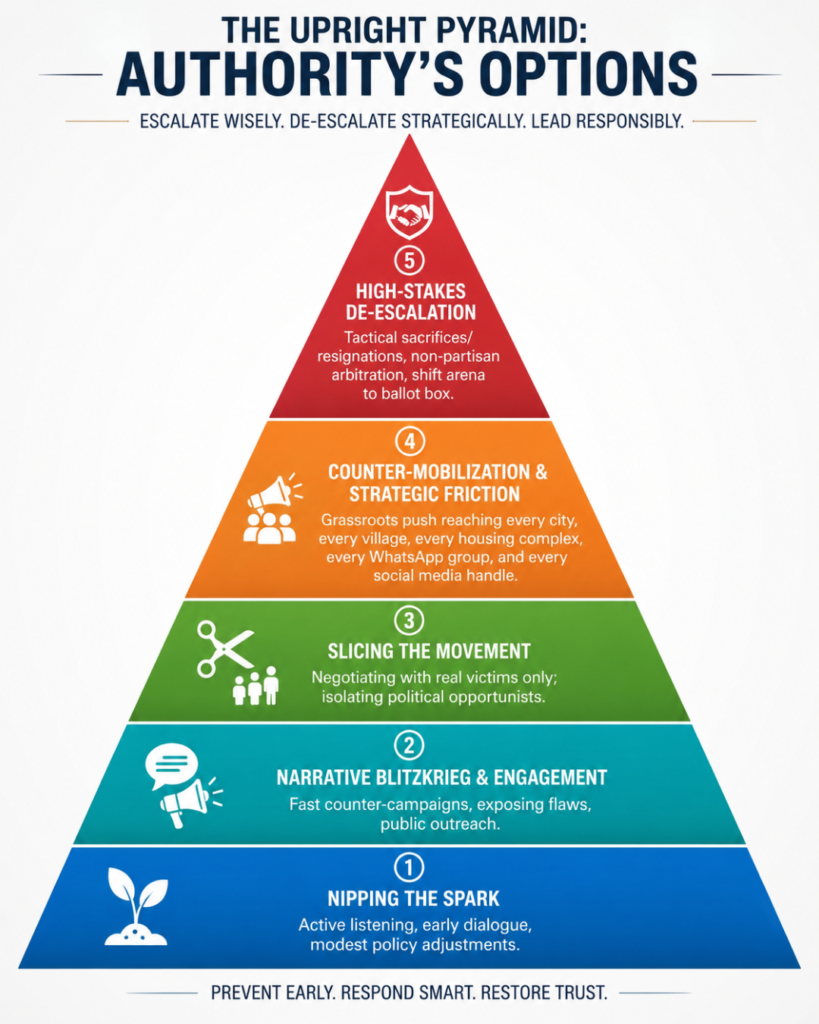
Having discussed the evolution of public unrest through its stages of development, let us examine the options available to the targeted authority across the same timeline. Notably, as the unrest pyramid broadens as it grows, the pyramid representing control options narrows with each successive stage, leaving the defender with fewer choices.
1. Nipping the Spark (Stage 1 Response)
At the earliest stage, when an issue is brewing and gaining public traction, it is a prime candidate for exploitation by opportunists. Therefore, authorities must monitor emerging grievances closely and address them immediately upon gaining momentum. If ignored, resolution becomes exponentially harder over time. At this point, the authority can issue clarifying statements, execute swift corrective policy tweaks, shape counter-narratives, and take visible administrative action to satisfy public concern and nip the issue in the bud. Control is simple and accessible at this stage.
2. Narrative Blitzkrieg and Engagement (Stage 2 Response)
If the brewing trouble was overlooked and proceeded to Stage 2, where an individual or small group is actively championing the cause, the threat becomes serious. They are quietly building a base and gaining momentum. Drumming up support at this phase is relatively easy because the public is curious and hopeful that someone is standing up for a broader cause.
At this stage, the authority still retains numerous options:
- Direct Intervention: Appoint a credible third-party negotiator to confront the challenger, utilizing both diplomatic incentives and legal deterrents to convince them to stand down.
- Counter-Narrative Blitzkrieg: Deploy government and institutional communication channels to launch a fast, decisive counter-campaign. Highlight structural flaws or personal vulnerabilities in the challenger’s record to strip the sheen off their campaign.
- Public Engagement & Policy Pivots: Significantly increase public engagement, launch popular alternative initiatives, or abruptly discontinue an unpopular policy to neutralize the agitator’s momentum.
3. Slicing the Movement (Stage 3 Response)
If Stage 2 is missed and the campaign progresses to Stage 3, peripheral issues will begin surfacing alongside the primary grievance. At this point, the state must strike at the structural roots of the movement.
The authority should announce a willingness to address genuine public demands, but strictly limit negotiations to actual victims or directly affected citizens, explicitly excluding third-party political opportunists. By sending a clear message (“We are ready to solve the problem, but we will talk only to the directly affected parties”), the state can sever the leadership from the core base. Real victims seeking practical resolutions will often accept fair terms, causing the broader crowd to disengage. If external political factions attempt to sabotage negotiations, targeted private deals or tactical political compromises may become necessary to prevent total escalation.
4. Counter-Mobilization and Strategic Friction (Stage 4 Response)
At this stage, the campaign has lost its original focus and morphed into a multi-headed movement with conflicting demands. Appeasing the crowd through standard policy concessions becomes nearly impossible because leadership is fragmented. Options are now severely constrained.
The defender may choose to make high-profile concessions on the core demand, hire respected public intermediaries to appeal for calm, or launch an aggressive counter-campaign across media channels to buy time.
Another strategic option is launching a structured counter-mobilization:
- Empower civil society figures and thought leaders to frame the movement as a threat to national stability backed by hostile forces.
- Fund and organize grassroots counter-groups to publicly highlight the risks the unrest poses to daily life, business, and public safety, reaching every city, every village, every housing complex, every WhatsApp group and every social media handle.
While expensive, exhaustive, and politically risky, such actions become necessary because early, low-cost intervention points were missed.
5. High-Stakes De-escalation and Institutional Shifts (Stage 5 Response)
If the campaign reaches Stage 5, it has turned violent, hyper-emotional, and destructive, rendering routine dialogue ineffective. Confronting the mob directly with heavy-handed force risks causing casualties, triggering a catastrophic sympathy wave that could instantly collapse the regime. At this terminal phase, the defender must abandon direct defense of its authority and deploy strategic de-escalation maneuvers to dismantle the crowd’s momentum without firing a shot:
- Tactical Sacrifices: Offer immediate sacrifices by forcing the resignation of key figures at the center of the storm, such as the Police Chief, a relevant Minister, or the primary architects of the controversial policy. This provides the moderate majority in the crowd a visible “win” and a reason to disperse, isolating hardline agitators.
- Institutional Mediation: Surrender the stage to non-partisan arbitrators, inviting universally respected judicial figures, religious leaders, or civil society elders to step in. Placing the issue under a binding judicial or commission reference shifts the narrative away from a direct clash with the government and grounds it in the rule of law.
- Surgical Isolation and Logistics Interruption: Behind the scenes, replace mass physical confrontation with targeted legal detainment of core organizers away from the physical protest site. Simultaneously, disrupt transport networks, high-power sound equipment, and financial pipelines sustaining the epicenter.
- Shifting to the Ballot Box: If the crowd continues to demand total regime collapse, the authority’s ultimate move is to shift the arena from the streets to the ballot box by announcing an immediate national referendum or early elections under independent supervision. This instantly strips the mob of its moral authority, reframing the conflict around democratic processes and forcing the movement to prove its mandate through votes rather than violence.
Conclusion: The Cost of Delay
The inverted pyramid of social unrest and the shrinking pyramid of state options reveal an unyielding reality of governance: time is asymmetric.
In the earliest stages of an issue, control requires little more than active listening, open dialogue, and modest policy adjustments. But as passive dissatisfaction is allowed to fester, it inevitably attracts opportunistic actors, external funding, and radicalized agendas. What could have been resolved with a conversation at Stage 1 eventually demands high-stakes political sacrifices, institutional interventions, or near-total structural disruption at Stage 5.
Ultimately, public unrest is rarely a sudden, unpredictable explosion. It is a slow, readable build-up of unaddressed grievances compounded by administrative delay. A government’s survival, and the preservation of social order, depends not on how forcefully it can suppress a crisis at its peak, but on how early it has the humility and foresight to recognize the spark.
Nipping the issue in the bud is not just a strategic choice; it is the only stage where authority retains full control over its own destiny.

Vineet Gupta is the Founder and Managing Editor of PuneNow, where he leads editorial coverage on Pune’s civic developments, local infrastructure, traffic, and urban governance. With an academic background from the University of Wales and professional experience across journalism, hospitality, finance, and academia, Vineet brings a unique perspective to hyper-local journalism. Based in Pune, he is passionate about empowering residents with accurate, timely news that affects their daily lives, while also offering insightful commentary on mindful living, parenting, and community connection.