Pune’s Dams Hold Approximately 14% Water Stock While the Monsoon is Nowhere in Sight
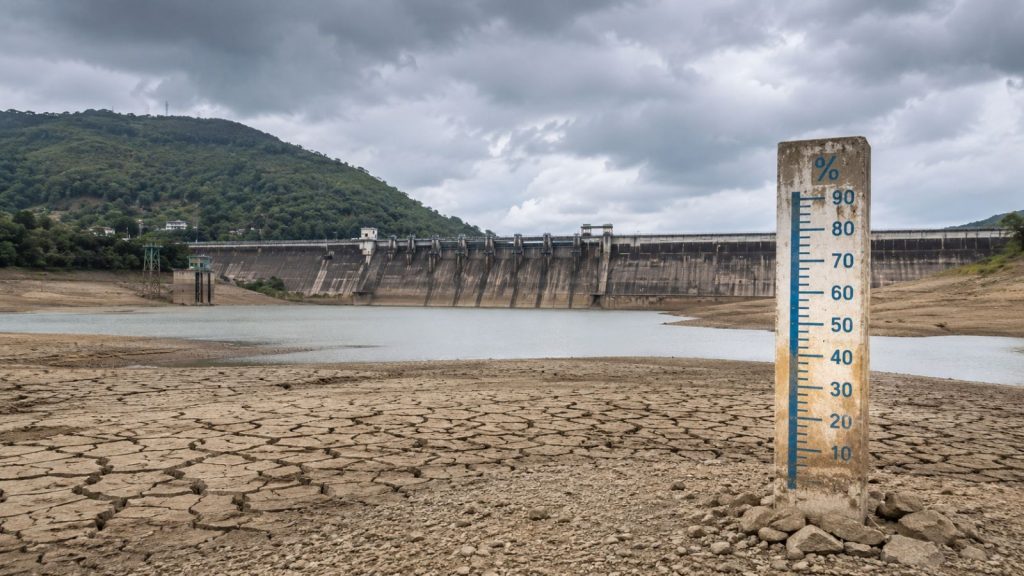

On the morning of 18 June, the combined live storage across the six major dams that keep Pune’s taps running stood at just 233.64 million cubic metres, a little over one-seventh of their total designed capacity. The number tells a story the city is beginning to feel in its daily life: alternate-day water supply, shuttered car washes, drained swimming pools, and an anxious wait for rain that, by every weather forecast available, will not arrive in earnest for at least another week.

PMC action: The Pune Municipal Corporation began alternate-day water supply across most of the city from 15 June, cutting consumption by an estimated 400 million litres per day. Vehicle washing centres and swimming pools have been ordered shut. PMC officials say current reserves, if rationed, can last until 20 August even in a worst-case rainfall scenario.
The Khadakwasla cluster: Pune’s primary lifeline
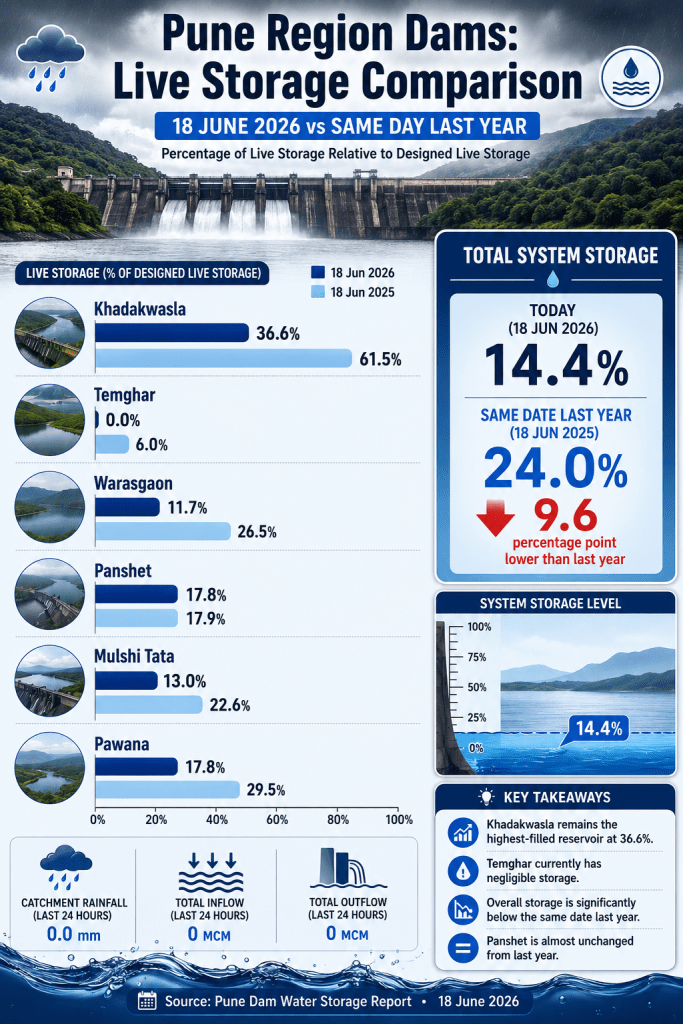
The four reservoirs of the Khadakwasla system, Khadakwasla, Panshet, Warasgaon, and Temghar, together supply drinking water to the Pune Municipal Corporation (PMC) area, which includes the old city, Hadapsar, Kothrud, Aundh, and most of the city’s densely populated neighbourhoods. Together, their designed live capacity is a little over 826 Mcum. Today, they hold a combined live storage of around 116.85 Mcum – roughly 14% of that capacity.
Temghar, the smallest of the four with a designed live capacity of just over 105 Mcum, has effectively run dry. Its live storage stands at zero. Khadakwasla, the closest reservoir to the city and the last in the chain, holds 20.49 Mcum against a designed live capacity of 55.91 Mcum – a fill of 36.6%, down sharply from 61.5% on this date last year. Panshet and Warasgaon are at 17.8% and 11.7% respectively, each significantly below their year-ago levels.
“Only 5.03 TMC of water remains in the Khadakwasla dam system, of which 3 TMC has been earmarked for Pune city.”
PMC officials, June 2026
Pawana: The PCMC question
Across the ridge, Pawana dam is the primary source for the Pimpri-Chinchwad Municipal Corporation (PCMC), which supplies water to the booming industrial city of Pimpri-Chinchwad – home to auto manufacturers, pharmaceutical firms, and a fast-growing residential population. Pawana’s live storage stands at 48.84 Mcum against a designed capacity of 274.32 Mcum. That is a fill level of 17.8%, compared to 29.5% on 18 June last year – a year-on-year decline of nearly 12 percentage points.
PCMC currently supplies 620–630 million litres of water per day to Pimpri-Chinchwad. The corporation has so far not announced a supply cut matching the PMC’s alternate-day schedule, but the reservoir trajectory, if the monsoon continues to stall, leaves limited room for delay.
Mulshi: Hinjawadi and the tech township belt
Mulshi dam, the largest of the six by designed capacity at 522.76 Mcum, feeds Hinjawadi IT Park and the cluster of new townships – Wakad, Baner extension, Marunji, and surrounding areas – that have rapidly urbanised over the past decade. Today, Mulshi holds 67.95 Mcum of live storage, a fill of just 13%, compared with 22.6% on this date in 2025. In absolute terms, it carries the most water of any of the six dams, but even its cushion is thinning faster than seasonal norms would suggest.
Why the monsoon is late
The southwest monsoon entered Kerala on 4 June, two days ahead of its normal date – a promising start. But after crossing into southern Maharashtra through Sindhudurg and Kolhapur on 6 June, it stalled. Meteorologists point to a combination of factors: the absence of a supporting Madden-Julian Oscillation (MJO) pulse, dry continental air entrenched over peninsular India, and the re-emergence of El Niño conditions over the Pacific – a pattern that has historically suppressed rainfall over the Indian subcontinent.
Pune has recorded zero rainfall over the last 21 days, a drought streak not seen since at least 2014 for this time of year. The city’s Shivajinagar observatory logged a minimum temperature of 26.1°C on 12 June – the highest June minimum in seven years – and maximum temperatures have consistently hovered 3–4°C above seasonal norms. The IMD’s revised forecast, issued on 29 May, put the season’s total rainfall at 90–95% of the long-period average, with a significant probability of below-normal totals. Rainfall deficits across Maharashtra for the 1–12 June period ranged from 43% in Marathwada to 73% in Vidarbha; Pune’s Madhya Maharashtra region was down 68%.
Major rainfall in Pune’s dam catchment areas is now not expected before around 21 June, and even that forecast is provisional. The IMD’s latest bulletin, dated 17 June, indicates the monsoon is likely to advance into parts of Telangana, Odisha, and Jharkhand around 23 June – suggesting the system’s energy is still moving north and east, not yet pivoting west toward the Sahyadri range that feeds Pune’s reservoirs.
“Meteorologists attribute the delayed and weak monsoon activity to the absence of support from the Madden-Julian Oscillation – a key atmospheric phenomenon that often enhances rainfall over the Indian region.”
Meteorological sources, June 2026
What comes next
PMC officials have said that the alternate-day supply system, implemented from 15 June, is expected to reduce daily water consumption by about 400 million litres – bringing draw-down from 1,550 MLD to approximately 1,150 MLD. The civic body has calculated that this should extend existing reserves to 20 August, even if rainfall in the catchment remains well below normal through July. Residents facing supply disruptions can reach PMC’s helpline at 1800-1030-222 or via the PMC Care App.
For Pimpri-Chinchwad, the path forward depends heavily on how quickly Pawana catches up once the rains arrive. The PCMC supplies water to one of Maharashtra’s fastest-growing urban areas, and unlike the Khadakwasla cluster, Pawana does not have a chain of feeder reservoirs to draw on – it is a single reservoir with a single catchment.
For Hinjawadi and the tech township belt served by Mulshi, the situation is complicated by the pace of residential development that has outrun infrastructure planning. Water tankers, already a fixture in many societies, are likely to see higher demand and higher prices in the weeks ahead.
Across all three supply systems, the arithmetic is the same: the city needs a good, sustained spell of rain over the Sahyadris – and it needs it soon. Every dry day that passes between now and the monsoon’s arrival is a day’s worth of storage the reservoirs will need to recover before the city can exhale.
Data sourced from the Daily Water Storage Report of Major Dams, dated 18 June 2026. Storage figures are live storage in million cubic metres (Mcum). Percentage figures represent live storage as a proportion of designed live storage capacity. Meteorological data sourced from IMD press releases and published weather reports. Civic water supply data sourced from published PMC and PCMC statements.