Who Was Marshal Arjan Singh? A 107-Year-Old Legacy of Valor and Bravery in the Skies
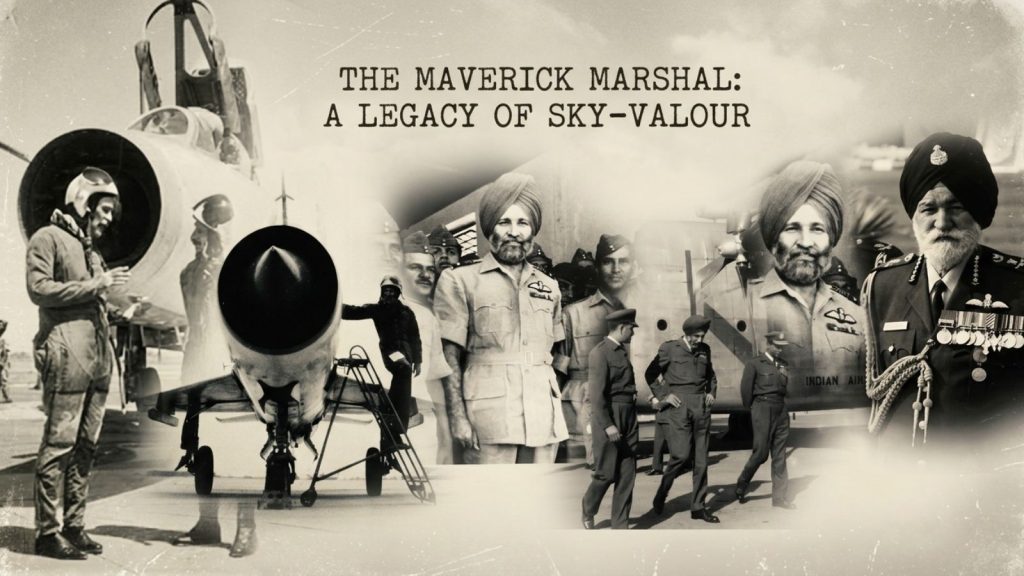

NEW DELHI – Today, as the Indian Air Force (IAF) marks the 107th birth anniversary of Marshal of the Air Force Arjan Singh, the nation remembers more than just a five-star rank. We remember a “Maverick” pilot who survived crashes, defied enemy fire in the jungles of Burma, and led a young nation’s air force to its greatest victories.

The Pilot Who Cheated Death: The NWFP Survival
Long before he was a global statesman, Arjan Singh was a young Pilot Officer testing his nerves in the North-West Frontier Province (NWFP) in 1940. While flying a Westland Wapiti biplane, he was shot down by Pathan tribesmen.
His aircraft slammed into a rocky, dry stream bed, a crash that would have ended most careers. Instead, with a display of the “iron will” that would later define the IAF, Singh was back in the cockpit flying the same dangerous routes just two weeks later. This early brush with death served as the blueprint for his lifelong philosophy: resilience under fire.
Commanding the “Tigers” Through the Siege of Imphal
By 1943, Squadron Leader Arjan Singh was in command of the elite No. 1 Squadron, the “Tigers.” When the Japanese launched a massive offensive in Burma, Singh didn’t wait for orders to stay safe. He petitioned high command to move his squadron to the front lines.
During the grueling 1944 Imphal Campaign, Singh flew Hawker Hurricanes in relentless close-air support missions. He famously led from the front, logging more combat hours than almost any pilot under his command to ensure his “Tigers” never lost their bite.
A Medal on the Front Lines: The DFC
His exploits were so daring that they caught the eye of the Supreme Allied Commander, Lord Mountbatten. In a rare break from military protocol, Mountbatten flew to the Imphal front in 1944 to personally pin the Distinguished Flying Cross (DFC) on Singh’s chest. The award recognized his “fearless and determined” leadership during the Arakan Campaign, a moment that cemented his status as a legendary air warrior.
The “Maverick” Spirit: Risking it All for Morale
Arjan Singh believed that a fighter pilot without “dash” was no pilot at all. In 1945, he nearly faced a court-martial for performing a dangerously low-level “beat-up” pass (a high-speed low pass) over a house to boost the spirits of a struggling trainee. He stood his ground against the top brass, arguing that such flair was essential to maintain the fighting spirit of his men. The charges were dropped; the IAF knew they had a rare leader on their hands.
From Combat Hero to Five-Star Marshal
These early years of combat paved the way for his strategic brilliance during the 1965 Indo-Pak War. As Chief of the Air Staff, he utilized the same tactical aggression he learned in Burma to stop enemy armored thrusts and secure air superiority for India.
In 2002, the Government of India conferred upon him the rank of Marshal of the Air Force. He remains the first and only five-star officer in the history of the IAF, a rank he held with legendary humility until his passing.
A Legacy That Still Soars
Today, ceremonies at the Gateway of India and airbases across the country honor his 107-year-old legacy. From surviving biplane crashes to leading supersonic jets, Marshal Arjan Singh remains the ultimate symbol of Indian air power. He proved that for those with courage, the sky is never the limit.