🚗 30 Minutes Shaved Off: Mumbai-Pune Expressway’s ‘Missing Link’ Locks May 1 Opening Date

MUMBAI/PUNE: In what promises to be a game-changer for the 75,000 vehicles that traverse the Mumbai-Pune Expressway daily, the long-awaited ‘Missing Link’ project is finally set to open on May 1, 2026, slashing travel time by up to 30 minutes and banishing the notorious Khandala-Lonavala ghat bottleneck to history.

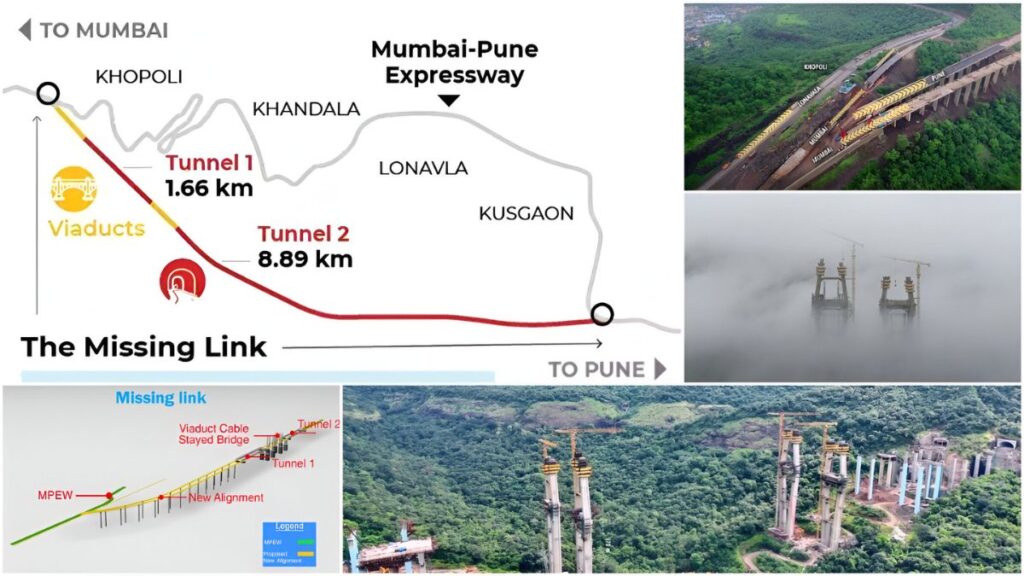
After years of delays triggered by the COVID-19 pandemic, engineering complexities, and challenging terrain, the Maharashtra State Road Development Corporation (MSRDC) confirmed that the project is now 98 per cent complete, with finishing touches underway on India’s tallest road cable-stayed bridge .
With only 15 metres of work pending on the Mumbai corridor and 6 metres on the Pune side of the cable-stayed bridge, full connectivity is expected by March 10, followed by mandatory load testing and safety trials in April before the public opening .
The Missing Link: What It Is and Why It Matters
The 13.3-kilometre ‘Missing Link’ stretches between Khopoli on the Mumbai side and Kusgaon near Pune, bypassing the steep, winding 19.8-kilometre ghat section that has long been the expressway’s Achilles’ heel . By cutting the distance by approximately six kilometres, the new four-lane alignment offers a straighter, safer alternative that eliminates the sharp curves and steep gradients that frequently trigger accidents and snarls .
For commuters, the numbers translate to tangible relief. Travel time between the two cities is projected to drop from about 3.5 hours to roughly 3 hours via Vashi, while those using the Atal Setu from South Mumbai could complete the journey in just 2.5 hours .
Engineering Marvel: Tunnels and India’s Tallest Road Bridge
The Missing Link is not merely a bypass, it is an engineering spectacle that reflects advanced infrastructure capabilities.
The route’s key features include:
- 900-metre viaduct at Khopoli, elevated 60 metres above ground
- Tunnel 1: 1.64 km, leading into Tiger Valley
- Cable-stayed bridge: A 650-metre span over Tiger Valley, supported by two 180-metre pylons, making it India’s tallest road cable-stayed bridge, surpassing the Bandra-Worli Sea Link’s 128-metre pylons
- Tunnel 2: A massive 8.92-kilometre tunnel that passes 180 metres beneath Lonavala lake
The tunnels, each 23.5 metres wide, rank among the widest in Asia and required extensive safety engineering, including water mist fire suppression systems, variable speed signage, automatic number plate recognition, and voice evacuation systems .
Safety First: Hazardous Vehicles Barred
In a critical safety decision, MSRDC has confirmed that vehicles carrying hazardous substances, including petrol, diesel, LPG, CNG, and chemicals, will not be permitted to use the Missing Link .
According to IRC guidelines, long tunnels fall under the highest risk category. “In case of a fire inside a tunnel, there is a serious risk of suffocation with catastrophic consequences,” said Rajesh Patil, Joint Managing Director of MSRDC, citing a similar accident in Japan that resulted in casualties . Tankers carrying water, milk, and non-hazardous cargo such as steel will, however, be allowed .
Traffic Relief and Emergency Alternative
The Missing Link is expected to transform traffic patterns on one of India’s busiest intercity corridors. Highway traffic police estimate that roughly 70 per cent of expressway traffic, comprising light motor vehicles like cars and travellers, will shift to the new alignment .
“The main advantage will be for those travelling from Pune towards Mumbai. It’s that direction where traffic crawls because light vehicles get stuck behind heavy ones on the ghat stretch,” said Tanaji Chikhale, Superintendent of Police, Highway Traffic, Raigad .
The urgency of an alternate route was starkly highlighted in February 2026, when a gas tanker accident brought traffic to a halt for 32 hours, creating 20-kilometre queues and leaving thousands stranded without food or water . The Missing Link would have served as a vital diversion during that crisis.
Safety Concerns: Calls for Caution
Despite the excitement surrounding the May 1 opening, voices of caution have emerged. Shiv Sena (UBT) MLC Milind Narvekar, in a letter to Chief Minister Devendra Fadnavis, urged that the link not be opened in haste .
Narvekar demanded that all technical tests and ancillary works be completed before inauguration, suggesting that for the first six months, only passenger vehicles be permitted while heavy vehicles continue using the old route . MSRDC officials have reiterated that traffic will only be allowed once all mandated safety standards and load tests are satisfied .
Toll Charges: What Commuters Can Expect
Concerns over a potential toll hike following the Rs 6,695-crore investment have been addressed by authorities. According to reports, the toll collection timeline has been extended to 2045, with rates reviewed every five years, the next revision scheduled for 2030 . No immediate or sharp increase in toll rates is expected .
Looking Ahead: Beyond Faster Commutes
The Missing Link’s impact extends beyond travel time savings. Urban planners suggest the project could influence regional development patterns, making peripheral locations near Lonavala and Khalapur more viable for housing and commercial investment . However, environmental experts caution that sustained monitoring of slope stability, water drainage, and biodiversity safeguards will be essential in the ecologically sensitive Western Ghats .
As the April 30 construction deadline approaches, all eyes are on MSRDC to deliver a project that, after six years of delays, promises to finally decongest the Mumbai-Pune corridor, and ensure that the next emergency does not bring the state’s busiest highway to a standstill.