Ahead of Many Countries, Maharashtra Now World’s 30th Largest Economy; Set to Become India’s First Trillion-Dollar State by 2029
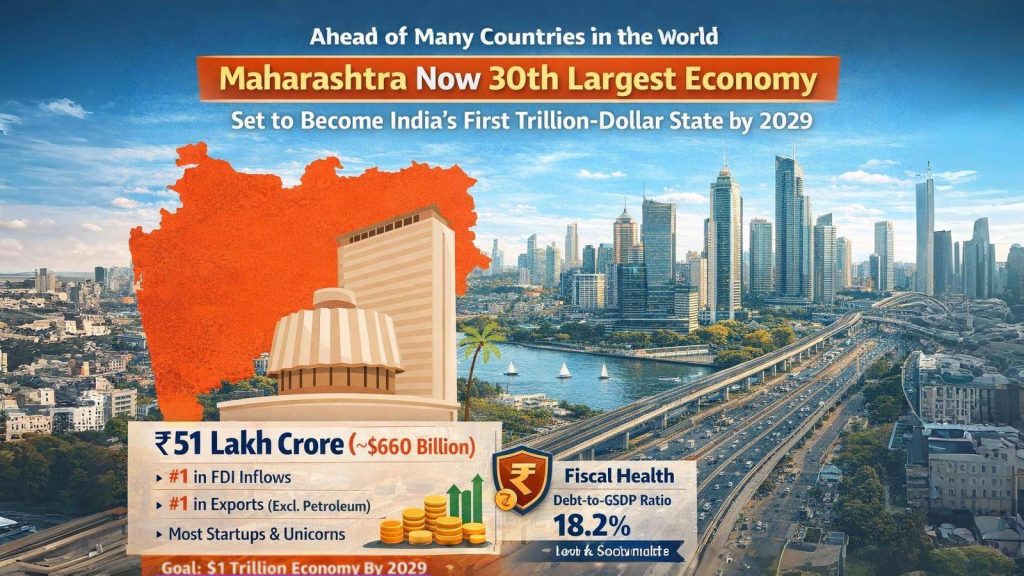

In a landmark revelation during the 2026-27 budget discussion, Maharashtra Chief Minister Devendra Fadnavis announced that the state’s economy has surpassed several developed nations, positioning it as India’s undisputed economic powerhouse.

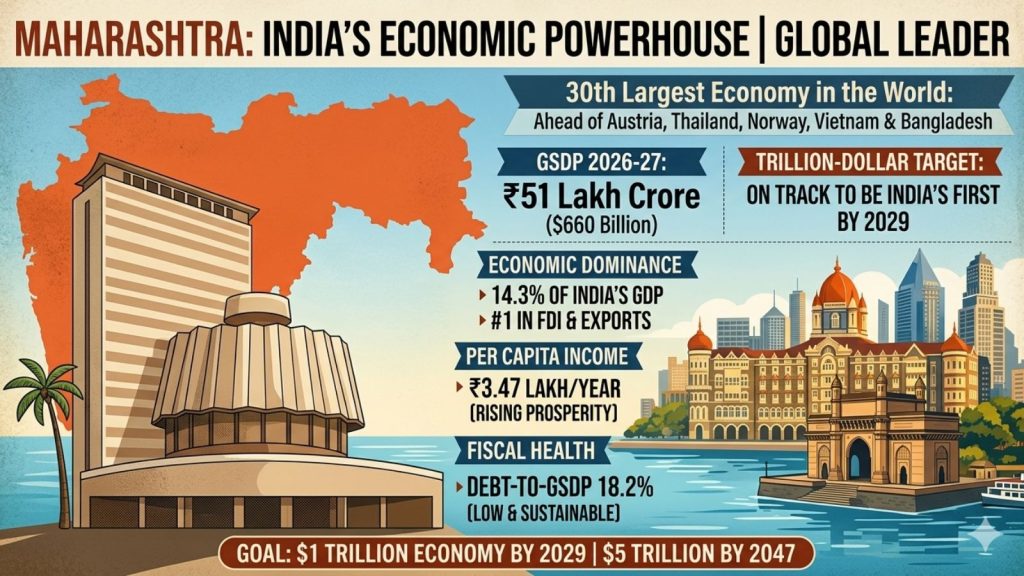
Mumbai, March 12, 2026: In an assertion of Maharashtra’s economic dominance, Chief Minister Devendra Fadnavis on Wednesday informed the state legislative assembly that Maharashtra has emerged as the 30th largest economy in the world, overtaking developed and emerging nations including Austria, Thailand, Norway, the Philippines, Vietnam, and Bangladesh. Replying to the general discussion on the 2026-27 state budget, Fadnavis projected that Maharashtra is firmly on track to become India’s first trillion-dollar sub-national economy within the next few years.
महाराष्ट्राची अर्थव्यवस्था जगातील तिसावी मोठी अर्थव्यवस्था. महाराष्ट्राची अर्थव्यवस्था ऑस्ट्रिया, थायलंड, नॉर्वे, फिलिपिन्स, व्हिएतनाम, बांग्लादेश या देशांच्या अर्थव्यवस्थांपेक्षा मोठी – मुख्यमंत्री देवेंद्र फडणवीस@Dev_Fadnavis #अर्थसंकल्पीयअधिवेशन#अर्थसंकल्पीयअधिवेशन२०२६… pic.twitter.com/Fj8Trg5Bkx
— MAHARASHTRA DGIPR (@MahaDGIPR) March 11, 2026
The Chief Minister’s statement comes amid a heated debate in the assembly, where approximately 84 members participated in discussions on the state’s financial health. Countering the opposition’s allegations of mounting debt, Fadnavis presented a detailed picture of the state’s robust economic fundamentals, fiscal discipline, and ambitious growth trajectory.
Maharashtra’s GSDP Surges Past Nations, Eyes UAE and Singapore Next
Presenting comparative data, CM Fadnavis highlighted the exponential growth of the state’s economy over the past decade. He noted that if Maharashtra were a sovereign nation, it would currently rank 30th globally by Gross Domestic Product (GDP), having left behind countries with historically stronger economies.
“Maharashtra’s economy is expanding at an unprecedented pace. We have already overtaken the economies of Austria, Thailand, Norway, the Philippines, Vietnam, and Bangladesh,” Fadnavis stated. “Within the next two to three years, we are confident of surpassing the economies of the United Arab Emirates (UAE) and Singapore as well.”
The Chief Minister attributed this rapid growth to policy consistency, increased capital investment, and the entrepreneurial spirit of the state. He emphasized that the state’s Gross State Domestic Product (GSDP) has witnessed a remarkable jump from approximately Rs 16 lakh crore in 2013-14 to an estimated Rs 51 lakh crore (approximately $660 billion) in the current fiscal year.
Trillion-Dollar Target: India’s First Economic Powerhouse
Reiterating the government’s vision, CM Fadnavis expressed confidence that Maharashtra will achieve the historic milestone of becoming India’s first trillion-dollar economy by 2029. This ambitious target aligns with the central government’s broader goal of making India a developed nation by 2047.
“Maharashtra is not just contributing to India’s GDP; we are leading it,” Fadnavis asserted. “Our growth rate stands at 7.9 per cent at constant prices and 10.4 per cent at current prices, which is significantly higher than the national average. We are committed to ensuring that by 2029, Maharashtra becomes the first Indian state to cross the trillion-dollar mark in economic output.”
He further projected that by 2047, when India celebrates 100 years of independence, Maharashtra’s economy has the potential to scale up to $5 trillion, playing a pivotal role in the nation’s journey towards ‘Viksit Bharat’.
Maharashtra’s Contribution to National Economy: Unmatched
Highlighting the state’s critical role in India’s economic landscape, the Chief Minister provided key statistics that underscore Maharashtra’s dominance.
“Despite accounting for only 9.5 per cent of India’s population, Maharashtra contributes a staggering 14.3 per cent to the nation’s GDP,” Fadnavis informed the house. “This is a testament to our productivity and economic efficiency.”
He listed several sectors where Maharashtra leads the country:
- Foreign Direct Investment (FDI): Maharashtra continues to attract the highest FDI inflows in India.
- Exports (excluding petroleum): The state is the top exporter, driving India’s trade balance.
- Startups and Unicorns: Maharashtra houses the maximum number of startups and unicorns, fostering innovation.
- Banking and Credit: The state leads in bank deposits and credit disbursal.
- GST Collection: Maharashtra consistently tops the charts in Goods and Services Tax (GST) revenue collection.
- Forest Cover: Even in environmental parameters, Maharashtra ranks first in increased forest cover according to the ‘Forest of India’ report.
Rising Prosperity: Per Capita Income Soars
The economic growth has directly translated into rising prosperity for the state’s residents. CM Fadnavis informed the assembly that the per capita income of Maharashtra has increased from Rs 3.17 lakh to an estimated Rs 3.47 lakh, placing it among the highest in the country and significantly above the national average.
Fiscal Discipline: Debt Well Under Control
A major portion of the Chief Minister’s address was dedicated to countering opposition criticism regarding the state’s borrowings. Fadnavis robustly defended the government’s fiscal management, emphasizing that the debt is productive and well within sustainable limits.
“The opposition keeps raising the issue of debt, but they do not look at the complete picture,” he said. “One must compare debt in relation to income. In 2013-14, when the state’s income was Rs 16 lakh crore, our debt stood at around Rs 3 lakh crore. Today, our income has grown to Rs 51 lakh crore, and the debt is at Rs 9.32 lakh crore.”
He clarified that the state’s Debt-to-GSDP ratio currently stands at a healthy 18.2 per cent, which is significantly lower than the permissible limit of 25 per cent set by fiscal responsibility norms.
Maharashtra’s Fiscal Health vs Other Indian States
Drawing a comparison with other major states, CM Fadnavis showcased Maharashtra’s superior fiscal management. He pointed out that while Maharashtra maintains a low debt-to-GSDP ratio, several other states are grappling with much higher debt burdens.
“Except for Gujarat (15.3 per cent) and Odisha (13.1 per cent), most other states have a much higher debt-to-GSDP ratio than Maharashtra,” Fadnavis stated. “States like Madhya Pradesh, Rajasthan, Punjab, Kerala, and West Bengal have ratios ranging from 30 to 46 per cent. This clearly shows that Maharashtra’s fiscal position is far more robust and sustainable compared to others.”
Capital Expenditure: Investing in Future Growth
The Chief Minister emphasized that the borrowings are not for revenue expenditure but for building long-term assets. He highlighted that the government has significantly ramped up capital expenditure to boost infrastructure and create jobs.
“We have increased capital investment from Rs 25,000 crore to nearly Rs 2 lakh crore,” he noted. “This money is being channeled into irrigation, power projects, industrial infrastructure, highways, the Jal Jeevan Mission, and the Pradhan Mantri Awas Yojana. This is productive debt that will generate future revenue and enhance the quality of life for our citizens.”
A Vision Rooted in Heritage and Progress
Beginning his address by paying tribute to Chhatrapati Sambhaji Maharaj on his martyrdom day, CM Fadnavis also noted the auspicious coincidence of the budget presentation falling on Chhatrapati Shivaji Maharaj Jayanti. He framed the government’s economic vision as a continuation of the good governance and foresight exemplified by the Maratha rulers.
“Despite challenges, Maharashtra has the capacity to maintain fiscal discipline while achieving development,” Fadnavis concluded. “This budget is a roadmap to take the state forward, and for that, the cooperation of all sections of society and all members of this house is essential.”
With the target of becoming the nation’s first trillion-dollar economy firmly in sight, Maharashtra has not only reinforced its status as the richest state in India but has also staked its claim as a formidable economic entity on the global stage.