Third Mumbai Project: Inside Maharashtra’s Blueprint for Mumbai 3.0 Beyond Atal Setu
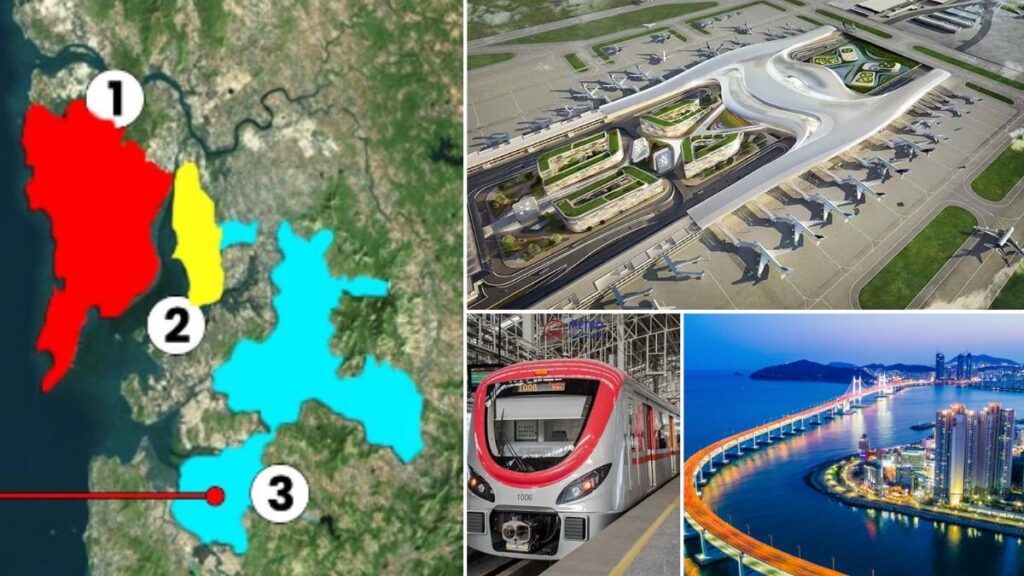

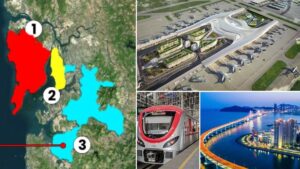
Mumbai: The Maharashtra government is aggressively scripting a new chapter in the state’s urbanisation story. Moving decisively beyond the congested confines of the original seven islands and the subsequent development of Navi Mumbai, the state has unveiled a detailed blueprint for a “Third Mumbai” , a massive new urban centre designed to decongest the region, attract global investment, and accommodate the city’s future growth. With a formal land policy now in place and a dedicated Rs 4,000 crore outlay in the recent MMRDA budget, the vision for Mumbai 3.0 is rapidly taking shape on the ground .
Land Policy Clears the Path for Development
The foundation for this ambitious project was laid in February 2026, when the Maharashtra cabinet approved a comprehensive land acquisition and allotment policy for the development of Third Mumbai near the Atal Setu (Mumbai Trans Harbour Link) . Chief Minister Devendra Fadnavis confirmed that approximately 200 square kilometres of land has been formally handed over to the Mumbai Metropolitan Region Development Authority (MMRDA) to ensure planned and systematic urban expansion .
This policy is not just about acquiring land; it establishes a clear framework for how the region will grow. It will govern all development projects under the newly appointed New Town Development Authority and future MMRDA initiatives in the impact zone of the Mumbai Trans Harbour Link (MTHL) . The primary goal is to facilitate faster execution of infrastructure and urban projects, thereby promoting balanced regional growth and providing a much-needed alternative to Mumbai’s saturated core .
Decoding the New Land Rules
The new policy introduces several innovative mechanisms to streamline development and attract investment, particularly in the Atal Setu impact zone :
- 22.5% Land Refund for Project-Affected People: For landowners whose property is acquired, the government will implement a scheme to return 22.5% of the land in a developed form. If the returned plot is smaller than 40 square meters, cash compensation will be provided instead. Compensation can also be offered in the form of Floor Space Index (FSI) or Transferable Development Rights (TDR) .
- ‘Pass-Through’ Policy for Quicker Industrialization: To jumpstart development in undeveloped areas, a ‘pass-through’ policy has been approved. Under this, allottees can bear the cost of land acquisition and infrastructure development in installments. Crucially, the MMRDA will levy a 15% establishment charge, and land will be provided on an “as-is-where-is” basis, with the allottee responsible for future costs .
- FDI Incentives to Attract Global Capital: To position Third Mumbai as a global investment destination, priority allotment will be given to industries bringing in Foreign Direct Investment (FDI). Investors must acquire a minimum of 100 acres and invest at least Rs 250 crore per 100 acres (excluding land cost) within four years. Up to 25% of the total developed area is earmarked for such FDI-driven projects .
MMRDA Budget 2026-27: Funding the Vision of Mumbai 3.0
The government’s commitment to Mumbai 3.0 was further solidified in the MMRDA budget for 2026-27. The authority presented its first surplus budget in nine years, with a massive 87% of its Rs 48,072.5 crore outlay dedicated to infrastructure works .
A significant highlight is the Rs 4,000 crore earmarked specifically for the new Karnala–Sai–Chirner (KSC) New Town, the official name for the Third Mumbai project . MMRDA officials described this allocation as the “operationalisation of MMR’s next urban frontier,” designed to decongest Mumbai, attract global capital, and create structured employment ecosystems aligned with NITI Aayog’s Growth Hub concept . Additional funds of Rs 500 crore for the Pen growth centre and Rs 100 crore for the Kharbav business park further complement this decentralisation plan .
Maharashtra Budget 2026 Amplifies the Plan
The broader Maharashtra Budget 2026, presented by Chief Minister Fadnavis in early March, reinforced the state’s long-term urban strategy. The government projects that by 2047, 70 per cent of Maharashtra’s population will reside in urban areas, contributing nearly 80% of the state’s GDP .
In this context, Third Mumbai is positioned as a key driver of economic growth. The budget documents identified specific areas like Kushmanda and Sai-Chirner as part of this new urban zone . Furthermore, the plan is to integrate this new city with other mega-infrastructure projects, including the Vadhavan Port, which alone is projected to generate over 12 lakh jobs, and a future development corridor referred to as “Mumbai 4” or “Fourth Mumbai” .
A BKC-like Business District and a Master Plan in Motion
The architectural vision for Third Mumbai is grand and meticulously planned. Earlier announcements by CM Fadnavis revealed the establishment of a new business district at Raigad-Pen, modelled on the successful Bandra-Kurla Complex (BKC) . Dubbed the “first city” of the Third Mumbai region, this growth centre will be located just 15-20 km from the Navi Mumbai International Airport (NMIA) , offering a ‘plug-and-play’ environment for businesses and creating a ‘walk-to-work’ ecosystem with well-paid jobs in global capacity centres and fintech .
Officially known as the Karnala-Sai-Chirner (KSC) New Town, the project spans 124 villages in Raigad district . The master planning process is already underway, involving advanced techniques like drone-based mapping and LiDAR surveys. The target is to complete a comprehensive development strategy and master plan by August 2026 .
Housing, Sustainability and the Road Ahead
The vision for Mumbai 3.0 extends beyond just offices and infrastructure. It aims to be a complete, livable city. The government’s ‘No New Slum Framework’ aims to redevelop around 20 lakh slum tenements and construct 10 lakh affordable housing units in the MMR, many of which will likely be located in this new growth corridor .
However, experts point out that the project’s success hinges on addressing critical challenges. Transparent land allocation, robust rehabilitation plans for the over 120 villages within the project area, and embedding climate resilience measures from the outset are paramount . Given the region’s coastal location and exposure to monsoon intensification, integrating green buffers and water-sensitive design will be crucial to creating a sustainable and inclusive “Third Mumbai” that truly serves as a model for 21st-century urban India.