Talking about a Revolution
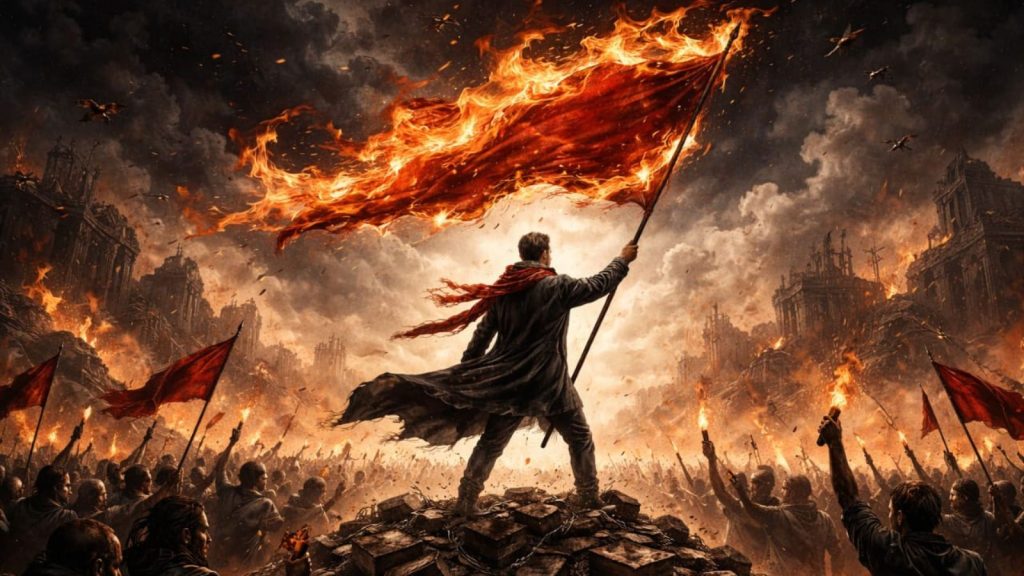

“I rebel, therefore I exist.” I had just finished re-reading Albert Camus’ ‘The Rebel’. Re-reading it is a necessity. It took some six years for Camus to research and study the material on which his thesis was based. One reading of this kind of writing is not enough to experience the nature and grandiosity of its storytelling. After reading through its pages, one begins to learn how to read the narrative as it unfolds before you on a human canvas.
The world appears to be continually in a state of revolution that springs from rebellion and its corollary, which is submission. Both rebellion and submission appear as two prongs on which the spectre of human enterprise rests. Either we submit and forestall our free will, or we rebel and create something new, which means we disturb the existing order, like the angels stirring the waters of Bethesda. Each stirring resulted in a miracle and renewal of life.
If submission is necessary, so is rebellion. In the relationship of being the probable opposite of each other, one thing that remains constant is the idea of authority that both of these concepts grapple with. Now I can choose to submit even when I do not believe. I can also will myself to rebel when I choose to reject any oppression that requires me to submit. Often this is done when one’s sense of identity is threatened and tortured up to a point when one cries, “Enough! I can take it no more”. At this point, one has realised the limits of one’s liberty in proportion to one’s awareness of liberty that one can have. Having realised this, man disengages from deferring his salvation to a time and place of God’s choosing, and arms himself towards his own freedom. Faith in divine deliverance has led him, for too long, to resign himself to injustice. “Enough”, becomes his cry for freedom. Not amor fati, a love of fate, but odium fati, a resentment of one’s deplorable condition, which now necessitates a movement towards rebellion.
Camus, the existentialist, examines his idea of human rebellion and the revolution that results from it. For Camus, a rebel is someone who says both ‘yes’ and ‘no’. No, to the continued state of oppression that he is subjected to, and yes to the change that brings about liberation. Hence, such a rebellion stands sanctified and stamped by an approval that aims to level the existential field for human endeavour to flourish. BR Ambedkar also rebelled in order to annihilate the virulent contours of caste and bring all people into the mainstream. It was necessary for him to be one of the founding fathers of the Indian constitution in order to provide within our foundational manifesto, the right to a ‘good life’ that breaks free from the shackles of oppression artfully rooted in divine injunction.
Rebellion is also an imperative when one considers the creative fields. A rebel transforms the operating canvas and creates new economic and social conveniences, which, over time, become a naturalised way of living. Rebellion is what the artist and the scientist do. They question existing scenarios and reimagine the existential landscape, pointing out to humanity the pathways to our own salvation in the ‘here and now’. There is no need to wait for ‘someplace else’. Thich Nhat Hanh calls this an immersion into the present moment, which then becomes a wonderful moment. As a matter of fact, the contention is that ‘here and now’ is all that there is.
Is there freedom in accepting things as they are? The Stoic may argue in favour of this argument – a conformity with nature. To endure without any appeal outward. Is this an obedience to one’s fate and a submission to predestination? Does this also preclude free will and the emergence of human creativity? But one has to rebel against suffering, since it does exist. This message made Gautama Buddha a humanistic deliverer from the oppression of human bondage and, curiously, turned him into a God.
Art, too, can reflect a principle of obedience and submission in delineating how we live, as in the classical art of medieval times. Art, like the dadaists and the meta-modernists, can also defy how we live and show us how we ought to live; what to keep, discard, renew, and create anew, not always through a search for unity and absolute clarity but also a reverence for the fragmentation in how we find our way around. Such art becomes a revolution.
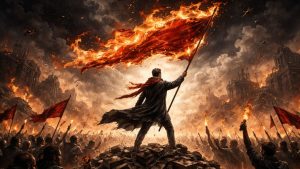
Like all good things, too much of something can turn the entire enterprise awry. Camus cautions that revolutions tend to contain seeds of corruption that can turn them into the same monstrosities they have fought against. Revolutions which get out of control end up as nihilistic enterprises, becoming a pretension of the ideology they once espoused and which are pursued to murderous ends. Revolutions, which often begin with good intentions, often become auto-intoxications and end up as tyrannical enterprises. This rebel, who once pleaded for justice, now, after exacting a terrific revolution, desires to wear a crown and exact revenge on his oppressor perched on the same throne from which he overthrew his tormentor. Justice and individual rights, which were a precursor to his revolution, are now suspended to preserve the revolution. In this, he abandons fidelity to his original cause and inevitably becomes his oppressor with an exaltation of evil that has emerged from his virtue. Virtue and vice become indistinguishable from where he now sits. The revolutionary has now become a murderer, says Camus, as a necessary justification for his cause. From a readiness to give up his life for the revolution, man is now willing to take life to preserve his own. In that, he wishes to become a martyr and sublimate himself into his cause.
The rebel now looks upwards, sees God, and decides that, to be really free, it is now necessary for him to replace the idea of God with himself. This places him as his own last court of appeal. In the words of Jean Paul Sartre, Camus’s one-time friend and later nemesis, man is condemned to be free. This freedom, now rediscovered, makes it necessary that he recreate human ethics and rules of engagement that serve as first principles, with no recourse to any metaphysical ideal. All that was God’s is now rendered unto Caesar, observes Camus. Here, man as an artist needs to create dangerously. Nietzsche’s assertion that Damocles has never danced better than from the seat from which hung the sword requires a new morality in which the rebel must act so that his rebellion becomes a revolution. Counterintuitively, in his essay on creativity, Camus argues that man’s creativity thrives in limitations and dies in unbridled freedom. I leave you to reflect on this piece of thinking.
Now, what if the subversion of arrogating the idea of God to himself requires man to rescue his God from the infidel who, due to his own lack of fidelity, identifies as the oppressor? This is a great destiny that man sets for himself. God’s very existence is dependent on him. Now his rebellion requires him to commit murder so that he vindicates himself to his God and solemnises his rebellion. Camus, in his play ‘The Just Assassins’, captures the essence of Kaliayev’s justified belief. Kaliayev is incarcerated for setting off a bomb in the vehicle of the Grand Duke and killing him. The Duchess visits him in his prison, asking him to atone for his crime so that she can secure his pardon and release. For Kaliayev, the act is one of justice. He is preparing to die. If he sought a pardon, then his act would amount to murder, and Kaliayev believes that he is not a murderer. That would be vile and defile his sense of self. His cause elevates him to the necessity of becoming a martyr. His violence is sacrificial, an ethical act performed for the sake of justice. The price for this is his martyrdom. He must pay the ultimate price for his act.
Is Kaliayev a fanatical murderer, an ethical idealist or a tragic romantic like Shakespeare’s Brutus? Or is he all of this? How does one judge the Rebel, the revolution he sets in motion, the instrumentality of his action and what happens next?
In examining the cause of the Rebel, one must be careful to inquire into the moral argument that guides action. For Sartre, “what man needs is to find himself again and to understand that nothing can save him from himself.” The doctrine of action by the rebel requires hope and optimism, one that is inspired by a love for humanity and guided by reason, which Bertrand Russel argues as an allusion to the idea of what is human in us.

Dr Anil D’Souza brings 3 decades of experience in corporate and academic leadership with significant experience in organisational culture development and leadership coaching. Dr D’Souza employs the performing arts as crucial drivers of enterprise and individual change, and has published research papers on the impact of theatre on change management.
Anil holds a PhD, an MBA and certifications in Counselling Psychology, Leadership Coaching, Transactional Analysis, MBTI, Assessment and Development Centres, Creative Design Thinking, among others. Beyond the classroom, Anil is part of an experimental theatre group based in Mumbai and enjoys travelling and performing his music.