Pune’s Magarpatta City: Farmer-Led Urban Success Story
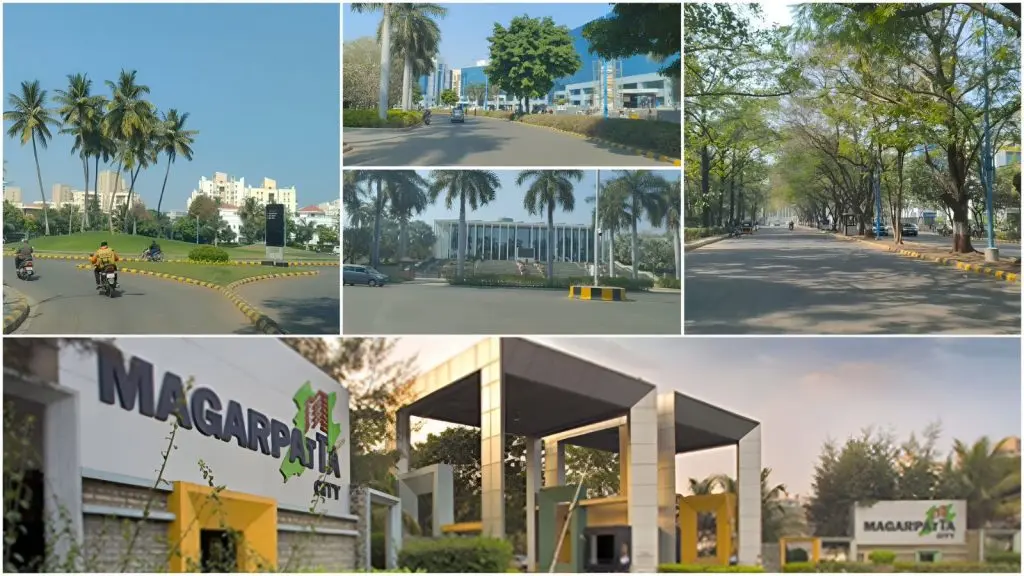

In a country where urban expansion often comes at the cost of rural displacement, one Pune neighborhood stands as a defiant, flourishing exception.

The Blueprint of Inclusive Capitalism
The genesis of Magarpatta City is a masterclass in collective bargaining. In the early 1990s, the Magar clan, a community of 120 farmer families, faced a critical crossroads. As Pune’s urban sprawl reached their 430 acres of ancestral farmland, the easy path would have been to sell to developers for a one-time windfall. Instead, under the leadership of Satish Magar, they made the radical decision to pool their land and form the Magarpatta Township Development & Construction Company Ltd.
By transforming from landowners into shareholders, these families ensured that the “value-added” profits of urbanization stayed within the community. Today, this 450-acre township stands as a self-sustaining ecosystem that balances high-tech industry with social equity.
A City Within a City: Scale and Social Impact
While many modern developments are mere residential clusters, Magarpatta was envisioned as a “networked society.” Its current scale is a testament to that 30-year-old vision:
- Residential & Professional Hub: The township is now home to approximately 35,000 residents and supports over 65,000 jobs, primarily within the massive Cybercity IT Park.
- Integrated Infrastructure: Beyond housing, the project includes an on-site hospital, multiple schools, and a shopping mall, creating a true “walk-to-work, walk-to-school” environment.
- Vertical Integration: A unique aspect of the social model is that the original farmer families didn’t just walk away with dividends; they were trained to run the township’s essential services, handling security, landscaping, and maintenance, thus securing multi-generational employment.
Sustainability Benchmarks and Global Recognition
Magarpatta City has earned international praise for its eco-conscious upkeep, often being cited as one of India’s most beautiful and well-maintained urban spaces.
- Green Lungs: Nearly 30% of the township (approx. 120 acres) is dedicated to green cover, anchored by the central 25-acre Aditi Garden.
- Waste-to-Energy: The township operates a zero-garbage model, where daily waste is segregated and processed on-site. Biodegradable waste is converted into biogas, which powers parts of the city, while the non-biodegradable scrap is sold for recycling.
- Solar Pioneer: It has been recognized by the Limca Book of Records for hosting one of India’s largest residential solar water heating systems, significantly reducing the community’s carbon footprint.
This is Magarpatta City, Pune. Built and managed entirely by 120 farmer families of Magar clan – beats every UPSC babu managed municipality out there in comparison. https://t.co/YpKqEFOABl pic.twitter.com/31KAjudkRJ
— anirban (@AnirbanDesmukh) February 15, 2026
The 2026 Debate: Gated Success vs. Public Scalability
Despite its accolades, Magarpatta City finds itself at the center of a modern urban planning debate. As it matures in 2026, critics point to its gated model as a potential limitation. While the private maintenance ensures high standards of cleanliness and safety, features that draw thousands of high-net-worth IT professionals, some urbanists question whether such “privatized planning” can be scaled to serve a larger, diverse public city.
Furthermore, its success has created external pressure. As of February 14, 2026, the Pune Unified Metropolitan Transport Authority (PUMTA) has identified the Magarpatta area as a major traffic “choke point.” While the internal roads are wide and walkable, the township’s borders face significant vehicular congestion, sparking discussions on how semi-private hubs must better integrate with public transit expansions like the upcoming Pune Metro Phase 2.
Real Estate Outlook: Investment and Rental Yields in 2026
For the PuneNow reader looking at the numbers, the Magarpatta micro-market remains remarkably resilient.
| Metric | Estimated 2026 Value |
| Residential Rental Yield | 4.5% – 5.5% |
| Commercial Rental Yield (Cybercity) | 7% – 9% |
| Avg. Property Rate | ₹11,500 – ₹14,000 per sq. ft. |
Investors continue to prioritize this locality because the “participatory model” ensures that the original 120 families, now savvy business owners, have a vested interest in the township’s long-term upkeep. This results in superior resale premiums compared to newer, purely commercial developments in East Pune.