Pune Becomes First in Maharashtra to Mandate Sensor-Based Air Quality Monitoring at Construction Sites

PUNE – Decided to combat deteriorating air quality, the Pune Municipal Corporation (PMC) has officially mandated the installation of sensor-based air quality monitoring systems at all ongoing construction projects across the city. This directive makes Pune the first municipal corporation in Maharashtra to implement such a real-time tracking system for construction-related emissions.

The initiative follows a circular issued by the PMC on December 15, 2025, aligning with the Maharashtra Pollution Control Board (MPCB) guidelines under the Environment (Protection) Act, 1986. The primary goal is to mitigate the rising levels of particulate matter (PM2.5 and PM10) which have become a major public health concern.
Collaborative Action for Clean Air
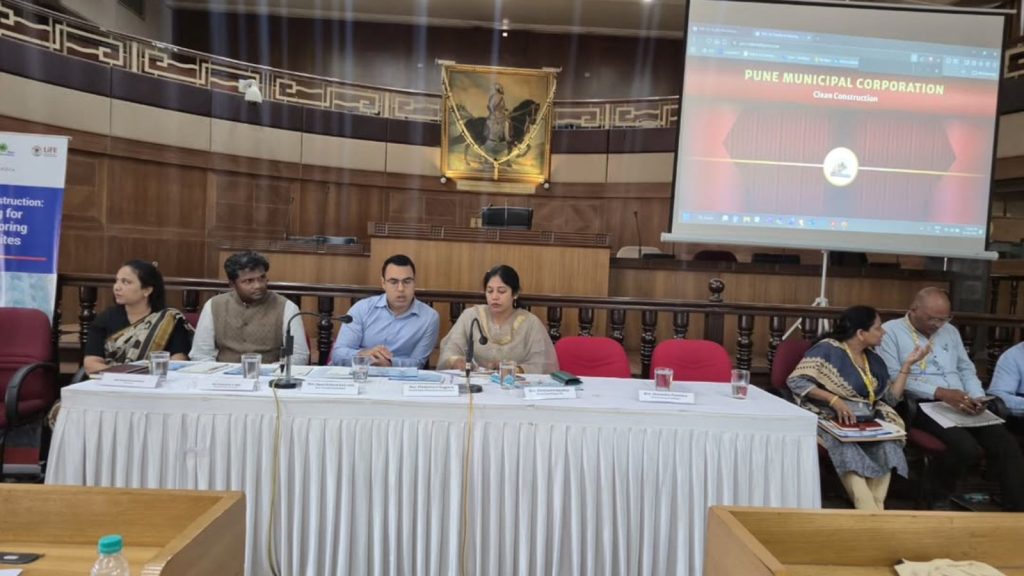
To streamline the implementation, a workshop titled “Air Pollution Control and Mitigation Measures in the Construction Sector” was held on Tuesday. The event saw a massive turnout of stakeholders, including the World Resources Institute (WRI) India, the Indian Institute of Tropical Meteorology (IITM), and representatives from major real estate bodies like CREDAI and NAREDCO.
Inaugurating the event, Mayor Manjusha Nagpure emphasized the urgency of the situation. “Combating air pollution requires a coordinated effort. While we urge citizens to use public transport, the construction sector must proactively adopt dust control initiatives,” she stated, hailing the sensor-based system as a landmark innovation for the city.
Data-Driven Enforcement
The urgency of the mandate is backed by alarming data. Municipal Commissioner Naval Kishore Ram highlighted a 2022 report by ARAI, which revealed that the construction sector contributes to nearly 23% of PM10 emissions in the city.
“With rapid urbanization, construction activities have surged. This system will provide real-time data, allowing us to flag sites with high emission levels immediately for inspection and corrective action,” Commissioner Ram explained.
Additional Municipal Commissioner Prithviraj B.P. added that the data collected from these sensors will be integrated into a central monitoring framework maintained by the civic administration, ensuring continuous oversight and accountability.
Industry Support
The building community has shown a positive response to the new regulations. Tejraj Patil of CREDAI Pune and Sanjay Deshpande of the Marathi Builders Association expressed their support, noting that such measures are essential for sustainable urban development. Deshpande further suggested that the monitoring should be inclusive of both large-scale and smaller construction sites to ensure uniform compliance.
Developed in collaboration with WRI India, this monitoring system is expected to set a benchmark for other cities in India struggling with urban dust and smog. By leveraging technology to enforce environmental standards, Pune aims to pave the way for a healthier, more breathable future for its residents.