Mumbai-Pune Expressway 33-Hour Chaos: FIR Filed Against Tanker Driver for Rash Driving; BNS Sections Invoked

By PuneNow News Bureau
RAIGAD – In the turn of events following one of the longest traffic nightmares in the history of the Mumbai-Pune Expressway, the Khopoli Police have officially booked the driver of the gas tanker that overturned last Tuesday. The accident, which triggered a massive 33-hour gridlock and left thousands of motorists stranded without basic necessities, has now moved from a rescue operation to a criminal investigation focusing on “rash and dangerous driving.”
FIR Registered Under BNS Sections; Driver Identified
The Khopoli Police in Raigad district registered the FIR (No. 0032/2026) on Sunday, February 8, against the tanker driver, identified as Ratan Singh Uday Narayan Singh (44). A resident of Azamgarh, Uttar Pradesh, Singh was operating the white-colored tanker (Registration No. NL01.AG.4250) at the time of the incident.
According to the complaint filed by Police Constable Swapnil Deepak Lad, the driver has been booked under the following sections:
- Section 281 of the Bharatiya Nyaya Sanhita (BNS), 2023: Rash driving or riding on a public way.
- Section 125 of the BNS: Act endangering life or personal safety of others.
- Section 125(a) of the BNS: Causing hurt by an act endangering life or personal safety.
- Section 184 of the Motor Vehicles Act, 1988: Driving dangerously.
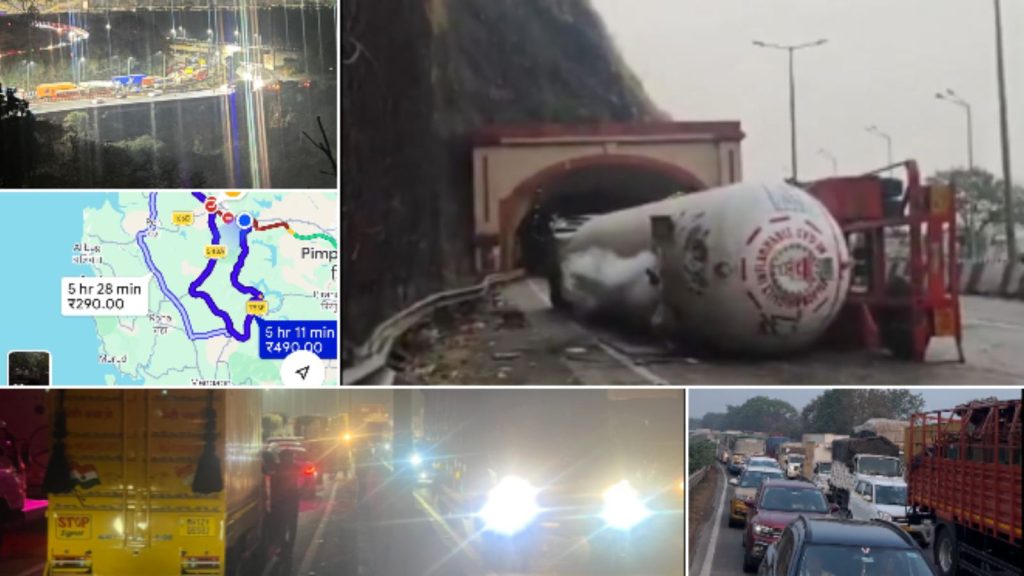
The FIR states that the vehicle, transporting 21 tonnes of highly flammable propylene gas from Cochin to Surat, was allegedly speeding. The driver lost control on a downward slope near the Adoshi Tunnel in the Khandala Ghat section around 5:00 PM on February 3, causing the vehicle to flip sideways and trigger a hazardous leak.
The 33-Hour Nightmare: Thousands Stranded Without Food or Water
The impact of the crash was immediate and catastrophic for regional connectivity. As Propylene gas is extremely flammable and heavier than air, authorities were forced to enforce a “no-man’s land” within a 500-meter radius. This resulted in the total suspension of traffic on the Mumbai-bound carriageway and partial blocks on the Pune-bound side.
What followed was a 33-hour ordeal where stationary queues stretched over 25 kilometers, reaching back to the Khalapur Toll Plaza. Commuters, including senior citizens, infants, and patients, were trapped in their vehicles overnight. Reports emerged of local vendors exploiting the crisis by charging triple the price for water bottles, while many spent over 24 hours without access to sanitation or food.
Key Statistics of the Gridlock:
| Category | Impact Details |
| Duration of Closure | ~33 Hours (5 PM Tuesday to 1:46 AM Thursday) |
| Traffic Backup | 20–25 km at peak congestion |
| MSRTC Impact | 139 bus trips cancelled; 163 buses stranded |
| Agency Involvement | NDRF, SDRF, BPCL, Highway Police, Fire Brigade |
“Elite Escape” vs. Commuter Crisis: The Sudhir Mehta Controversy
The incident took a viral turn when Pune-based industrialist Sudhir Mehta, Chairman of Pinnacle Industries, opted to bypass the gridlock by arranging a helicopter. After being stuck for eight hours near the Adoshi Tunnel, Mehta was airlifted to Pune.
While his “great escape” sparked a debate on social media regarding the “class divide” on Indian highways, Mehta used the platform to advocate for structural reforms. He proposed that the Maharashtra State Road Development Corporation (MSRDC) should mandate:
- Emergency Exit Points: Gated punctures at regular intervals to allow vehicles to turn back during prolonged blocks.
- Mandatory Helipads: Low-cost landing zones (under ₹10 lakh) for emergency medical evacuations and crisis management.
Technical Challenges in Recovery
Containment was significantly delayed due to the high internal pressure of the propylene gas. Experts from Deepak Phenolics Ltd and BPCL struggled for nearly 20 hours to plug three separate leaks in the tanker’s valves.
“The risk of a catastrophic explosion was real. We could not move the vehicle until the internal pressure dropped from 8 psig to a safer level of 2 psig,” stated a senior Highway Safety Patrol (HSP) official. The gas was eventually transferred to two secondary tankers before a hydraulic crane could clear the wreckage.
Current Traffic Status and Lessons Learned
As of Monday, February 9, traffic on the Mumbai-Pune Expressway has returned to normal volumes, though authorities remain on high alert. The Khopoli Police have confirmed that the driver, Ratan Singh, who sustained minor injuries to his right palm, will face further interrogation once he is discharged from MGM Hospital in Kamothe.
This incident has served as a wake-up call for the MSRDC and the State Government. With the Atal Setu and Samruddhi Expressway increasing vehicle density across the state, the 33-hour total paralysis of Maharashtra’s “lifeline” highlights a critical need for a more robust, tech-enabled disaster response system.