One Day, A Thousand Traditions: Why Every Indian Celebrates January 14
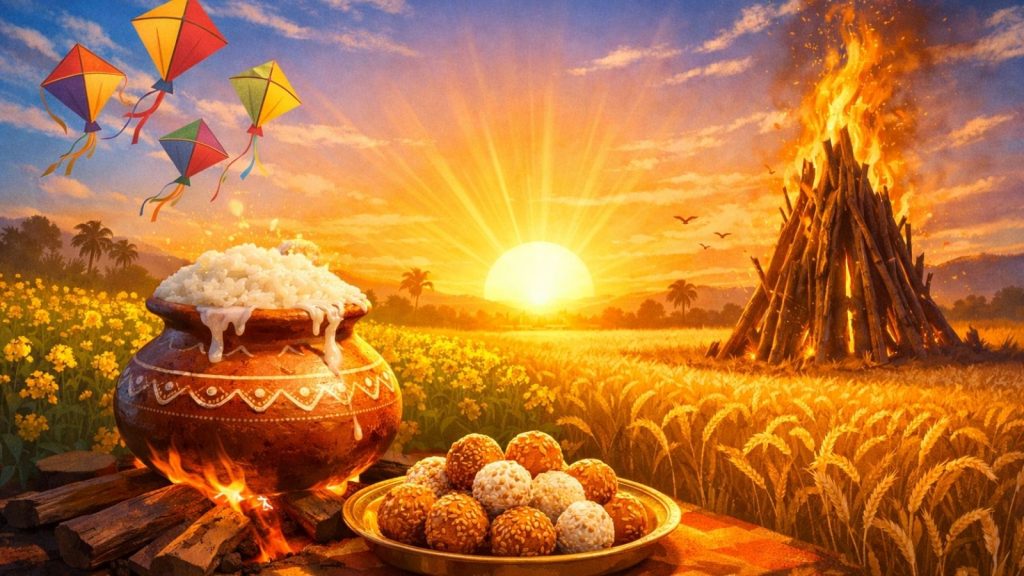

In a world that feels increasingly digital and disconnected, January 14 stands as a rare moment where 1.4 billion people look at the same sky with a singular sense of hope. Whether you are waking up to the smell of fresh Pongal in Chennai, the crackle of a Meji bonfire in Assam, or the sight of a thousand kites in Ahmedabad, you are part of an ancient, unbroken thread.

For the modern Indian, these festivals can sometimes feel like a maze of confusing dates and complex rituals. Is it on the 14th or 15th this year? Why do we eat sesame? And how is your neighbor’s Bihu related to your Sankranti? This isn’t just about religion; it’s about the science of the seasons and the celebration of the harvest.
Today, we bridge that gap. At PuneNow, we’re taking a journey across the Indian landscape to explore how one single day unites a thousand traditions, proving that while our languages may differ, our gratitude for the sun and the soil is exactly the same.
A Map of Flavors and Names: How Your State Celebrates
While the astronomical event is singular, the expression is beautifully fragmented. If you were to travel across India on January 14, you wouldn’t just see different rituals; you would taste an entirely different version of “gratitude.”
- Makar Sankranti (Maharashtra & Karnataka): In your home turf of Pune and across Maharashtra, the phrase “Tilgul ghya, god god bola” (Accept this sesame-jaggery sweet and speak sweet words) defines the day. It is a time for reconciliation and the strengthening of bonds.
- Thai Pongal (Tamil Nadu): For the Tamil community, this is a four-day extravaganza. The highlight is the boiling of freshly harvested rice with milk and jaggery in clay pots until it overflows, a ritual called “Pongal” which literally translates to “boiling over,” symbolizing a life of abundance.
- Magh Bihu (Assam): In the Northeast, the focus shifts to community and fire. Young men build temporary huts (Bhelaghar) and giant bonfires called Meji. After a night of feasting, the Meji is lit the next morning as a prayer to the God of Fire.
- Uttarayan (Gujarat & Rajasthan): The celebration moves to the rooftops. The sky becomes a battlefield of thousands of colorful kites. It’s a day of high-energy music, undhiyu (a seasonal vegetable sprout), and the collective shout of “Kai Po Che!”
- Khichdi Parv (UP & Bihar): Here, the festival is synonymous with the dish itself. Thousands of pilgrims flock to Prayagraj or Varanasi for a holy dip, followed by a meal of Khichdi, a symbolic mix of rice and lentils that represents the new harvest.
- Maghi (Punjab): Celebrated the day after Lohri, Maghi honors the bravery of the ‘Forty Immortals’ (Chali Mukte). While thousands take a holy dip in the sacred waters of Muktsar, kitchens across the state prepare Rau di Kheer, a unique dish where rice is slow-cooked in fresh sugarcane juice, cooling the body as it transitions into the new season.
The Science of the “Solar Shift”: Why January 14?
Most Indian festivals shift dates because they follow the Lunar calendar. However, Makar Sankranti is one of the few tied to the Solar cycle, which is why it almost always falls on January 14.
1. The Astronomical “Uttarayana”
Scientifically, this marks the end of the Winter Solstice in the Northern Hemisphere. The Sun enters the zodiac sign of Makara (Capricorn) and begins its northward journey (Uttarayana). For us on Earth, this means the “reign of darkness” (longer nights) is officially over. From tomorrow, the days start becoming longer, and the warmth begins to return.
2. The 2026 Timing (Muhurat)
For those planning their rituals, the Sankranti Moment for 2026 occurs at 3:13 PM on Wednesday, January 14.
- Punya Kaal (Auspicious Window): 3:13 PM to 5:45 PM.
- Maha Punya Kaal: 3:13 PM to 4:58 PM. If you are planning a holy bath or a special prayer, this 105-minute window in the afternoon is considered the most spiritually potent time of the year.
3. The Ayurvedic “Winter Shield”
Have you ever wondered why every state, from Punjab to Kerala, insists on eating sesame (Til) and jaggery (Gur) today? It isn’t just tradition; it’s ancient medicine.
- Internal Warmth: Sesame is “Ushna” (warming) in nature, helping the body maintain its core temperature as winter begins its final, coldest stretch.
- Immunity Boost: Jaggery is a “desi superfood” rich in iron and minerals that detoxifies the liver and strengthens the lungs against seasonal flu.
Beyond Rituals: The Tradition of ‘Daan’ (Charity)
While the food and kites take center stage, the spiritual backbone of January 14 is Daan (altruism). In Vedic tradition, the transition of the sun is a “portal” where the ego is set aside to serve the community.
Across India, this manifests in beautiful ways:
- In the North: Giving blankets and warm clothes to the needy is considered highly auspicious.
- In the West: Suhasinis (married women) in Maharashtra perform Haldi-Kukum and exchange Vaan (gifts consisting of household utility items).
- In the South: Farmers honor their cattle (Mattu Pongal), decorating cows with garlands and painting their horns to thank them for their labor in the fields.
The Lesson for 2026: Even if you aren’t religious, January 14 serves as a “Social Reset.” It is a day to clear old debts, forgive past grievances (as the Til-Gul suggests), and contribute to the welfare of those less fortunate.
Frequently Asked Questions about January 14 Festivals
Q1: Is Makar Sankranti 2026 on January 14 or 15? A: In 2026, Makar Sankranti falls on Wednesday, January 14. The Sun enters Capricorn (Makara Rashi) at approximately 3:13 PM IST on this day, making the afternoon of the 14th the primary time for celebration and rituals.
Q2: Why do we fly kites specifically on this day? A: Beyond the fun, kite flying was traditionally a way to get people out into the sun. After a long, cold winter, the morning sun on January 14 is rich in Vitamin D and helps clear skin infections and winter lethargy.
Q3: What is the significance of the “Uttarayana” period? A: Uttarayana is the six-month period when the sun travels northward. It is considered a “period of light” and is highly auspicious for new beginnings, weddings, and spiritual practices in Hindu philosophy.
Q4: Can I eat Khichdi on this day if I am not from North India? A: Absolutely! Khichdi is a pan-Indian “Sattvic” meal. It symbolizes the harvest because it combines the new rice and the new lentils (moong) of the season, representing a balanced and healthy start to the solar year.
Q5: What should I say when giving Til-Gul? A: The traditional Marathi phrase is “Tilgul ghya, god god bola,” which translates to “Accept this sesame-jaggery sweet and speak sweet words.” It’s a beautiful way to resolve conflicts and start the year on a positive note.
As the sun begins its northward journey tomorrow, it carries with it the collective prayers of a billion people. Whether you call it Sankranti, Pongal, Bihu, or Lohri, the essence is the same: a celebration of the harvest, a tribute to the sun, and a reminder of our shared roots.
In 2026, as we navigate a world that moves faster than ever, let us take a moment to slow down. Eat a piece of jaggery, look at the sky, and realize that while our methods of celebration may vary by state, the joy we feel is a single, national heartbeat.
From all of us at PuneNow, we wish you a harvest season filled with abundance, sweetness, and light.