
End of the 10-Minute Delivery? Blinkit, Zepto and Others Drop Hyper-Fast Delivery Claims After Government Intervention
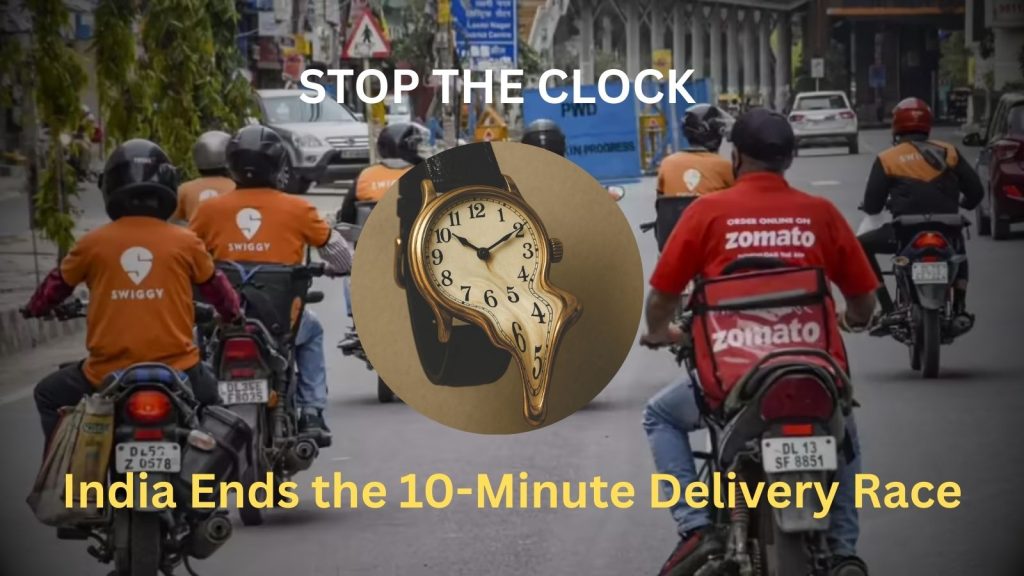

The era of the “10-minute delivery” promise in India is officially entering a cooldown phase as the Union Government intervenes to prioritize human life over hyper-convenience.

In a landmark shift for India’s burgeoning quick-commerce (q-commerce) sector, major aggregators including Blinkit, Zepto, Swiggy Instamart, and Zomato have agreed to remove explicit 10-minute delivery deadlines from their branding and marketing materials. The decision follows direct intervention from Union Labour Minister Mansukh Mandaviya, who has “persuaded” industry leaders to abandon the high-pressure marketing tactics that have long been criticized for endangering the lives of thousands of delivery partners.
The Ministerial Nudge: Safety Over Speed
The pivot away from 10-minute branding was solidified following a series of high-level meetings between the Ministry of Labour and Employment and top executives from India’s leading delivery platforms. During these discussions, Minister Mandaviya reportedly expressed grave concerns regarding the “invisible pressure” placed on gig workers.
While companies have consistently maintained that their algorithms do not penalize riders for “late” deliveries, the government argued that the external branding, displayed prominently on t-shirts, delivery bags, and app countdown timers, creates a psychological environment of urgency. This urgency, the Ministry noted, often compels riders to flout traffic norms, risk accidents, and navigate congested urban roads at unsafe speeds.
Blinkit Leads the Charge with Tagline Overhaul
Blinkit, the Zomato-owned market leader in the q-commerce space, has been the first to blink. The platform has already updated its core brand messaging across its app and digital interfaces. The previous tagline, “10,000+ products delivered in 10 minutes,” has been replaced with a more operationally focused promise: “30,000+ products delivered at your doorstep.”
Industry sources indicate that Zepto, Swiggy Instamart, and BigBasket are in the process of rolling out similar changes. While the operational “dark store” model, which relies on high-density mini-warehouses, will still allow for very fast deliveries, the explicit “10-minute” guarantee will no longer be a part of the consumer-facing value proposition.
The Legislative Backbone: Code on Social Security (2020)
This government intervention is not merely a “suggestion”; it is backed by the newly implemented Code on Social Security (2020), which officially came into force on November 21, 2025. For the first time in Indian legal history, the definitions of ‘gig workers’ and ‘platform workers’ have been codified, granting the government the authority to frame social security measures for this unorganized sector.
Under the new rules:
- National Social Security Board: A board has been established to monitor the welfare of gig workers.
- Mandatory Contributions: Aggregators are now required to contribute 1–2% of their annual turnover to a dedicated Social Security Fund.
- Accident & Health Insurance: The Code provides for accident insurance and maternity benefits, shifting the burden of risk from the individual rider back to the platform.
Minister Mandaviya has emphasized that the removal of the 10-minute deadline is a critical step toward ensuring the “dignity of labor” as India moves toward its goal of providing social security coverage to 100 crore workers by March 2026.
AAP’s Raghav Chadha Hails ‘Victory’ for Gig Workers
The move has also become a significant political talking point. AAP Rajya Sabha MP Raghav Chadha, who has been a vocal critic of the 10-minute model, hailed the decision as a “victory for the common man.”
Just days before the government announcement, Chadha made headlines by going “undercover” as a delivery partner for a day. He shared a viral video highlighting the “pain and misery” of riders earning as little as ₹762 for 15 hours of grueling work.
“Satyamev Jayate. Together, we have won,” Chadha posted on X (formerly Twitter). “This is a much-needed step because when ’10 minutes’ is printed on a rider’s jacket, the pressure is real and dangerous. This step will help ensure the safety of riders and everyone who shares our roads.”
Away from boardrooms, at the grassroots. I lived their day.
— Raghav Chadha (@raghav_chadha) January 12, 2026
Stay tuned! pic.twitter.com/exGBNFGD3T
The Dark Reality: Protests and the New Year’s Eve Strike
The momentum for this change was fueled by ground-level unrest. On New Year’s Eve 2025, more than 2 lakh gig workers across India staged a massive nationwide strike. Organized by the Indian Federation of App-Based Transport Workers (IFAT), the strike paralyzed delivery services in metros like Delhi, Bengaluru, and Pune.
Workers demanded:
- Removal of the 10-minute delivery system.
- Restoration of previous payout structures (protesting the current low rates of ~₹19-20 per order).
- A minimum monthly wage of ₹40,000.
- Implementation of health and accident insurance under the new Labour Codes.
The scale of the protest, occurring on the year’s busiest delivery night, proved that the gig economy’s current model was nearing a breaking point.
Industry Response: Operational Efficiency vs. Marketing Gimmicks
Interestingly, while the branding is disappearing, the business model remains largely unchanged. Eternal (the parent company of Zomato/Blinkit) clarified in a filing to the BSE that there is “no change in the underlying business model” that would impact financials.
Industry experts explain that “10-minute delivery” was always more of a marketing hook than a strict operational reality for 100% of orders. By removing the branding, companies are:
- Reducing Regulatory Friction: Avoiding potential fines or stricter “speed limit” laws.
- Managing Expectations: Preventing customer dissatisfaction when traffic or weather causes delays.
- Improving ESG Scores: Aligning with Environmental, Social, and Governance (ESG) standards regarding worker safety.
ALSO READ | IRCTC Aadhaar Mandate 2026: Why You’re Locked Out of Online Booking and How to Fix It (Step-by-Step Guide)
What This Means for Consumers
For the average customer in Pune or Mumbai, this change may not drastically increase delivery times. If a dark store is located 2 kilometers away, the delivery will still likely arrive in 12–15 minutes. However, consumers will notice the disappearance of the “ticking clock” and the aggressive time-guarantee banners.
The shift signals a broader trend in the Indian tech ecosystem: a transition from “growth at any cost” to a more sustainable, regulated model that acknowledges the human component behind the digital interface.