From ₹18 to ₹72? Cigarette Prices Likely to Rise in India as Parliament Clears New Tax Law
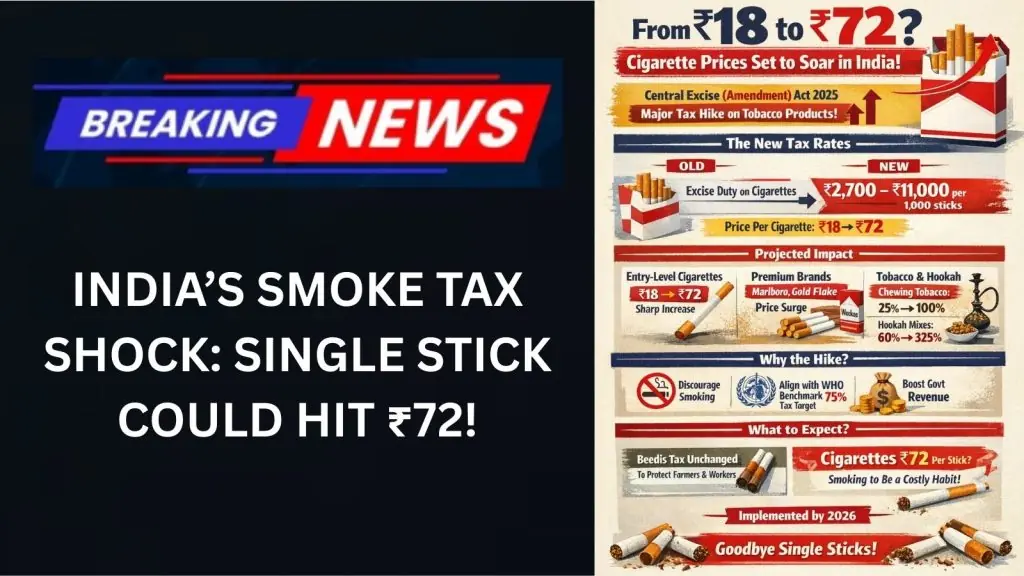

Smoking in India is about to get significantly more expensive as the government prepares to overhaul the tax structure for “sin goods.”

Following the passage of the Central Excise (Amendment) Act, 2025, the cost of tobacco products is projected to witness a sharp spike. While viral reports suggest that the price of a single cigarette stick could jump from ₹18 to ₹72, the ground reality involves a complex shift from the expiring GST Compensation Cess back to a revamped Central Excise Duty.
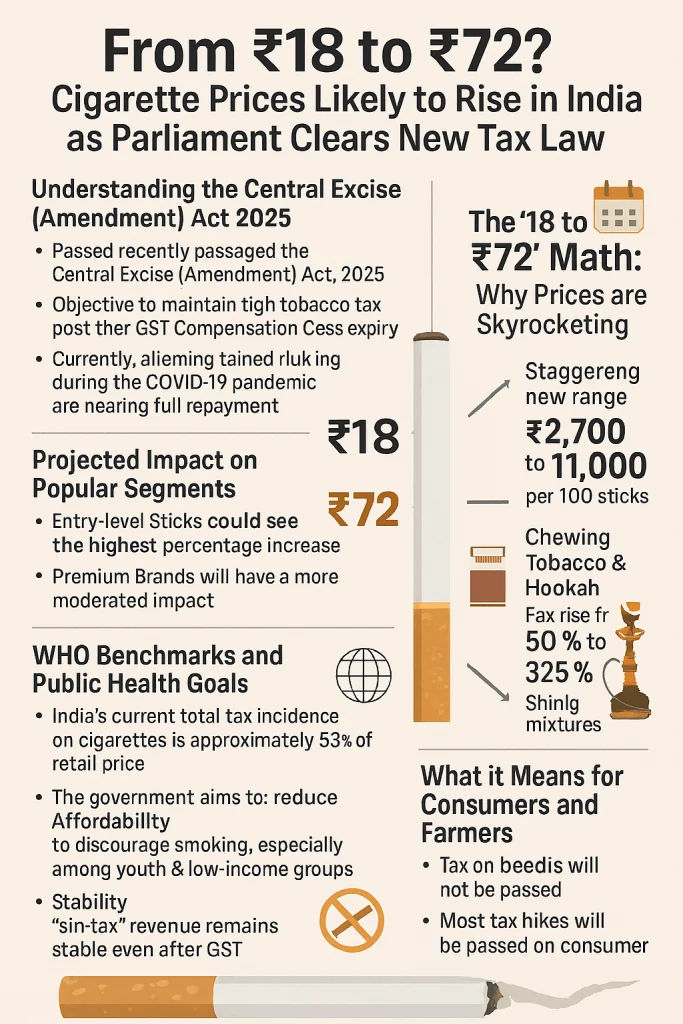
Understanding the Central Excise (Amendment) Act 2025
The Indian Parliament recently cleared the Central Excise (Amendment) Bill, 2025, during the Winter Session. The primary objective of this legislation is to provide the government with the “fiscal space” to maintain high tax levels on tobacco once the GST Compensation Cess expires.
Currently, tobacco products are taxed under a 28% GST slab, plus an additional compensation cess. However, as the loans taken during the COVID-19 pandemic are nearing full repayment (expected by late December 2025), the cess is set to be discontinued. To prevent cigarettes from becoming more affordable, Finance Minister Nirmala Sitharaman has moved to hike the base excise duty.
The “₹18 to ₹72” Math: Why Prices are Skyrocketing
The viral figure of a 400% price hike stems from the massive revision in excise duty slabs. Under the previous regime, the duty on cigarettes ranged between ₹200 and ₹735 per 1,000 sticks. Under the new Act, this has been raised to a staggering range of ₹2,700 to ₹11,000 per 1,000 sticks, depending on the length and filter of the cigarette.
Projected Impact on Popular Segments:
- Entry-level Sticks: Small, non-filter cigarettes currently priced at ₹18 could see the highest percentage increase as companies pass on the new specific duty.
- Premium Brands: While brands like Marlboro and Gold Flake will also see hikes, the impact may be relatively more moderated compared to the cheapest segments.
- Chewing Tobacco & Hookah: The tax on chewing tobacco is set to rise from 25% to 100%, while smoking mixtures for pipes will see a five-fold jump from 60% to 325%.
WHO Benchmarks and Public Health Goals
During the parliamentary debate, Finance Minister Nirmala Sitharaman highlighted that India’s current total tax incidence on cigarettes is approximately 53% of the retail price. This is significantly lower than the World Health Organization (WHO) benchmark of 75%.
By shifting to the new excise structure, the government aims to:
- Reduce Affordability: Discourage smoking, especially among the youth and low-income groups.
- Revenue Sharing: Unlike a cess, the revenue from Central Excise Duty is shared with the states, ensuring a broader fiscal benefit.
- Stability: Ensure that the “sin tax” revenue remains stable even after the GST mechanism changes.
What it Means for Consumers and Farmers
While the hike is steep, the Finance Minister offered a major clarification regarding beedis. To protect the livelihoods of nearly 50 lakh registered beedi workers and millions of tobacco farmers, the government has decided not to increase the tax on beedis.
For cigarette smokers, the implementation of these new rates is expected to coincide with the official notification of the cessation of the GST cess, likely before the start of 2026. Retailers suggest that while some brands may absorb a small portion of the tax, the majority of the burden will be passed on to the end consumer, making “single stick” purchases a luxury of the past.
Note: This is an evolving story based on media reports and an official notification from the Ministry of Finance, Government of India is awaited.