Chai and Why?


Amartya Sen contends that prolixity is uniquely an Indian phenomenon. His book, ‘The Argumentative Indian’, claims that the longest speech at the United Nations was delivered by an Indian, and that it remains unequalled. We love to discuss, debate and argue things out. Chai pe charcha, or discussions over tea, is a ubiquitously pleasurable Indian experience.
Some years ago, I watched ‘Notes on Chai’ at the Prithvi Theatre, Mumbai, performed by the effervescent Jyoti Dogra. The play situates the idea of reflective personal moments nourished by a cup of steaming hot chai. In the mundane daily trudge we make as we roll our Sisyphean boulder up the hill, the angst that wafts from our tedious ordinariness is given some relief in these moments of personal reflection, which the humble cup of chai offers. Dogra’s personal notes, on chai, erupt spontaneously between vignettes of the oppression in the human condition encountered in everyday experiences. These moments of refuge over chai are coveted by the ones who ‘take a break’ from the heave and ho that accompanies the dread of moving this boulder up the everyday mountain, and which one will face – again – tomorrow. It is an eternal trudge. So chai becomes a self-effacing mediator in one’s daily self-reflections.
Now chai is also the flavourful artefact that organises conversations between people at street corners or even in grungy offices. Chai evokes the therapeutic spirit of a counsellor in provoking and stimulating discourses that emerge from those who closet the opaque little cutting glasses in their tired fingers. Often, the chai neutralises and levels the various categorical positions that people occupy in their social status. The playing field is levelled, and what becomes decisive in determining one’s status in the discussion is the nature of the reasoning that one can devise. Chai has the innate power to bestow on us the ability to argue and debate areas of concern that often exist beyond our ability to influence any meaningful outcome. Except for the gratification that emerges through discussions of world affairs, which for the man on the street corner are as good as arguing the metaphysical.
Or perhaps not. Revolutions have been brought about by small conversations on street corners. A steady stream of consciousness will develop into an ideological rigour that can counter the angst of the status quo. This can happen gradually and imperceptibly, perhaps. Charchas over chai, over time, develop from localised social narratives and mutate into questions of civilisational character, like little streams that filter their unruly and meandering waters into an immense ocean wave that can sweep onto muddied shores and reimagine our existential trajectory. In the film, Ek Hota Vidushak (Once Was a Clown), Aburao employs satire in his theatre art to question the political enterprise of everyday existence, only to succumb to fame and become the caricature he once critiqued. There too, chai poured some charm into the vacuity of Aburao’s existential angst that he laments to himself.
Nelson Mandela asserts that in everyone wanting to speak, lies the purest form of democracy. That all men are free to voice their opinions and equal in their value as citizens. Tagore informs the necessity of deliberation and reasoning as foundational to a good society. Sen will continue to argue in a lighter vein recounting the words of Ram Mohun Roy; “just consider how terrible the day of your death will be. Others will go on speaking, and you will not be able to argue back.” Even then, I suppose, one is welcomed into the heavens with a cutting glass of chai.
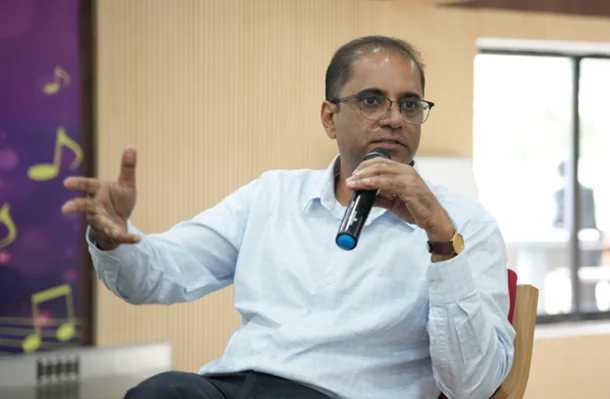
Dr Anil D’Souza brings 3 decades of experience in corporate and academic leadership with significant experience in organisational culture development and leadership coaching. Dr D’Souza employs the performing arts as crucial drivers of enterprise and individual change, and has published research papers on the impact of theatre on change management.
Anil holds a PhD, an MBA and certifications in Counselling Psychology, Leadership Coaching, Transactional Analysis, MBTI, Assessment and Development Centres, Creative Design Thinking, among others. Beyond the classroom, Anil is part of an experimental theatre group based in Mumbai and enjoys travelling and performing his music.