How a Week of Heavy Rain in Early July Gave Pune Nearly Five Months’ Worth of Drinking Water

Pune, July 12: Just three weeks ago, Pune was staring at the possibility of a difficult summer ahead. The monsoon had failed to make a meaningful impact, dam levels were worryingly low, and civic authorities were keeping a close watch on the city’s drinking water reserves.

Then came the first week of July.
Days of relentless rainfall across the Western Ghats transformed the picture almost overnight. Reservoirs that were running dangerously low filled up at a pace few expected, securing nearly five months’ worth of drinking water for Pune in just about a week.
The biggest beneficiary has been the Khadakwasla dam cluster, the lifeline of Pune city.
From Crisis to Comfort in Just Three Weeks
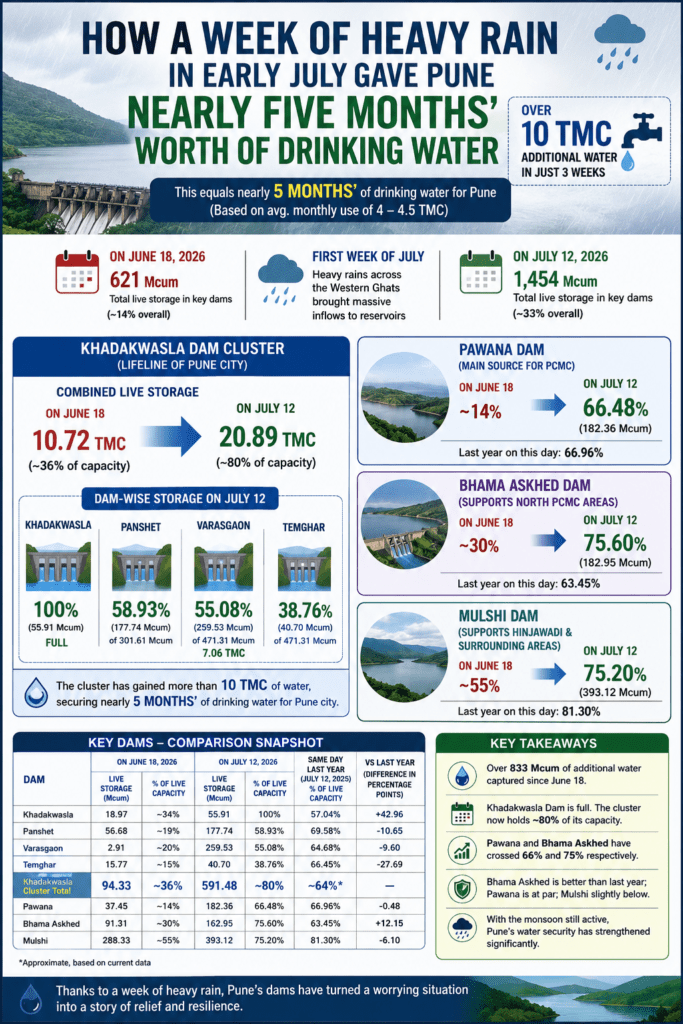
On June 18, the combined live storage in Khadakwasla, Panshet, Varasgaon and Temghar stood at just 10.72 TMC, or about 36% of their total capacity. With the monsoon yet to pick up, concerns were mounting over the city’s water security.
Today, the picture is dramatically different.
The four reservoirs now hold 20.89 TMC of water, equivalent to nearly 80% of their total live storage capacity. In other words, Pune has gained more than 10 TMC of additional water in less than a month, with most of the inflows coming during the first week of July.
For a city that draws around 4 to 4.5 TMC of water every month, this increase alone translates into nearly five months of drinking water.
Khadakwasla Already Full
Among the four reservoirs, Khadakwasla Dam has already reached 100% storage, allowing controlled releases into the Mutha River while continuing to receive inflows from upstream dams.
The remaining reservoirs have also witnessed remarkable recovery.
| Reservoir | Storage on July 12 |
|---|---|
| Khadakwasla | 100% |
| Panshet | 58.93% |
| Varasgaon | 55.08% |
| Temghar | 38.76% |
With the monsoon still active, these reservoirs are expected to continue receiving inflows over the coming weeks.
Pawana Gives Big Relief to PCMC
The turnaround has been equally significant for Pawana Dam, the primary drinking water source for Pimpri-Chinchwad.
On June 18, the reservoir was holding barely 14% of its live storage. Today, it stands at 182.36 Mcum, or 66.48% of capacity.
Although marginally below the 66.96% recorded on the same date last year, the reservoir has recovered enough to significantly ease concerns over water availability for the rapidly growing twin cities.
Bhama Askhed Performs Better Than Last Year
Another encouraging development is Bhama Askhed Dam, which supplies drinking water to several fast-growing northern parts of Pimpri-Chinchwad, including Moshi, Chikhali and Bhosari.
The reservoir currently stores 162.95 Mcum, equivalent to 75.60% of its live capacity.
Notably, this is well above last year’s 63.45%, making Bhama Askhed one of the best-performing reservoirs in the region this monsoon.
Mulshi Also Sees Strong Recovery
The Mulshi reservoir, owned by Tata Power, has also benefited from the heavy rainfall.
Its live storage has reached 393.12 Mcum, or 75.20% of capacity, compared with 81.30% on the same date last year.
While Mulshi is primarily a hydropower reservoir, it also supports drinking water needs of several townships and villages around Hinjawadi, Paud, Pirangut and Mulshi Taluka, making its healthy storage an important indicator for the rapidly urbanising western corridor.
Heavy Rains Changed the Story
The first half of June had raised fears of another difficult water year. Delayed monsoon rains had left reservoir levels well below comfortable levels, forcing civic agencies to prepare for the possibility of tighter water management.
However, the intense rainfall during the first week of July has rewritten that narrative.
Within days, the region’s key reservoirs captured billions of litres of rainwater. Pune’s principal drinking water source has effectively doubled its storage, Khadakwasla has reached full capacity, Pawana has crossed two-thirds capacity, Bhama Askhed has outperformed last year, and Mulshi has recovered strongly.
With July and August traditionally being the wettest months of the monsoon, the outlook for Pune’s water security has improved dramatically. Unless there is an unusually prolonged dry spell later in the season, the fears that loomed over the city just weeks ago have largely been washed away by a single week of exceptional rainfall.