Pune: Tendering Begins on New 36-Km High-Capacity Mass Transit Route (HCMTR) Mega Project to Decongest the Heart of the City
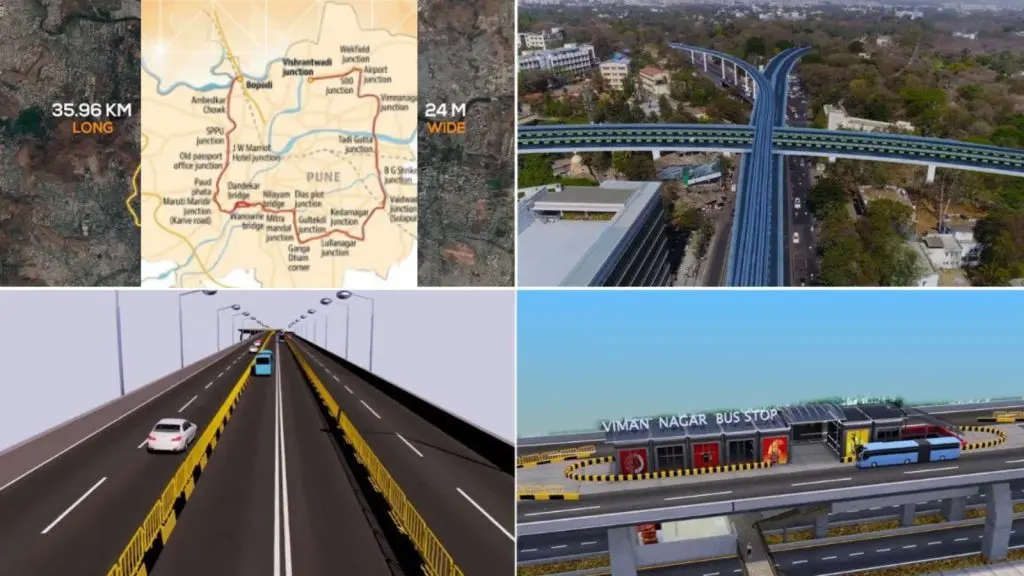

PUNE: For years, it felt like a distant urban blueprint forgotten in administrative files while Pune’s traffic situation grew progressively worse. But the wait is over. Pune’s ultimate traffic-buster, the High-Capacity Mass Transit Route (HCMTR) has been officially approved with the tendering process expedited.

This project has been conceived by Pune Municipal Corporation and directives have been issued to immediately launch the tendering process for this mega infrastructure project, signaling that actual ground construction is finally around the corner to decongest the heart of Pune city.
The project is being revived and fast-tracked under the direct guidance of Maharashtra Chief Minister Devendra Fadnavis, following intensive strategy sessions between state leadership and Pune municipal officials.
Announcing the major breakthrough, Murlidhar Mohol, Pune Lok Sabha MP and Union Minister of State for Civil Aviation and Co-operation, made it clear that the government is treating this as a top priority. “We are undoubtedly committed to completing this project as soon as possible,” Mohol stated. “This is a project that will give a new direction to Pune’s future transportation system and is vital for building a planned, dynamic city.”
Details of the HCMTR
The HCMTR is engineered specifically as a localized, inner ring road contained entirely within the Pune Municipal Corporation (PMC) limits. Its sole purpose is to elevate internal traffic right above the oldest, most suffocating bottlenecks in the city.
The finalized structural blueprint of the HCMTR includes highly specific transit features designed to maximize vehicular efficiency:
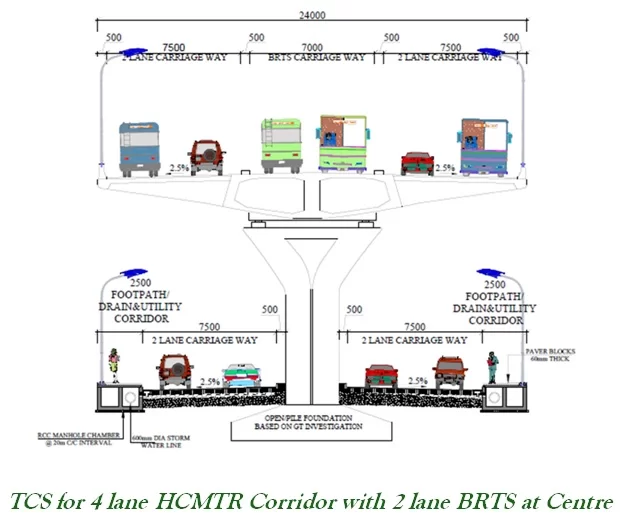
- Six-Lane Elevated Corridor: The project features a massive six-lane elevated highway spanning exactly 35.96 kilometers in length and 24 meters in width.
- 34 Junctions Cleared: The elevated structure will smoothly pass over 34 of Pune’s busiest ground-level junctions, eliminating stop-and-go signal delays.
- Dedicated BRTS Lanes: Out of the six lanes, 2 lanes will be strictly dedicated to the Bus Rapid Transit System (BRTS), complete with 26 elevated stations to handle heavy public transit passenger loads.
- Private Vehicle Access: The remaining 4 lanes are reserved strictly for private four-wheelers.
- Strategic Ramps: To ensure smooth merging and exiting without causing ground-level jams, the structure features 17 up-ramps and 16 down-ramps positioned at critical entry and exit nodes.
- Speed Optimization: The corridor is designed for a minimum speed of 50 kmph and an average operating speed of 25 kmph, significantly outperforming current rush-hour speeds on city streets.
- Market Yard Freight Integration: In a major logistics upgrade, heavier commercial vehicles traveling to and from the busy Market Yard can use this elevated corridor, bypassing dense residential neighborhoods entirely.
Full Route Alignment: The Heart of the Corridor
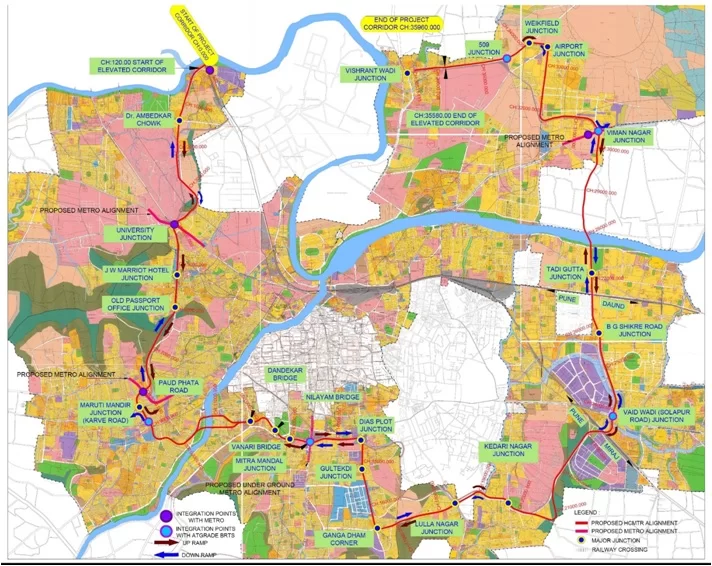
According to the official project route, the elevated ring corridor will weave seamlessly through the heart of Pune, creating a high-speed bypass across major neighborhoods:
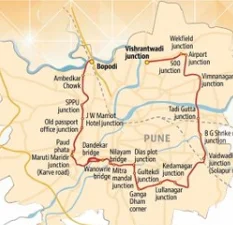
- The Northern & Eastern Links: Bopodi, Vishrantwadi Junction, Wekfield Junction, Airport Junction, and Viman Nagar Junction.
- The Southern & Eastern Connectors: Tadi Gutta Junction, B G Shirke Road, Vaiduwadi Junction (Solapur Road), Kedarnagar Junction, and Lullanagar Junction.
- The Core Southern & Western Junctions: Ganga Dham Corner, Gultekdi Junction, Dias Plot Junction, Nilayam Bridge, Mitra Mandal Junction, Wanowrie Bridge, and Dandekar Bridge. Note that specific track alignment adjustments have been carefully implemented from Laxminarayan Talkies Chowk to Market Yard Corner and from Gangadham Chowk to Aaimata Mandir.
- The Western & North-Western Hubs: Paud Phata Maruti Mandir Junction (Karve Road), Old Passport Office Junction, Savitribai Phule Pune University (SPPU) Junction, JW Marriott Hotel Junction, and Ambedkar Chowk.
The University Chowk Multimodal Hub
A major engineering highlight of the project is the creation of a massive, four-layered multimodal transport hub at University Chowk (SPPU Junction). This ultra-modern junction is designed to simultaneously accommodate the HCMTR corridor alongside the heavy commuter traffic from the Hinjawadi-Shivajinagar Metro Line 3, creating a seamless interchange point for commuters traveling between the IT capital and the city center.
The Big Picture: Completing Pune’s Three-Tier Ring Road Grid
To understand why the revival of the HCMTR is so monumental for search visibility and city planning alike, one must look at how it fits into the broader, macroscopic plan for the region. The state is systematically building a three-tier concentric ring road grid designed to segregate different types of traffic before they ever clash:
- The Outer Tier (MSRDC Outer Ring Road): A massive 173 km highway looping far outside urban boundaries. This acts as a heavy logistics bypass, intercepting long-distance commercial trucks traveling between Mumbai, Bengaluru, Nashik, and Solapur so they never enter Pune’s metropolitan limits.
- The Middle Tier (PMRDA Regional Ring Road): An 83.12 km loop connecting 44 rapidly growing suburban peripheral villages. This absorbs regional commuter traffic, allowing workforce populations to travel between industrial and IT hubs like Hinjawadi, Chakan, and Wagholi without adding pressure to the city center.
- The Innermost Tier (The PMC HCMTR Elevated Loop): Acting as the critical inner ring road, this 36-km ring handles the inner city core. It lifts local commuters, BRTS fleets, and Market Yard commercial vehicles directly above municipal bottlenecks.
Benefits for Punekars
The immediate rollout of the HCMTR tender marks the end of administrative stagnation and the beginning of a highly coordinated transit era. By moving local public transit and private vehicles onto a dedicated, signal-free elevated path, the project is structured to directly deliver several key benefits:
- Massive Reduction in Commute Times: Cutting open the gridlock at major junctions like SPPU, Swargate, and Karve Road.
- Dedicated Mass Public Transit: Providing an optimized corridor for modern BRTS systems to move thousands of citizens swiftly.
- Lower Vehicle Operating Costs: Uninterrupted traffic flow ensures better fuel efficiency and reduced wear-and-tear for private drivers and transport fleets.
- A Cleaner, Greener Pune: By eliminating the endless stop-and-go idling at congested intersections, the project aims to significantly lower vehicular emissions and pollution across Pune’s core neighborhoods.
With the tendering process now officially expedited, PMC and state authorities are aligning resources to ensure that actual construction begins without delay, bringing a long-awaited transport revolution straight to Pune’s doorstep.