Pune’s Infrastructure Boom: How Top 25 Mega Infrastructure Projects Are Reshaping the City’s Future
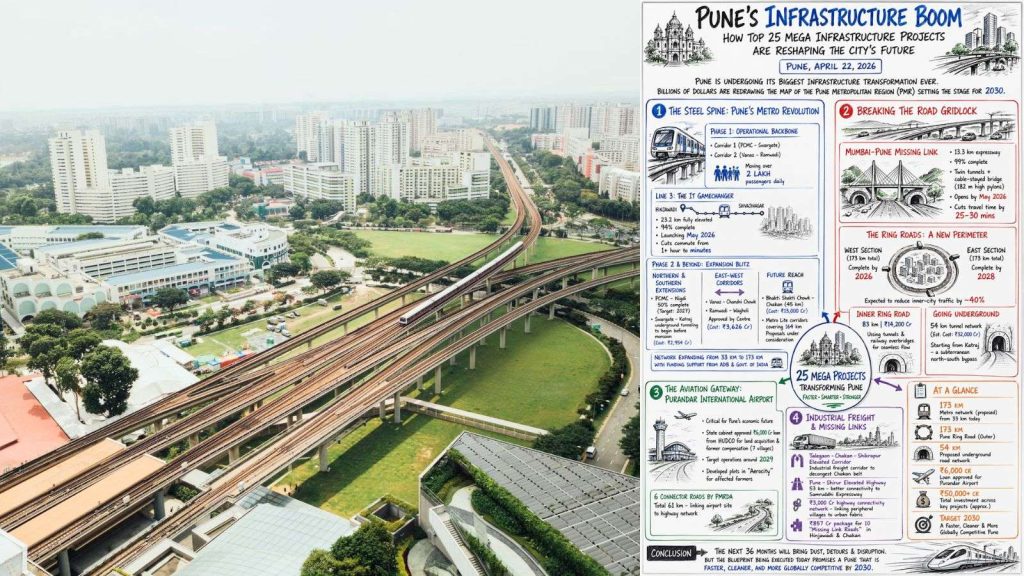

Pune, April 22, 2026 – Once known as the tranquil “Queen of the Deccan,” Pune is shedding its genteel skin at a blistering pace. As the city morphs into a sprawling metropolitan juggernaut driven by automotive and IT industries, the pressure on its old bones has become unbearable. The choked lanes of the old city, the bumper-to-bumper traffic on the Sinhagad Road, and the perennial snarls at Chakan are rapidly becoming relics of the past.

In their place, a concrete and steel renaissance is emerging. From the depths of the earth to the skies above the Sahyadris, Pune is currently witnessing the largest infrastructure mobilization in its history. With an estimated investment running into billions of dollars, the Pune Metropolitan Region (PMR) is not just fixing potholes; it is completely rewiring its circulatory system.
In this exclusive feature, PuneNow breaks down the top 25 mega-projects that are redrawing the map of the region, setting the stage for 2030.
The Steel Spine: Pune’s Metro Revolution
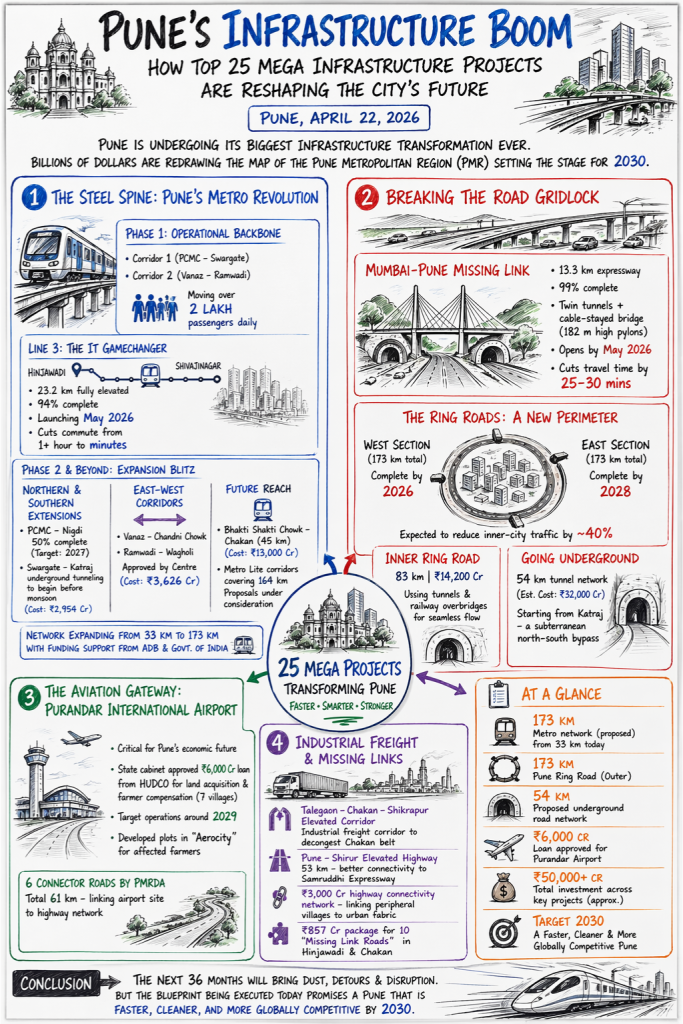
At the heart of this transformation is the Pune Metro, a project that has shifted from a distant promise to the city’s daily reality. As MahaMetro seeks further funding from the Asian Development Bank to expand the network from the current 33 km to a staggering 173 km, the city is finally getting the rapid transit system it deserved a decade ago.
Phase 1: The Operational Backbone
The foundation is now solid. Corridor 1 (PCMC to Swargate) and Corridor 2 (Vanaz to Ramwadi) are operational, moving over two lakh passengers daily and stitching together the western and northern industrial belts with the old city core.
Line 3: The IT Gamechanger
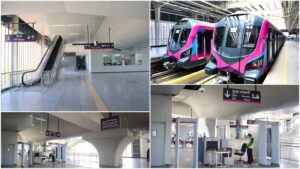
For the thousands of tech professionals commuting to the Rajiv Gandhi Infotech Park in Hinjawadi, salvation is finally here. The much-delayed Hinjawadi – Shivajinagar Metro Line 3 is set to throw open its doors to the public in May 2026.
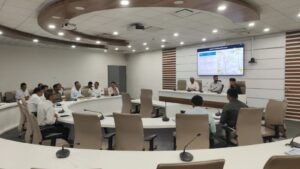
This 23.2 km fully elevated corridor, developed under a unique PPP model involving the Tata Group and Siemens, is currently 94% complete. Once operational, it will slash the dreaded commute from the city center to Hinjawadi from over an hour to just minutes . PMRDA Commissioner Dr. Abhijit Chaudhari recently conducted a final inspection of the 12 stations, confirming that safety certifications are in their final stages.
Phase 2 & Beyond: The Expansion Blitz
The government is not stopping at the IT hub. With a ₹517 crore allocation in the recent Union Budget, Phase 2 is already in motion.
- Northern & Southern Extensions: The PCMC to Nigdi line is 50% complete and targeted for next year, while the underground tunnel boring for the Swargate to Katraj extension (Projected cost: ₹2,954 crore) is slated to begin before the monsoon.
- East-West Corridors: The Centre has approved the ₹3,626 crore east-west expansion connecting Vanaz to Chandni Chowk and Ramwadi to Wagholi, ensuring that the eastern suburbs are no longer transit orphans.
- Future Reach: Proposals are on the table for a massive 45 km stretch from Bhakti Shakti Chowk to Chakan (₹13,000 crore) and Metro Lite corridors covering 164 km, signaling that Pune’s metro footprint will soon rival that of Mumbai.
Breaking the Road Gridlock
While the Metro flies above, a revolution is happening on the tarmac. The chronic congestion that defines Pune’s rush hour is being attacked from every angle, by tunnels, elevated corridors, and ring roads.
The Mumbai-Pune Missing Link
After years of waiting, the dreaded Khandala Ghat is about to be bypassed. The Mumbai-Pune Expressway Missing Link is 99% complete and expected to open by May 2026. This 13.3 km engineering marvel, featuring twin tunnels and a cable-stayed bridge with 182-meter-high pylons (taller than the Bandra-Worli Sea Link), will cut travel time between the two cities by 25-30 minutes.
The Ring Roads: A New Perimeter
To divert heavy traffic away from the city center, the Pune Ring Road is taking shape with a definitive timeline. Public Works Minister Dada Bhuse confirmed in the state assembly that the West Section is on track for completion by 2026, while the East Section will follow by 2028. Spanning 173 km, this outer ring road is expected to cut inner-city traffic by nearly 40%.
Simultaneously, the Inner Ring Road (83 km, ₹14,200 crore) is progressing, utilizing tunnels and railway overbridges to provide a seamless transit corridor within the urban limits.
Going Underground
With land at a premium, Chief Minister Devendra Fadnavis has pushed the pedal on a futuristic solution: underground roads. A massive 54 km tunnel network (estimated ₹32,000 crore) is proposed to start from Katraj, creating a subterranean north-south bypass that will leave the surface chaos behind.
The Aviation Gateway: Purandar International Airport
Perhaps the most critical puzzle piece for Pune’s economic future is the Purandar International Airport. With the current Lohegaon airport operating at saturation, the clock is ticking.
The project has finally gained “escape velocity.” The state cabinet has approved raising a ₹6,000 crore loan from HUDCO specifically for land acquisition and farmer compensation across seven villages. Chief Minister Devendra Fadnavis has chaired high-level reviews, instructing MIDC to complete land acquisition swiftly, targeting operations around 2029.
To ensure the airport doesn’t become an isolated island, PMRDA is simultaneously building six new connector roads totaling 61 km, linking the airport site to the existing highway network. Affected farmers are being placated with developed plots in a proposed “Aerocity” adjacent to the terminal, ensuring that the project lifts off with local support.
Industrial Freight and Missing Links
Pune’s status as the “Automotive Hub” of India relies on the smooth movement of freight, particularly in the Chakan, Talegaon, and Shirur belts.
The Talegaon – Chakan – Shikrapur Elevated Corridor is being designed specifically as an industrial freight corridor to decongest the Chakan belt. Complementing this, the Pune–Shirur Elevated Highway (53 km) will improve connectivity toward the Samruddhi Expressway, allowing logistics to flow eastward without touching city limits.
Furthermore, the PMRDA has sanctioned a ₹3,000 crore highway connectivity network to stitch peripheral villages into the urban fabric, alongside a ₹857 crore package for 10 specific “Missing Link Roads” targeting bottlenecks in Hinjawadi and Chakan.
Conclusion
The Pune of 2026 is a city under the knife. The next 36 months will be a period of dust, detours, and disruption. However, the blueprint being executed today, featuring 173 km of Metro rail, a ring road around the entire city, a new international airport, and India’s tallest road bridges, promises a metropolis that is faster, cleaner, and more globally competitive.
For residents and investors, the message is clear: The infrastructure boom is here, and it is reshaping Pune’s future at bullet-train speed.
Disclaimer: Project details, timelines, and cost estimates mentioned in this article are based on publicly available government announcements and official statements at the time of publication. Infrastructure projects may undergo revisions, delays, or scope changes over time.