Future of Rail Travel in India: 7 Bullet Train Corridors That Would Make Air Travel Unnecessary

Imagine traveling between Mumbai and Pune in just 48 minutes, and that too in the comfort a train! The journey that takes a minimum of 3 hours currently even with the fastest travel mode will be reduced to just the three-fourths of an hour. Not just Mumbai-Pune, there are 6 more pairs of stations that will be connected with high speed bullet trains.

The landscape of Indian infrastructure is undergoing a historic transformation. Following the Union Budget 2026-27, India has officially pivoted from planning to a massive expansion of its high-speed rail (HSR) network. With a record capital outlay of ₹2,78,000 crore for Indian Railways, the dream of a “Viksit Bharat” is now moving at 320 kmph.
In this article, we cover the latest updates on the Mumbai-Ahmedabad Bullet Train and the seven newly sanctioned high-speed corridors that will redefine inter-city travel in India.
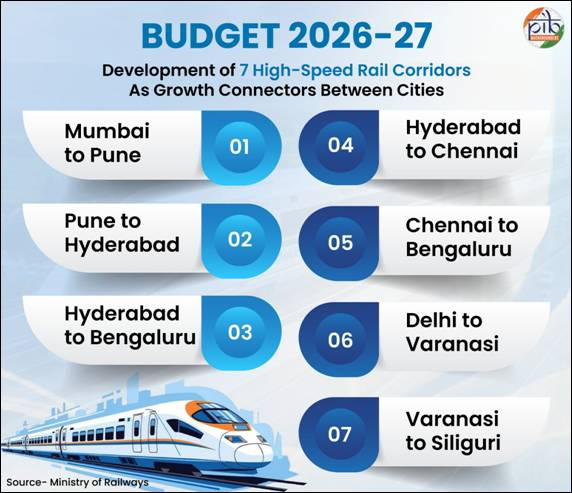
The 7 New High-Speed Rail Corridors in India
Union Finance Minister Nirmala Sitharaman recently announced seven new “Growth Connectors.” These corridors span nearly 4,000 kilometres with a total projected investment of ₹16 lakh crore.
1. Northern & Eastern Expansion
- Delhi – Varanasi: This flagship corridor will connect the national capital to the spiritual heart of India in just 3 hours and 50 minutes.
- Varanasi – Howrah (via Patna): Extending from Varanasi, this route will link major hubs in Bihar and West Bengal, reducing the travel time to Siliguri to approximately 2 hours and 55 minutes.
2. The Southern High-Speed Triangle
The South is set to receive a massive connectivity boost through a dedicated HSR triangle:
- Chennai – Bengaluru: Travel time slashed to 1 hour 13 minutes.
- Bengaluru – Hyderabad: Connects the two IT giants in just 2 hours.
- Chennai – Hyderabad: A journey of nearly 630 km completed in 2 hours 55 minutes.
3. Western Connectivity Hubs
- Mumbai – Pune: Perhaps the most anticipated short-haul route, reducing the 3-hour crawl to a mere 48-minute dash.
- Pune – Hyderabad: Creating a seamless link between Maharashtra and Telangana in 1 hour 55 minutes.
Mumbai-Ahmedabad Bullet Train: March 2026 Project Status
As India’s first high-speed rail venture, the Mumbai-Ahmedabad High-Speed Rail (MAHSR) project is the “learning lab” for the entire nation. Here is the latest progress report as of March 2026:
Civil Work & Infrastructure
- Viaducts & Piers: Over 339 km of viaduct and 428 km of pier work have been completed.
- River Bridges: 17 river bridges are finished, with major work on the Narmada and Tapi rivers in advanced stages.
- Tunnelling: In a major milestone, two massive Tunnel Boring Machines (TBMs) arrived at Mumbai’s JNPT port this month to begin the 21 km underground stretch between BKC and Shilphata, including India’s first 7 km undersea tunnel.
Rolling Stock & Indigenous Manufacturing
In a boost to Atmanirbhar Bharat, the BEML-Medha consortium recently bid for the design and manufacture of 16 high-speed trainsets. While the initial E5 Shinkansen sets are coming from Japan, these indigenous trains are designed for operational speeds of 250 kmph.
Bullet Train Journey Times: At a Glance
| orridor Name | Major Cities Connected | Approx. Distance | Estimated Journey Time |
| Mumbai – Ahmedabad | Mumbai, Surat, Vadodara, Ahmedabad | 508 km | 2 Hours 07 Mins |
| Delhi – Varanasi | Delhi, Noida, Agra, Lucknow, Varanasi | 865 km | 3 Hours 50 Mins |
| Varanasi – Siliguri | Varanasi, Patna, Arrah, Siliguri | 700 km | 2 Hours 55 Mins |
| Mumbai – Pune | Mumbai (BKC), Navi Mumbai, Pune | 150 km | 48 Minutes |
| Pune – Hyderabad | Pune, Solapur, Hyderabad | 711 km | 1 Hour 55 Mins |
| Chennai – Bengaluru | Chennai, Kolar, Bengaluru | 350 km | 1 Hour 13 Mins |
| Bengaluru – Hyderabad | Bengaluru, Anantapur, Hyderabad | 626 km | 2 Hours 00 Mins |
| Chennai – Hyderabad | Chennai, Nellore, Hyderabad | 744 km | 2 Hours 55 Mins |
Impact on Economy and Real Estate
The “Bullet Train effect” is already visible in Tier-II cities. Urban planners suggest that the Mumbai-Pune corridor will turn these two cities into a single economic “mega-region,” allowing professionals to commute daily between cities. Similarly, the Delhi-Varanasi line is expected to skyrocket tourism and logistics in Eastern Uttar Pradesh.
Expert Insight: “High-speed rail isn’t just about speed; it’s about capacity. By moving long-distance passengers to dedicated HSR tracks, we free up existing tracks for faster freight movement, directly lowering logistics costs for the country.” — Ministry of Railways.
Conclusion
The Bullet Train in India is no longer a distant dream. With the Mumbai-Ahmedabad project reaching critical milestones in 2026 and seven new corridors entering the survey and execution phases, India is on track to have one of the world’s most modern rail networks by 2030.