What Caused Ajit Pawar’s Plane Crash? AAIB Releases Preliminary Investigation Report

On a winter morning that was meant to be a short VIP hop from Mumbai to Baramati, a routine landing turned into a tragedy that stunned Maharashtra. What went wrong in those final minutes? The preliminary findings from the aviation watchdog now offer the first official clues.

Pune/Baramati: The preliminary investigation into the fatal Learjet crash that killed Maharashtra Deputy Chief Minister Ajit Pawar has brought low visibility and serious airport infrastructure gaps into sharp focus.
The report, released by the Aircraft Accident Investigation Bureau (AAIB), lays out the factual sequence of events from January 28, 2026. Officials have clearly stated this is not the final report, and no firm conclusions on the exact cause should be drawn yet.
The Crash: What Happened That Morning
The aircraft involved was a Learjet 45XR (VT-SSK) operated by VSR Ventures Pvt. Ltd. It was flying from Mumbai to Baramati on a non-scheduled VIP charter flight.
There were five people on board:
- Two pilots
- One cabin attendant
- Two passengers, including Ajit Pawar
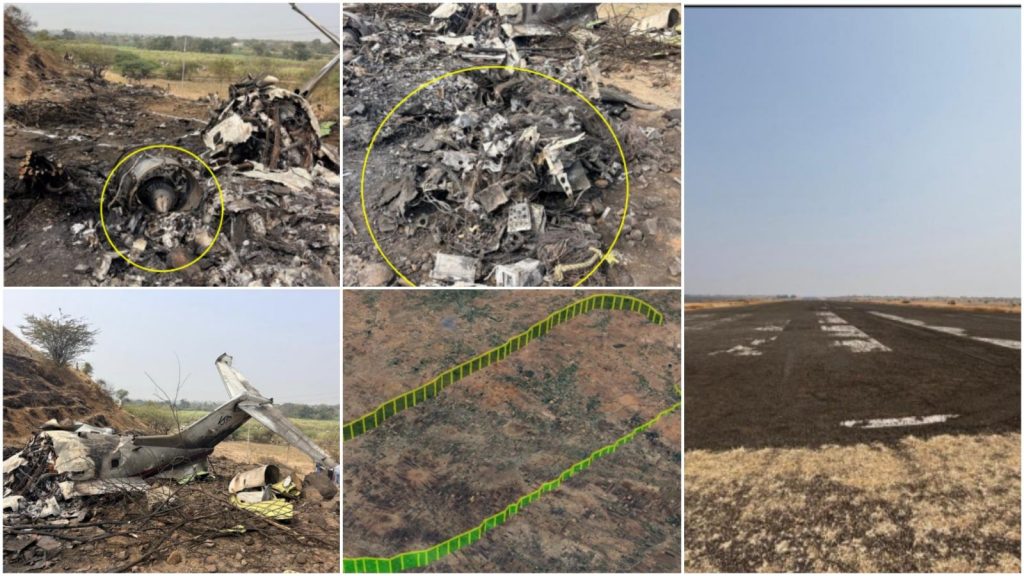
At approximately 8:46 am IST, while attempting to land at Baramati Airport, the aircraft crashed about 50 metres to the left of Runway 11 near the threshold.
According to the report:
- The jet first struck trees
- It then impacted ground at a lower level than the runway surface
- The aircraft caught fire
- It was completely destroyed
All five on board died.
Visibility Below Minimum Limits
One of the most important findings relates to weather conditions at the time of landing.
Baramati is an uncontrolled airfield and does not have a full-fledged meteorological setup.
On the morning of the crash:
- The tower reported visibility of 3 kilometres
- However, Visual Flight Rules (VFR) operations require a minimum visibility of 5 kilometres
Nearby controlled airports at Pune and Mumbai were also reporting low visibility due to mist, haze and smoke. Satellite imagery suggested shallow fog patches around Baramati.
Despite being informed of 3 km visibility, the aircraft continued its approach.
Two Landing Attempts Before the Crash
Communication records reveal that the aircraft made two attempts to land.
First Approach
- The aircraft initially lined up for landing
- The pilots requested a change of runway
- They later reverted to Runway 11
- Visibility was again confirmed as 3 km
- The aircraft executed a go-around and climbed back
Second Approach
- The aircraft once again aligned with Runway 11
- The pilots reported “field in sight”
- The tower cleared them to land
- Moments later, a distress exclamation was heard from the cockpit
The aircraft then crashed to the left side of the runway.
Airport Infrastructure Under Scrutiny
The investigation team found several safety shortcomings at Baramati Airport, which is managed by Maharashtra Airport Development Company Limited.
Key observations include:
- No full-fledged meteorological facility
- No navigational aids other than windsocks
- Windsocks installed only at one end of the runway
- Faded runway markings
- Presence of loose gravel on the runway surface
- No in-house Aircraft Rescue and Fire Fighting unit
- No proper boundary wall around the aerodrome
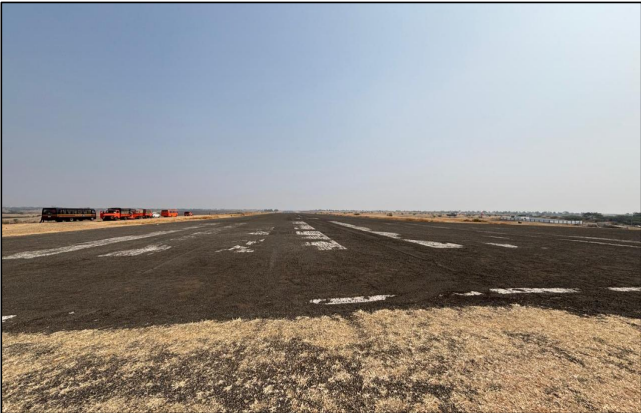
The runway was last resurfaced in 2016.
Although primarily used for flying training operations, the airport regularly handles non-scheduled charter and VIP flights.
Importantly, the report notes that visibility at the time was below the prescribed minimum for VFR operations.
Experienced Crew, Valid Aircraft
The aircraft and crew credentials were found to be in order.
- The 61-year-old Captain had nearly 19,000 flying hours, including over 2,800 hours on this aircraft type.
- The 25-year-old First Officer had close to 2,500 flying hours.
- Both had experience flying to Baramati and operating VIP flights.
Pre-flight breath analyser tests were negative.
The aircraft had:
- Valid registration
- Valid airworthiness certification
- No reported technical issues in its previous flight two days earlier
Both the Flight Data Recorder (FDR) and Cockpit Voice Recorder (CVR) have been recovered.
- FDR data has been successfully downloaded and is under analysis
- The CVR, which suffered thermal damage, will be examined with assistance from the US National Transportation Safety Board
AAIB Issues Interim Safety Recommendations
Even before the final findings, the AAIB has issued interim safety recommendations.
These include:
- Strict enforcement of VFR visibility limits at uncontrolled airfields
- Allowing operations only when weather conditions meet DGCA norms
- Improving safety standards at uncontrolled airports
- Enhancing landing aids and basic weather facilities
- Examining whether such aerodromes should be formally licensed for regulated operations
The bureau has emphasised that the purpose of the investigation is accident prevention, not assigning blame.
What Happens Next
The final cause of the crash will only be determined after:
- Detailed analysis of flight recorder data
- Examination of cockpit voice recordings
- Further wreckage study
- Scrutiny of operational and maintenance records
For now, the preliminary findings highlight a serious combination of low visibility and limited airport infrastructure at an uncontrolled airfield handling a high-profile VIP flight.
The final report will provide clearer answers. Until then, the questions surrounding this tragic crash remain open.