Pune’s Falling Air Quality: Can LEZ Promise Clean Air for Citizens’ Lungs?
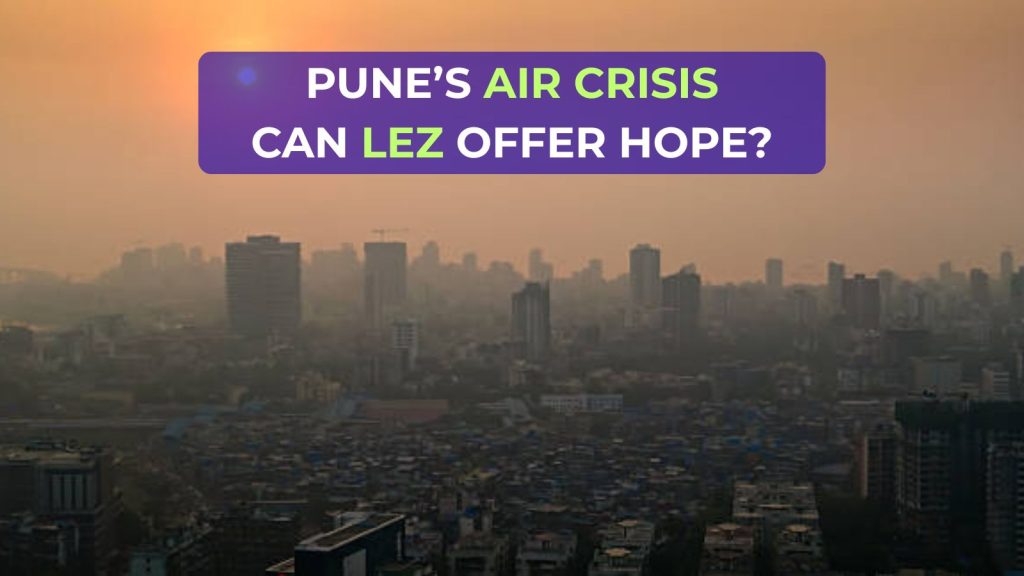

PUNE – As the Air Quality Index (AQI) in several pockets of Pune and Pimpri-Chinchwad continues to oscillate between ‘Poor’ and ‘Very Poor’ this February, a radical urban solution is moving from policy papers to the pavement: Low Emission Zones (LEZs).

With the transport sector contributing to nearly 46% of the city’s PM2.5 emissions, urban planners and environmentalists are pointing toward the ITDP India roadmap as the definitive blueprint to reclaim Pune’s air. But as the Pune Municipal Corporation (PMC) prepares its Climate Action Plan, the question remains: is the city ready for restricted vehicle zones?
The Anatomy of Pune’s Air Quality Crisis
For residents in Shivajinagar, Lohegaon, and Pashan, the “morning walk” has become a health hazard. Recent data from the Indian Institute of Tropical Meteorology (IITM) suggests that a combination of stagnant winter winds and a high density of pre-BS IV vehicles has created a persistent smog blanket over the district.
The National Green Tribunal (NGT) Western Zone Bench has already taken suo moto cognizance of the situation, urging the PMC and the Maharashtra Pollution Control Board (MPCB) to fast-track mitigation efforts.
What is a Low Emission Zone (LEZ)?
A Low Emission Zone is a geographically defined area where the entry of highly polluting vehicles is either restricted or penalized via an Environmental Protection Fee. Based on the ITDP India study, “Low Emission Zones: A Roadmap to Cleaner Air in India,” these zones prioritize public health by encouraging a shift toward:
- Electric Vehicles (EVs)
- BS-VI Compliant Engines
- Non-Motorized Transport (Walking and Cycling)
The Pune and PCMC Roadmap: 80% Emission Reduction by 2030
The ITDP roadmap identifies Pune and Pimpri-Chinchwad as primary candidates for LEZ implementation. By targeting high-traffic grids and restricting older, heavy-emission commercial vehicles, the study projects a staggering 80% drop in vehicular PM2.5 emissions by 2030.
Implementation in Pimpri-Chinchwad
PCMC is already ahead of the curve, identifying 15 potential grids for a pilot program. Unlike an outright ban, the authorities are considering a “polluter pays” model, where older vehicles are charged a fee, the proceeds of which are funneled back into the city’s EV Readiness Plan.
PMC’s Climate Action Plan
The Pune Municipal Corporation is integrating LEZs into its broader Climate Action Plan. This includes the expansion of public transport network and the creation of “Green Corridors” where only zero-emission vehicles are permitted during peak hours.
Challenges: Public Sentiment and Enforcement
Implementing an LEZ in Pune is not without hurdles. Key concerns include:
- Enforcement: The need for a robust Automatic Number Plate Recognition (ANPR) camera network.
- Economic Impact: The effect on small-scale transporters using older diesel vehicles.
- Infrastructure: Ensuring the PMPML bus fleet and Metro can handle the “mode shift” from private cars.
A Global Model for a Local Problem
From London’s Ultra Low Emission Zone (ULEZ) to Paris’s “Crit’Air” system, global cities have proven that restricting tailpipe emissions is the fastest way to lower respiratory ailments in urban centers. For Pune, a city once known for its pleasant weather and now struggling for breath, the LEZ isn’t just a policy, it’s a necessity for survival.