Door-Darshan
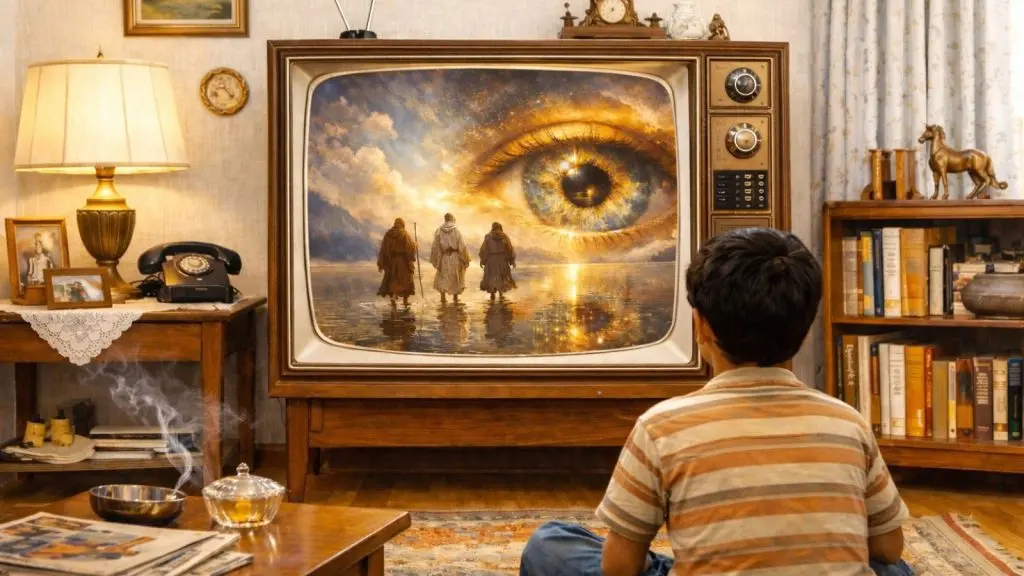

As a young boy, I grew up with the only TV channel that my generation knew – Doordarshan. ‘Darshan’, in the study of meaning, broadly refers to the development of perspective, though I don’t use the word ‘perspective’ in the singular. Now, whether this perspective is grounded in experience or precedes it is a question that has been extensively discussed over the centuries. Suffice to say, Doordarshan determined for the viewer a singular lens to the outside world that one devotedly came to revere. This lens revealed the world to us and determined in which direction and with what focus it would zoom across various lands, bringing their stories into our cramped middle-class living rooms, often filling us with wonder and awe. It also reflected the helpless resignation at the reality that this one channel could determine how ‘door’ (far) we could reach out for ‘darshan’ of the world outside our habitats, which were usually confined to the locality we lived in. (Liberalisation was still a mental concept, yet to be admitted into India).

Interestingly, I got introduced to quite a few classics that were serialised for our viewing pleasure. I recall Gogol’s classic ‘The Overcoat’, which became Shyam Benegal’s ‘Navi Sherwani’. As a young boy, I was mesmerised by the gothic visuals through which the story was filmed within its impoverished budget. ‘Kalakriti’ by Benegal brought to me O. Henry and his celebrated ‘The Last Leaf’. The character of Rehman Chacha reminded me of Miss Havisham from Dickens ‘Great Expectations’. Both evoked a resigned realisation of the absurdity in the human condition, imbuing a state of inertia in a world that unforgivingly hurried along and which had dealt them an unfair hand. There was a vacuous thrift in their personal economy, and Time ceased to be a human necessity. My young eyes, through which I received the worldview of my childhood, were enchanted by this lens through which these films were televised. The embarrassingly spartan productions with their coarse and scratchy film sets developing into black & white vignettes strangely brought a new colour to my imagination. This was before we could afford a colour TV. But I had met Gogol through Benegal. And then Munshi Premchand, who seemed friendlier than he did in our school textbooks, where he reflected rather sternly through the eyes that looked over the glazed spectacles of the grouchy Hindi teacher. The TV Premchand I came to love.
The adaptation of Tolstoy’s ‘The Three Hermits’ resonated longer than most other stories. This one turned into ‘Teen Sadhu’, where a revered Guru, when passing by a remote village, encounters three ascetics across a lake, deep in the forest. Believing this to be a fortuitous meeting, he decides to educate the three naked hermits on how to pray. Having delivered his method of ritual and prayer, he begins to cross the lake in a boat, only to find the hermits running on the surface of the water, as if it were dry land, towards his boat, since they had apparently forgotten the rituals he had taught them. They seek his forgiveness and implore him to teach them once again so that they remember better. The Guru is humbled. “Go”, he says repentfully, “it is not for me to teach you.”
As a young boy, I was accustomed to the paraphernalia surrounding the ritualised engagements through which one invoked the many deities that we revere in our saints, trinities and forces of temptation. These ‘teen sadhus’ gave me a heretical glimpse of human morality that challenged quite a few ideas that I received in my school, home and neighbourhood. All the long prayers that I had learned by rote and which I would proudly recite in socialised community gatherings, now, very excitingly and solemnly, filled me with a new doubt.
What made Tolstoy write this story? What made Benegal adapt it for our darshan? Why was Dr Bhimrao Ambedkar refused permission to deliver his speech at the Jat-Pat-Todak Mandal of Lahore in 1936, which I later read as ‘The Annihilation of Caste’? What did Harivansh Rai Bachchan mean when he wrote his poem ‘Madhushala’? There appears to me a causal deterministic strain in how each of these pieces of great art anthologise the mystery of the human experience, how it comes to become us and how we can, with reverence, receive it. Khayyam, in the 11th century, writes in his Rubaiyat, “Myself when young did eagerly frequent – Doctor and Saint, and heard great Argument – About it and about; but evermore – Came out by the same Door as in I went”. The Creation Hymn in the Rigveda, in its epistemic humility, contains these lines: “Who really knows? Who will here proclaim it? Whence was it produced? Whence is this creation? The Gods are later, with the creation of this Universe. Who then knows whence it has arisen?”

Dr Anil D’Souza brings 3 decades of experience in corporate and academic leadership with significant experience in organisational culture development and leadership coaching. Dr D’Souza employs the performing arts as crucial drivers of enterprise and individual change, and has published research papers on the impact of theatre on change management.
Anil holds a PhD, an MBA and certifications in Counselling Psychology, Leadership Coaching, Transactional Analysis, MBTI, Assessment and Development Centres, Creative Design Thinking, among others. Beyond the classroom, Anil is part of an experimental theatre group based in Mumbai and enjoys travelling and performing his music.