Trump Slashes Tariffs from 50% to 18%; What Did India Give Up in Return?
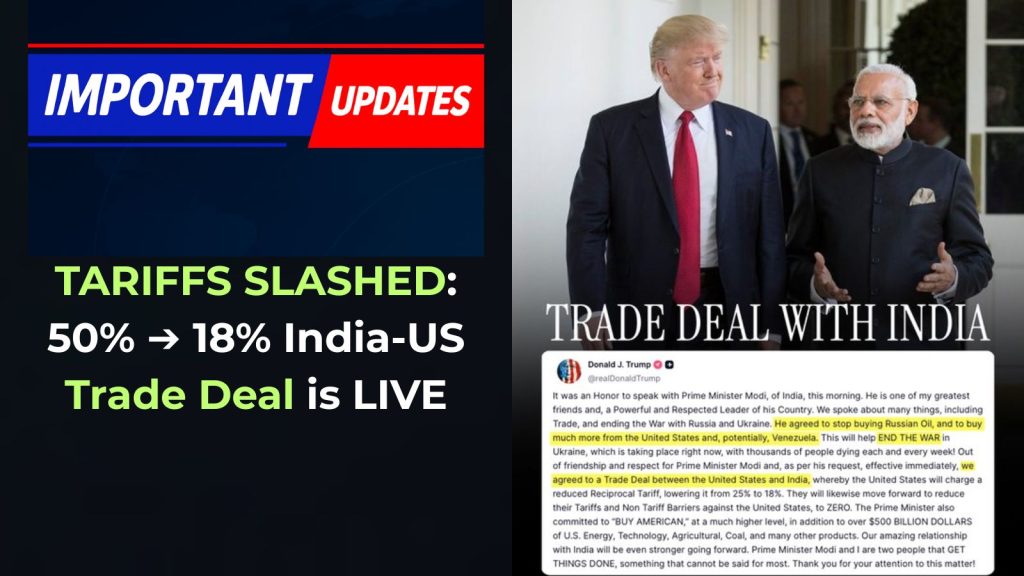

India-US Trade Deal 2026: From 50% Tariffs to 18% as New Delhi Halts Russian Oil for $500B US Energy Pact

A Masterclass in Direct Diplomacy
In a move that has sent shockwaves through global markets and effectively reset the geopolitical clock, Prime Minister Narendra Modi and U.S. President Donald J. Trump have finalized a historic trade agreement, slashing punitive American tariffs on “Made in India” goods to a highly competitive 18%. This breakthrough, emerging from a high-stakes 30-minute phone call on Monday morning, marks the end of a bruising trade war and initiates a massive energy pivot that will see India move away from Russian crude oil in favor of American and Venezuelan supplies.
The White House Announcement: The End of the “Russian Connection”
The breakthrough was first telegraphed by U.S. Ambassador Sergio Gor and subsequently detailed by President Trump on Truth Social and official White House channels. The American position was made crystal clear: the tariff relief is a direct reward for India’s strategic shift regarding the war in Ukraine.
The White House released the following statement via X (formerly Twitter):
“It was an Honor to speak with Prime Minister Modi, of India, this morning… He agreed to stop buying Russian Oil, and to buy much more from the United States and, potentially, Venezuela. This will help END THE WAR in Ukraine” — President Donald J. Trump
PM Modi’s Response: Celebrating the 18% Reality
While the White House focused on the geopolitical leverage, Prime Minister Modi addressed the economic windfall for India’s manufacturing sector. In a post that garnered millions of impressions within minutes, the PM highlighted the relief for the “Made in India” initiative.
The Prime Minister posted:
“Wonderful to speak with my dear friend President Trump today. Delighted that Made in India products will now have a reduced tariff of 18%. Big thanks to President Trump on behalf of the 1.4 billion people of India for this wonderful announcement. When two large economies and the world’s largest democracies work together, it benefits our people and unlocks immense opportunities for mutually beneficial cooperation. President Trump’s leadership is vital for global peace, stability, and prosperity. India fully supports his efforts for peace. I look forward to working closely with him to take our partnership to unprecedented heights.”
The Mathematical Collapse: How 50% Became 18%
To understand the jubilation in Indian boardrooms, one must look at the “Tariff Wall” that had choked Indian exports since August 2025. Following India’s continued procurement of discounted Russian crude, the Trump administration had implemented a “stacking” tariff regime that was the highest for any major U.S. trading partner.
- The 25% Reciprocal Base: Part of Trump’s global “Reciprocal Trade Act” strategy.
- The 25% Punitive Penalty: A specific levy under the “Addressing Threats by the Government of the Russian Federation” executive order.
- The Effective Reality: For months, key Indian exports were hitting the U.S. border with a 50% total duty.
By agreeing to the “Energy Pivot,” India has seen the 25% punitive penalty rescinded entirely. Furthermore, the 25% reciprocal base has been lowered to 18%.
Comparison: The New Tariff Ladder in the U.S. Market
- India: 18% (New Deal)
- Pakistan: 19%
- Bangladesh: 20%
- Vietnam: 20%
- Mexico: 25%
- China: 34%
- Canada: 35%
The $500 Billion Pivot: Sourcing Energy from the Americas
The deal is not merely a reduction in taxes; it is a fundamental restructuring of India’s energy and import strategy. President Trump announced that India has committed to a “Buy American” policy at a “much higher level,” including a pledge to purchase over $500 billion in U.S. energy, technology, agricultural products, and coal.
Crucially, the deal suggests India will look to Venezuela as a secondary source. Following recent U.S. geopolitical moves in Caracas, Venezuela’s vast heavy crude reserves are now being positioned as a direct replacement for the Urals and ESPO grades India previously imported from Russia.
The “Zero Tariff” Horizon: A New FTA?
Perhaps the most ambitious claim in the Trump announcement is that India will move to reduce its own tariffs and non-tariff barriers against the United States to ZERO. While the Indian Ministry of Commerce, led by Piyush Goyal, has focused on the immediate benefits of the 18% rate, the prospect of a “Zero Tariff” regime signals a move toward a comprehensive Free Trade Agreement (FTA) that would rival the “mother of all deals” India recently signed with the European Union.
Winners in the Indian Economy: A Sectoral Deep Dive
The 18% tariff is more than just a number; it is a lifeline for millions of jobs across India’s industrial corridors.
1. Textiles and Apparel (Tiruppur & Noida)
The textile industry was perhaps the hardest hit by the 50% tariff, losing significant market share to Vietnam. With an 18% rate, India becomes the most competitive apparel exporter to the U.S. in the region.
2. The Pune Advantage: Auto Components & IT
For manufacturing hubs like Pune, the deal unlocks the “Auto Component” bottleneck. Pune-based ancillary units serving U.S. EV manufacturers can now export at margins that were previously impossible. Furthermore, as the deal includes a “Technology” component, Pune’s IT services sector expects a surge in “Trusted Partner” contracts under the new strategic alignment.
3. Gems and Jewellery (Surat & Mumbai)
Exports of cut and polished diamonds to the U.S.—India’s largest market—had plummeted by 76% in late 2025. The restoration of trade momentum is expected to bring thousands of workers back to the polishing units of Surat.
4. Marine Products & Shrimp
India remains a top source of shrimp for the U.S. The high tariffs had forced exporters to offer deep discounts or pivot to the EU. The 18% rate stabilizes the seafood supply chain and secures India’s dominance in the American freezer aisle.
Geopolitical Implications: Ending the “Neutrality” Trap
For years, India has performed a delicate balancing act between Washington and Moscow. This trade deal suggests that the economic cost of “neutrality” had finally become too high. By choosing the 18% tariff and the $500 billion U.S. energy pact, New Delhi has pragmatically prioritized its “Viksit Bharat 2047” goals over its legacy energy ties with Russia.
As External Affairs Minister S. Jaishankar arrives in Washington for the Critical Minerals Ministerial, the world will be watching to see how quickly the “technicalities” of this deal are converted into signed law.