National Highway New Toll Rules: Who Gets Exemptions and How Local Discounts Work
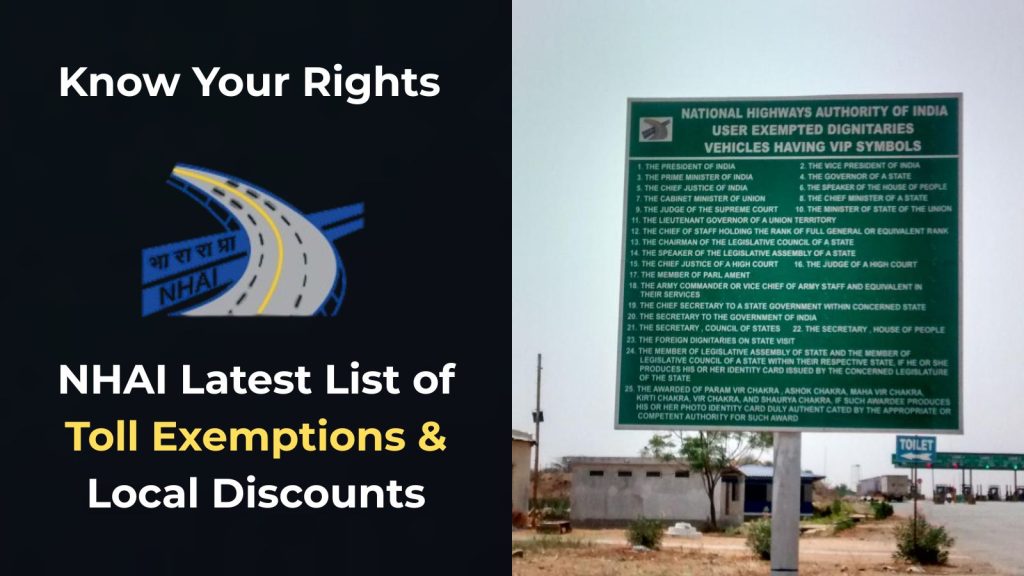

Navigating India’s expanding network of National Highways often brings up a recurring question for commuters: Who is actually exempt from paying toll fees? Under the National Highways Fee (Determination of Rates and Collection) Rules, 2008, the Ministry of Road Transport and Highways has established a clear hierarchy of exemptions, discounts for frequent travelers, and specific provisions for local residents.

As the digital landscape of toll collection shifts toward 100% electronic systems, understanding these legal frameworks is essential for every vehicle owner in India.
The Elite List: Who is Exempt from Toll?
Rule 11 of the 2008 Act explicitly lists the dignitaries and official vehicles that are not required to pay user fees. These exemptions are categorized into those “transporting and accompanying” high-ranking officials and those “used for official purposes”.
Constitutional and State Dignitaries
The exemption extends to the highest offices in the country, including:
- National Leadership: The President, Vice-President, and Prime Minister of India.
- Judiciary: The Chief Justice of India and Judges of the Supreme Court, as well as Chief Justices and Judges of High Courts.
- State Leadership: Governors, Chief Ministers, and Speakers of Legislative Assemblies.
- Legislature: Members of Parliament (MPs) and Members of the Legislative Assembly (MLAs) or Legislative Council (MLCs) within their respective states, provided they produce a valid identity card.
Military and Defense Personnel
Exemptions are also provided for gallantry award winners, including recipients of the Param Vir Chakra, Ashok Chakra, Maha Vir Chakra, Kirti Chakra, Vir Chakra, and Shaurya Chakra, upon production of a photo ID.
Furthermore, vehicles used for official purposes by the Ministry of Defense, including those covered under the Indian Toll (Army and Air Force) Act, 1901, are exempt. This includes Central and State armed forces, Paramilitary forces, and Police, provided they are in uniform.
Full List of Toll Exemptions and Local Discounts
Read the notification issued by Ministry of Road Transport and Highways, clarifying details of toll exemptions and local discounts.
Emergency and Essential Services
To ensure the rapid movement of critical services, the following vehicles are exempt:
- Ambulances and Funeral Vans.
- Fire-fighting departments or organizations.
- NHAI vehicles used for inspection, survey, construction, or maintenance.
- Specially designed vehicles constructed for use by persons suffering from physical disabilities.
Discounts for Frequent and Local Users
For the regular commuter, the 2008 Rules provide significant financial relief through structured discounts and monthly passes.
1. Multiple Journey Passes
If you cross a toll plaza multiple times within a short period, you can opt for:
- Two-way Journey: A pass costing 1.5 times the single journey fee, valid for 24 hours from the time of payment.
- Monthly Pass (50 Journeys): Frequent travelers can pay two-thirds of the amount for 50 single journeys, valid for one month.
2. The 20-Kilometer Rule for Locals
Residents living within 20 kilometers of a toll plaza are eligible for a specialized monthly pass.
- Cost: Originally set at a base rate of Rs. 150 per month (for 2007-08), this rate is revised annually.
- Conditions: This pass is only issued for non-commercial vehicles and if no service road or alternative route is available.
- District-Level Discounts: Vehicles registered within a particular district (excluding those with National Permits) may receive a 50% discount at toll plazas within that district.
Understanding Toll Collection: FAQs
Understanding Toll Collection: FAQs
Why do some plazas have different rates or rounding rules?
Toll rates depend on the length of the road stretch (usually 60 km), the cost of structures like bridges or tunnels, and the year the project was awarded. Plazas governed by the 2008 rules round fees to the nearest ₹5, while older projects may still round to ₹1.
Does a government officer get a personal exemption?
No. Exemptions apply only to government organisations such as NHAI when vehicles are used specifically for highway inspection, construction, or maintenance. Central or State government officers using private vehicles are not exempt.
Are Ex-Servicemen or journalists exempt from toll?
No. At present, there are no toll exemptions for Ex-Servicemen, defence civilian employees, or media professionals.
What is the penalty for overloading?
As per the 2008 Toll Rules, an overloaded vehicle must remove the excess load and pay a penalty equal to ten times the applicable toll fee.
Does toll collection ever stop completely?
No. Once the capital cost of a highway is recovered, toll is not removed. Instead, it is reduced to 40% of the original rate to cover ongoing maintenance expenses.
How do I get a local pass with FASTag?
You need to submit proof of residence within 20 km of the toll plaza to the concessionaire. After verification, the local discount is linked directly to your vehicle’s FASTag.
Q: Why do some plazas have different rates or rounding rules? The user fee is calculated based on the length of the road stretch (typically 60 km), the cost of structures like bridges or tunnels, and the specific year the project was awarded. Plazas under the 2008 rules round to the nearest Rs. 5, while older ones may still round to Re. 1.
Q: Does a government officer get a personal exemption? No. Exemption is only available for government organizations (like NHAI) using vehicles specifically for highway inspection, construction, or maintenance. Central or State government officers in private vehicles are not exempt.
Q: Are Ex-Servicemen or journalists exempt? No. Currently, there are no exemptions for Ex-Servicemen, Defense civilian employees, or media professionals.
Q: What is the penalty for overloading? Under the 2008 Rules, an overloaded vehicle must have the excess load removed and pay a penalty equal to 10 times the applicable fee.
Q: Does the toll collection ever stop? Once the capital cost of the highway is recovered, the fee is not eliminated but reduced to 40% of the original rate to cover ongoing maintenance costs.
Q: How do I get a local pass with FASTag? You must submit proof of residence (within 20km) to the toll concessionaire. Once verified, the discount is configured directly onto your vehicle’s FASTag.