Khambatki Tunnel Trials Start: End of Deadly ‘S’ Curve; Reducing Ghat Crossing Time on Pune-Satara Highway to 5-10 Minutes
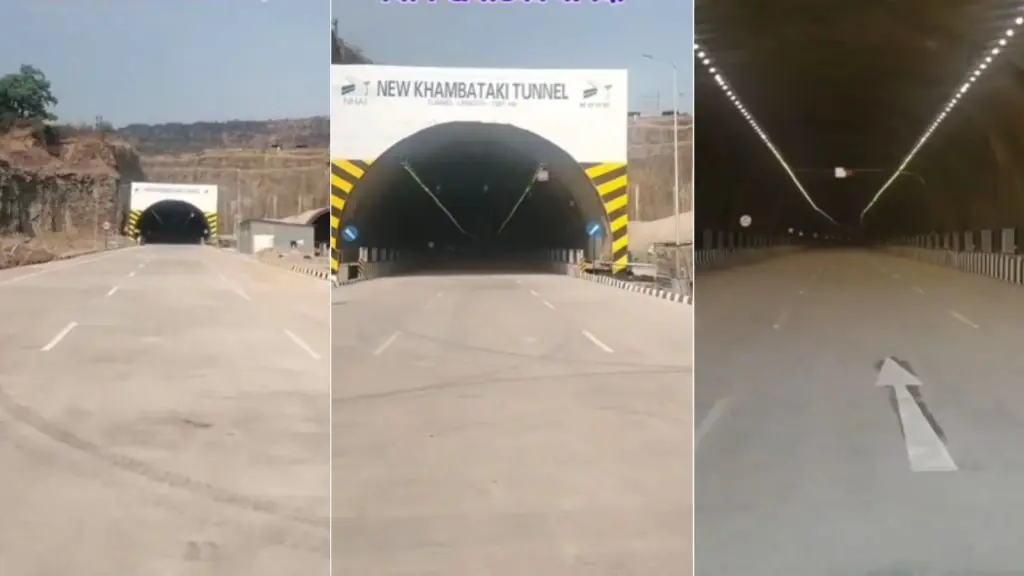

PUNE: In a major milestone for Maharashtra’s infrastructure, the National Highways Authority of India (NHAI) officially commenced the experimental trial run of the new Khambatki Tunnel on the Pune-Satara Highway (NH-48) on Saturday, January 17, 2026. The opening of the tunnel for light vehicles marks the beginning of the end for the notorious traffic bottlenecks and fatal accidents that have long plagued the Khambatki Ghat section.

The trial run, inaugurated by Satara District Collector Santosh Patil and District Police Chief Tushar Doshi, is scheduled to last for eight days. During this period, authorities will closely monitor traffic behavior, ventilation systems, and structural safety before moving toward a full-scale opening for all vehicle types.
Light Vehicles Only: Understanding the Trial Phase
Currently, the NHAI has restricted entry to the new tunnel to light motor vehicles (LMVs), such as cars, SUVs, and small vans, traveling from Satara toward Pune.
Heavy vehicles, including multi-axle trucks, containers, and state transport buses, are strictly prohibited from entering the tunnel during this eight-day window. These larger vehicles must continue to use the existing three-lane ghat road. This restriction is primarily due to the ongoing finishing work on the massive viaduct (valley bridge) located on the Pune-bound exit of the tunnel. Engineers estimate that while the tunnel itself is ready, about 15% of the work on the connecting bridge infrastructure remains to be completed.
Bypassing the Fatal ‘S’ Curve: A Major Safety Milestone
The primary objective of this ₹926 crore project is to eliminate the dangerous “S” curve on the Khambatki Ghat. For decades, this specific stretch has been identified as a “Black Spot” by the Ministry of Road Transport and Highways (MoRTH).
The sharp, winding turns of the old ghat road often lead to brake failures in heavy vehicles and high-speed collisions involving passenger cars. By “straightening” the highway through the mountain, the new twin tunnels provide a level, six-lane path that bypasses these hazards entirely.
Travel Time Reduction:
- Old Route (Ghat): 20 to 45 minutes depending on traffic and vehicle breakdowns.
- New Route (Tunnel): 5 to 10 minutes.
Technical Specifications and Engineering Challenges
The Khambatki Tunnel project is an engineering marvel designed to handle the massive surge in traffic on the Pune-Bangalore corridor. Over the last decade, vehicle density on this stretch has jumped from 22,000 to over 55,000 passenger car units (PCUs) daily.
The project features twin tunnels, each with three lanes, totaling approximately 6.46 km in length when including the approach roads. The tunnels are equipped with modern safety features, including:
- SCADA-based Monitoring: Real-time tracking of air quality and traffic flow.
- Emergency Call Boxes: Located at regular intervals for stranded motorists.
- Advanced Ventilation: High-powered fans to clear exhaust fumes and maintain visibility.
- Fire Suppression Systems: Specialized sensors and hydrants to tackle potential emergencies inside the mountain.
Addressing the “Lighting Gap” Concerns
While the trial run has been welcomed by commuters, the first 24 hours of operation have highlighted some critical concerns. Several motorists reported that the internal lighting in the tunnel is currently inadequate.
Local activists have pointed out that only a small fraction of the permanent lamps are functional, creating a “black hole” effect that can cause temporary blindness for drivers entering from bright daylight. NHAI Regional Officer A. Shrivastava has assured the public that the trial period is intended precisely to identify these gaps. Work on the electrical substations and lighting arrays is being fast-tracked to ensure 100% illumination before the final inauguration.
Economic Impact on Western Maharashtra
The streamlining of the Pune-Satara-Kolhapur corridor is expected to have a significant positive impact on the regional economy.
- Logistics Efficiency: Trucks carrying perishable agricultural goods from the “sugar belt” of Satara and Kolhapur will reach the markets of Pimpri-Chinchwad and Mumbai much faster, reducing wastage.
- Fuel Savings: By eliminating the steep climb up the ghat, heavy vehicles will save thousands of liters of fuel daily, contributing to both economic savings and lower carbon emissions.
- Tourism Boost: Easier access to major tourist hubs like Mahabaleshwar, Panchgani, and the Kas Plateau will likely increase weekend footfall from Pune and Mumbai.
पुणे-बंगळूर राष्ट्रीय महामार्गावरील खंबाटकी बोगदा प्रकल्पाची चाचणी झाली असून ९२६ कोटी रुपये खर्च करून हा बोगदा बनवण्यात आला आहे.
— शुभम कराड (@shubham_9909) January 18, 2026
या ६.४३ किमी लांबीच्या प्रकल्पात १.२ किमीचे दुहेरी बोगदे आणि १ किमीचा वायडक्ट समाविष्ट आहे.
सध्या घाटातून जाण्यासाठी सुमारे ४५ मिनिटे लागतात,तर नवीन… pic.twitter.com/6qPNcTG9zt
The Road Ahead: Full Completion Timeline
Following the completion of the eight-day trial on January 25, the NHAI will conduct a comprehensive safety audit. If the results are satisfactory and the remaining 15% of the viaduct work progresses as planned, the tunnel is expected to be opened for heavy vehicles by late February or early March 2026.
Frequently Asked Questions (FAQs)
Frequently Asked Questions (FAQs)
Is the new Khambatki Tunnel open for travel today?
Yes. The tunnel is currently open only for light vehicles such as cars and SUVs traveling from Satara toward Pune. It is operating on an experimental trial basis.
What are the exact dates for the trial run?
The trial run began on January 17, 2026, and is scheduled to continue for eight days, ending around January 25, 2026.
Why are heavy vehicles not allowed in the tunnel yet?
Heavy vehicles are restricted because the connecting valley bridge (viaduct) on the Pune side is still around 15% incomplete. The structure must be fully certified before it can handle multi-axle truck loads.
Will the old Khambatki Ghat road be closed?
No. The existing Khambatki Ghat road will remain operational. Even after full commissioning of the tunnel, the ghat road may be used as an alternate route or converted to one-way traffic to reduce congestion.
How many lanes does the new Khambatki Tunnel have?
The project consists of twin tunnels with three lanes each, offering a total of six lanes for smoother traffic flow.
Does the tunnel address the dangerous “S” curve accident spot?
Yes. One of the primary objectives of the tunnel is to bypass the notorious “S” curve on the old Khambatki Ghat, which has been a major accident black spot for decades.
Is there any specific speed limit inside the tunnel during the trial?
Yes. During the trial phase, motorists are advised to maintain a speed of 40–50 km/h as lighting, ventilation, and safety systems are still being calibrated.
Q1: Is the new Khambatki Tunnel open for travel today? Yes, but only for light vehicles (cars/SUVs) traveling from Satara toward Pune. It is currently operating on an experimental trial basis.
Q2: What are the exact dates for the trial run? The trial run began on January 17, 2026, and is scheduled to last for eight days, ending around January 25, 2026.
Q3: Why are heavy vehicles not allowed in the tunnel yet? Heavy vehicles are restricted because the final work on the connecting valley bridge (viaduct) on the Pune side is still roughly 15% incomplete. The bridge needs to be fully certified to carry the weight of multi-axle trucks.
Q4: Will the old Khambatki Ghat road be closed? No. The existing ghat road will remain operational. Even after the tunnel is fully open, the ghat road may serve as an alternative route or be used for one-way traffic to further reduce congestion.
Q5: How many lanes does the new Khambatki Tunnel have? The new twin tunnels have three lanes each, providing a total of six lanes for smooth traffic flow.
Q6: Does the tunnel address the “S” curve accident spot? Yes. The main purpose of the tunnel is to bypass the dangerous “S” curve on the old Khambatki Ghat, which has been a major accident “black spot” for decades.
Q7: Is there any specific speed limit inside the tunnel during the trial? Yes, motorists are advised to maintain a cautious speed of 40-50 km/h during the trial phase due to ongoing calibration of lighting and safety systems.
For more live updates on Pune, visit our Pune News Today page.