Delhi Air Quality Index (AQI) Hits ‘Severe’ 403: Gas Chamber Returns as Dense Fog Chokes NCR
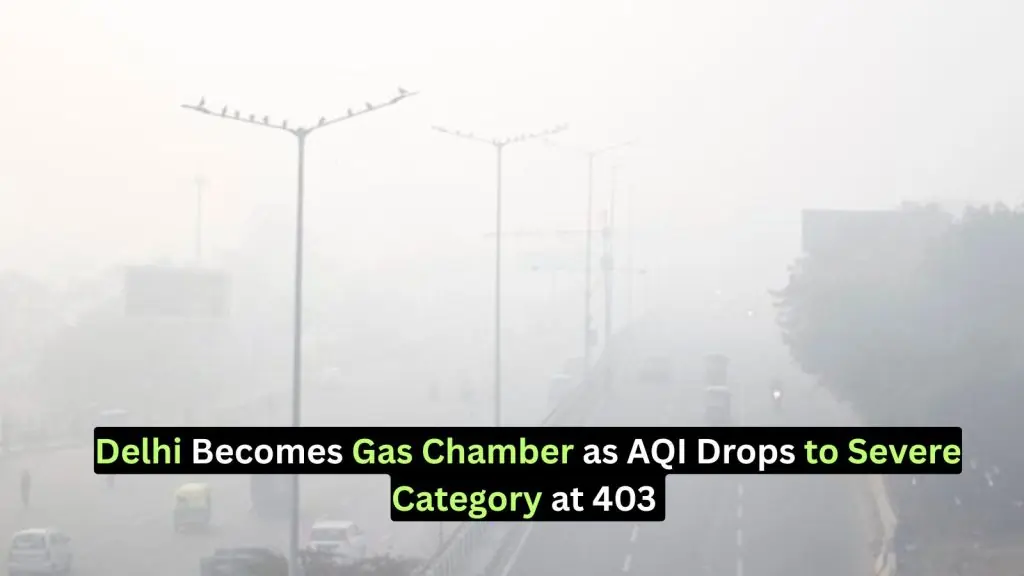

Delhi woke up to a literal “white-out” on Monday morning as a toxic cocktail of dense fog and stagnant pollutants pushed the city’s air quality back into the hazardous ‘Severe’ zone.

According to the Central Pollution Control Board (CPCB), the 24-hour average Delhi Air Quality Index (AQI) settled at 403 by 8:00 AM on December 29, 2025. The sudden spike marks a significant deterioration from Sunday’s “Very Poor” reading of 390, effectively turning the National Capital Region (NCR) into a high-altitude gas chamber once again.
‘Severe’ Hotspots: Anand Vihar and Vivek Vihar Breach 450-Mark
While the city-wide average sits just above 400, several neighborhoods are breathing air that is significantly more dangerous. Data from the SAMEER app highlights a grim situation in East and North Delhi:
- Anand Vihar: 456 (Severe)
- Vivek Vihar: 458 (Severe)
- Wazirpur: 443 (Severe)
- Patparganj: 431 (Severe)
The CPCB classifies any AQI above 400 as ‘Severe,’ warning that such air affects even healthy individuals and “seriously impacts” those with existing respiratory or cardiac ailments.
Flight and Train Chaos: Visibility Drops to 50 Metres
The Delhi-NCR air pollution news today is dominated by massive logistical disruptions. A thick blanket of dense fog reduced visibility to near-zero levels in many parts of the city.
At the Indira Gandhi International (IGI) Airport, visibility plummeted to just 50 metres, forcing the activation of CAT-III landing procedures. Over 65% of flights have been impacted, with major airlines issuing travel advisories.
A Local Comparison: Pune Air Quality Update
For our readers at PuneNow, the contrast is stark but concerning. While Delhi battles “Severe” air, the Pune Air Quality Index (AQI) has also seen a winter dip, currently recorded at 356 (Hazardous/Severe) in certain pockets like Shivajinagar and Hadapsar.
While Pune lacks the “dense fog” visibility issues of the North, the city is experiencing a similar “temperature inversion” where cold morning air traps vehicular and construction dust. Local health experts in Pune have advised citizens to avoid early morning jogs until the sun is fully out.
Will GRAP Stage 4 Return to Delhi?
The sudden spike has put the Commission for Air Quality Management (CAQM) on high alert. Just five days ago, on December 24, authorities had lifted the stringent GRAP Stage 4 implementation measures.
However, with the Delhi smog forecast 2025 indicating calm winds for the next 72 hours, the Sub-Committee on GRAP is expected to meet this afternoon to decide on re-imposing emergency bans on diesel trucks and non-essential construction.
Health Emergency: AIIMS Doctors Issue Warning
Medical experts are calling this a “medical emergency.” Speaking on the health impact of severe AQI, doctors at AIIMS New Delhi noted a 30% rise in emergency room visits for asthma attacks and chronic obstructive pulmonary disease (COPD).
“The current atmospheric conditions are trapping ultra-fine particulate matter (PM2.5) at the breathing level. This isn’t just a respiratory issue; it’s a systemic health crisis,” a senior resident at AIIMS stated.
Quick Safety Tips:
- Avoid Outdoor Exercise: Do not go for morning walks until the smog lifts.
- Use N95 Masks: Standard cloth masks are ineffective against PM2.5.
- Stay Hydrated: Drink plenty of water to help flush out toxins.